It’s overwhelming when I think about everything I don’t know about the world, to contemplate the cultures I don’t have the time or resources to absorb, the languages I won’t ever learn, the global systems I can’t fully understand with all of their intricate cogs and hierarchies. But I do know one thing: being expected to do anything for eight hours a day is barbaric. American working culture is literally killing us. We sit in our ergonomic chairs for a majority of our waking hours, and for what? To facilitate an economy so complex that professional economists can’t predict what the fuck is going to happen. How is GDP growth really integral to our well-being as a people? There are several countries with low GDP growth that are thriving. Finland’s GDP growth stands at 0.4 percent. That country has one of the best education systems in the world. Norway’s stands at 0.9 percent.That country was ranked as UN’s best country for living in a 2015 Human Development Report. And for all of our efforts in the US, where do you think we rank in global GDP growth? As of June 2016, we ranked 115th at a modest 2.6 percent. We don’t need to keep wasting resources on developing a nineteenth brand of salad dressing. We are already bursting at the seams with types of salad dressing. We need to channel our power into the thing that counts: raising healthy, environmentally conscious communities. That’s it.
To unpack that, a “healthy” community is one with universal access to a quality education, low crime, high life expectancy, affordable healthcare, tolerance, and leaders held accountable to the public. And the importance of being environmentally conscious is unquestionable. We shouldn’t let our indulgence and over-consumption lead to the exploitation of less developed countries; we shouldn’t let our indulgence and over-consumption jeopardize the future of our children and the planet they will inherit.
Wouldn’t we be better served as a society if we spent less time working and more time with family and friends, pursuing interests outside of the workplace which add value to the world in other ways (e.g., making art, learning an instrument, volunteering with kids, playing sports)? Of course, there are some who are pathologically addicted to their work, spending 10, 12, 16 hours of their day being damn diligent. Think of the professions where this happens: the associate lawyer who scrutinizes documents for the smoking gun to win the case, the bushy tailed consultant living in Dubai who doesn’t realize she’s studying up on weapons of war so she can facilitate American imperialism in the Middle East, the HMO doctor who has exactly 12.5 minutes for each of her 29 patients. While the Japanese have the word “karōshi” to describe death from overwork, English-speakers have yet to come up with a fitting term for this phenomena. I’m not arguing that people shouldn’t work eight hours or more. On the contrary, I think people should work all day long. I’m arguing that doing the same thing for eight hours is barbaric, especially if part of the proceeds from that labor trickle upward as they do in a capitalist economy. We should be diversifying our activities and reprioritizing the things that really matter: socializing, staying active, and spending time with our families to ensure the healthy development of the next generation.
My fiancé Jon and I have spent the past eight months exploring the US, deciding which outdoorsy small town we want to call home.When my friends inquire about the curious American subcultures from our travels, one place sticks out in my mind like a giant bovine erection: welcome to Hurricane, Utah…the gateway to Zion National Park.
Pronounced “Hur-a-kin” by the locals—an effort to mimic the accent of early settlers from Liverpool—this Mormon mecca was established as part of Brigham Young’s program to bring agriculture to southern Utah. It remains today one of the more conservative towns in the state, a refuge for Colorado City defects and a polygamy-friendly community.
Jon and I wandered the aisles of Davis Food & Drug at the perimeter of town, observing a group of four women in dull pastel ankle-length dresses who were discussing the menu for their 15 children. Lone men in collared shirts spoke of “bleeding the beast,” code for collecting welfare to make the US government atone for its sins. Two blonde teenage boys in overalls walked into the grocery store and spoke slowly with glazed eyes. I realized that their dreamy remove wasn’t influenced by booze or pot like normal kids their age: they were simply sheltered to the point of dullness. And everyone in Hurricane spoke this way, as if through the fog of an all-consuming ideology. Yes, the community was impeccably clean, safe, and replete with law-abiding drivers, but something seemed amiss in the uncritical constitution of this population. That was until we met Steve Ward, of course: the swashbuckling, tattooed owner of Barista’s restaurant.
While driving into Hurricane, we hadn’t even realized that we’d passed the most controversial establishment in all of Utah. From the distance of a half-mile, a towering pedestal at the center of town came into sight. As we got closer, we could make out the silhouette of a giant animal. And finally, it became clear. The tallest structure in Hurricane, UT was a marquee with a gargantuan copper sculpture of a bull. And this wasn’t just any bull: this animal donned a magnificent, conical cock with pendulous testicles. Try to imagine this sculpture at the center of a very conservative, very Mormon town. Did I mention that this is across the street from the local high school?
We arrived at our AirBnB, and were immediately warned about Barista’s. Mary—our lovely and piously Mormon host—told us to avoid the place at all costs. While giving us a tour of the sparkling apartment adjoined to her home, I took note of maudlin wall-hangings with phrases like “Once in our home, always our friends.” Her graciousness did not extend to Mr. Ward, however, the town’s most infamous business-owner. She cautioned that not only were Barista’s prices astronomical, but Mr. Ward was a brutish misfit who should be ejected from the community. I decided to investigate the place online, and was delighted to have stumbled upon not only an impassioned local controversy, but also upon some of Yelp’s most entertaining reviews in the country.
I kicked off my research with an article from the Spectrum (March 2015), which reported that the citizens of Hurricane had gathered 600 signatures to shut down Barista’s for “unscrupulous business practices and a hostile attitude toward patrons.” Steve Ward countered that the residents of Hurricane were “haters” and he wasn’t going anywhere. He added that, “The reason [the citizens] don’t like the bull is because they know it’s beautiful and amazing.”
Michelle N. (Fahy, Ireland): Horrible service. Despicable, disrespectful, jerk of an owner.
MK (San Diego, CA): I would rather get anal warts than eat here. Avoid this restaurant at all costs. Food tastes like it was made with horse shit that was fermented in the expired beer that they serve.
Lane R. (Salt Lake City, UT): The owner came out of the kitchen and told me to “get the f#%* off his property.” Then he physically threatened me. Weird. Very weird. Do yourself a favor… DON’T
Jamie Kay DeWitt, a local in Hurricane, posted screenshots of some sophomoric exchanges she’d endured from Barista’s Facebook manager:
Most curiously, St. George News reported that Barista’s had removed the large member from the copper bull in March of 2015. The young news anchor said solemnly, “The penis has drawn national attention for the controversy stirred over its rather large size.” For the next month, the bull cock was proudly on display atop Barista’s bar counter. My takeaway from that article was Steve’s wife Pam Ward exclaiming, ”We will be here”—and here she banged the table—”until”—bang!—”the day”—bang!—”we die.”
One month later, Death and Taxes (April 2015) declared that the castrated bull had its penis reattached, and Steve Ward proclaimed, “I’ve got people coming from all over the world and they’re like, ‘Where’s the penis?’ I’ve got people coming from North Carolina, I’ve got people from China…I put the dick back up for my customers because they want the dick. My customers like dick.” Even the LA Times (June 2015) got in on the action at this point, and we learned that Ward had spent $130,000 on this irreverent local icon.
Needless to say, I resolved to meet Steve Ward while we were in town. I arrived at the restaurant, marveling at the bull’s controversial member from every angle, and was met by this family-friendly marketing at the front door:
Notice how the picture with young Camile Vera from Baha [sic] California was posted around the same time as the reattachment of Hurricane’s infamous penis in April 2015. I moved to the side of Barista’s and was greeted by a woman in daisy dukes telling me cutely that I must “Enter in rear.”
I dutifully entered Barista’s rear, and there he was: Steve Ward in the flesh—the veritable don of national controversy. I only wish I’d gotten a better look at the phrases tattooed across his forearms as he sauntered to my table. After examining the beer list, I asked, “How did you secure a license to serve beers over 4 percent?”
For those of you who haven’t been to Utah, they have some unusual liquor laws to accommodate their Mormon ancestry. First, there’s the “Zion curtain,” the omnipresent bar rule which shields vulnerable patrons’ eyes from the process of pouring alcohol. That’s right: in Utah, if alcohol is served, it must be poured behind a barrier. People can drink booze and even order a “side car” of liquor if they want to make a drink a double, but Utah’s citizens aren’t adult enough to witness bartenders in the act of pouring alcohol. Second, beers from Utah are predominantly 4 percent alcohol and under, even more traditionally heady brews such as IPAs.
It seemed a mystery that Barista’s was serving beers over 4 percent, and so I inquired about the licensure. Without cracking a smile, Mr. Ward leaned in conspiratorially and whispered, “I had to take the town mayor into the alley and rough him up a bit.” Not skipping a beat, I cleared my throat and said softly, “I think I read about that exchange in your Yelp reviews.” Mr. Ward laughed like a stoned schoolgirl and took my drink order. Given Barista’s reputation for serving expensive, subpar food, I’d resolved to make this a drinks-only occasion.
There were three other tables sitting in the restaurant. Steve Ward posted up in a central location, scanning the room. He proceeded to shout at my fellow diners across the room,“Hey! Yeah, you three. Do you need anything…? You good? Ok. Cool…What about you over there? Yeah, you… You cool? All right.”
I’d never witnessed this peculiar strategy of customer service. Efficient? Yes. Disruptive to diners? Absolutely.
He returned to my table with a non-apologetic grin and put my first real Utah IPA in front of me. Although it tasted expired, I thanked him politely and asked where he was from originally. He leaned in, his sour breath stinging my eyes, and muttered with a wink, “I’ll tell you later back at my estate…” I abruptly declined the invitation, and Jon came in shortly afterward. Not surprisingly, the dynamic changed once my fiancé was present and Stephen Ward suddenly was all business.
A few weeks after this encounter, I wonder how long Barista’s will endure and whether they’ll be forced again to castrate the copper bull to appease local sensibilities. What Hurricane’s residents didn’t seem to appreciate is that Steve Ward’s transgressions gave that community their bogeyman, a figure against which they could define their own values in opposition. As much as the glassy-eyed blonde teenagers at the grocery store didn’t seem to know life outside of their town, the area was given purpose and meaning in organizing against a local business owner who didn’t fit their mold. More than anything, I wonder what Steve Ward gets out of it. Sure, Hurricane is situated at the base of Zion National Park, and sure, Steve’s family once owned a hotel in town, and sure, Ward claims to be worth $2.8 million as a result of his business (St. George News, “No Filter” April 2015). More than anything, I think Ward gets off on being the local contrarian who is pushing that ossified Mormon community into the realm of 21st century sex and ostentation. Whatever the outcome, he’s leaving an indelible mark on Hurricane, UT and continues to thrive as an antihero. At the very least, he’s ridden his copper bull into my archives of American countercultural history.
It’s 2065 and my contemporaries—the Millennials (a.k.a. Generation Y)—are bemoaning the loss of a simpler time, a time before self-driving cars, fully immersive VR internet, robot caretakers, human genetic engineering, ubiquitous product printers, and widespread mind-machine interfaces (MMIs). Of course these developments have presented some unique moral and ethical challenges, but I assure you that the compass of human progress is pointed in the right direction!
Everyone knows that the aggrandizement of the past happens with every subsequent group of aging people. By illustration:
Old white men complained to their children and grandchildren that the democratic process had been polluted by giving women—the hysterical and mentally incompetent sex—the vote.
Old southerners complained to their children and grandchildren that lynchings went much more smoothly before the end of Jim Crow laws.
Old, divorced homophobes complained to their children and grandchildren that gays and lesbians were ruining the sacred institution of marriage.
You see? And I would argue that the world of 2065 is a much more connected, forward-thinking, and generous place than it was 50 years ago.
Let’s talk about the savagery of the United States in 2015:
1) Whistleblowers were imprisoned, alienated, and exiled rather than celebrated as heroes. Chelsea Manning was imprisoned for exposing the war crimes of the American military during the failed invasions of Iraq and Afghanistan. In 2015, she was threatened with solitary confinement for having a copy of Vanity Fair—the Caitlyn Jenner issue, a small comfort to someone who identified as transgender—and a tube of expired toothpaste. Julian Assange—founder and editor-in-chief of Wikileaks—was accused of “terrorism” by then Vice President Joe Biden and several high-profile Americans in the media called for his assassination. His crime? Providing an outlet for people to anonymously expose and examine the inner workings of their governments. Wikileaks heroically aired various international scandals including Manning’s U.S. war logs, the human rights abuses at Guantanamo Bay, and a slew of diplomatic cables which exposed the embarrassing incompetencies and backstabbing among leaders from many powerful countries. Edward Snowden revealed that the U.S.’s National Security Agency (NSA) had been secretly collecting information about American citizens without just cause in conjunction with major telecommunications and social networking conglomerates. Furthermore, the NSA spied onpolitical and business leaders in countries publicly considered our allies (e.g., Japan, Germany, France). In 2013, Aaron Schwartz—an activist for the freedom of information and net neutrality—hanged himself amidst a tormenting FBI-led investigation and a ruthless prosecution which wanted to make a scapegoat out of the 26-year-old who dared to question the increasing stranglehold of private corporations on access to scholarly journal articles, legal documents, and other materials which belong in the public domain. These are only three of the whistleblowing activists who now are celebrated as men of bravery, but only after being threatened, intimidated, and debased for standing up for what they believed.
2) Law enforcement was deployed with blatant prejudice. In addition to the cases of the whistleblowers, the laws in 2015 were applied differentially based on race, class, and politics. Non-violent users of illegal drugs rotted in jail cells while white-collar criminals who ushered in the Great Recession got off scot-free. People convicted of selling small amounts of drugs were prosecuted while large pharmaceutical companies made billions of dollars off of people’s addictions to opiates (e.g., Vicodin), amphetamines (e.g., Adderall), and mood-altering substances (e.g., Xanax). Finally, unarmed black men such as Freddie Gray, Eric Garner, Michael Brown Jr., Walter Scott, and Laquan McDonald were killed by white police officers while Dylan Roof—a white supremacist who slaughtered nine black people at a Charleston Church—was gently taken away from the gruesome crime scene.
3) People believed that owning an assault rifle was a constitutional right. The National Rifle Association (NRA) was one of the most powerful lobbyist groups and a campaign donor darling of many conservative politicians. In December 2012, Adam Lanza gunned down a classroom of first-graders and the U.S. failed to make any significant gun control changes. In 2015, there were over 350 mass shootings involving at least two victims and the government still refused to pass a law which would require simple background checks for gun purchasers.
4) Atheists, Muslims, and other religious minorities were persecuted for not being Christian. Back in 2015, it wasn’t ok to be a non-Christian in a high position of political leadership. To be a non-believer was viewed as tantamount to being without morals. All political candidates, regardless of their party, were forced to say, “And God bless America” at the end of their speeches in order to make God-fearing citizens confident that their leaders were religious enough. In the Republican presidential primary, Fox News host Megyn Kelly asked the 10 participants whether they had received instructions directly from God with respect to how to run a country. And she wasn’t referring to a Hindu, Jewish, or Muslim God. That would have been completely out of the question. In the beginning of the 21st century, being a non-Christian all-but-disqualified you from the upper rungs of political leadership.
5) Working for eight hours daily was standard. Despite the incredible technological developments in machines and robots—not to mention the vast pool of underemployed young people—it was still expected in 2015 that Americans work for at least eight hours daily. And since no mortal was truly capable of working effectively for eight hours, people surreptitiously procrastinated during the gaps in their concentration, perusing Facebook, news sites, or chatting with coworkers. Employers and the employed seemed incapable of recognizing their natural barriers to productivity, affected by sleep deprivation, stress, and other reasonable facts of being human. Rather than identifying the problem—reducing individual working hours, hiring more people, and moving toward full employment—regulations on businesses were lax and company owners instead pushed their salaried workers to work longer and longer hours. Rather than revolt, workers in 2015 reacted very curiously. White-collar workers in particular—feeling the pressure of status anxiety—toiled for 60, 70, and even 80 hours per week and wore it as a badge of pride. We know now that these conditions are inhumane. Working too long increases stress and decreases social connectivity, family togetherness and lifespans, but in 2015, eight hours daily (or more) was standard.
6) The United States had the largest gap between the rich and the poor and highest child poverty rate of any developed nation. Despite these sad facts, in 2015, a vocal and politically organized group of conservatives pushed for greater tax cuts, less business regulations, and other measures that we know now only exacerbated the vast wealth inequality. “Trickle-down economics” was a fiction created to justify the concentration of wealth in fewer hands. Unfortunately, the purported “job-creators” (i.e., companies) squandered their tax breaks on higher executive salaries and shareholder payouts than they did actually creating more jobs. At that time, there was also a myth of class mobility. The idea was that if you worked hard enough, you could one day buy property, send your children to college, and retire comfortably. It was a clever story which shifted the responsibility for individual circumstances onto the people themselves while masking the primary reasons that people fail: inadequate access to quality education, healthcare, and social support.
7) Xenophobia ran rampant in a nation founded by immigrants. Without any hint of irony, many working class, white Americans—whose families at some time had immigrated to the U.S., mind you—believed in Donald Trump, a bigoted billionaire who was running for president. Trump’s plan involved constructing a massive wall along the U.S.’s southern border to protect it from the Mexicans, a group he believed was responsible for all of the country’s ills. Not content to slander only one group, Trump went on to proclaim that Muslims should be denied entry into the United States based on the behavior of a few isolated extremists. Thirty-one governors declared that Syrian refugees—a predominantly Muslim group fleeing a brutal civil war—were not allowed into their states. By contrast, Canadian Prime Minister Justin Trudeau welcomed the Syrians personally, handing them winter coats as they exited the plane and began new lives.
8) Wars were waged in the name of securing American business interests. In the 20th and early 21st centuries, the U.S. engaged in a number of conflicts around the world to secure its own business interests. The Banana Wars in Cuba, Puerto Rico, Panama, Nicaragua, Haiti, the Dominican Republic, Honduras, and Mexico were fought to preserve U.S. corporate interests in Central America. Many wars were fought to prevent the spread of communism—the premier ideological opponent to capitalism—including the Korean War and the Vietnam War. The U.S. fought in the Gulf War to protect Saudi Arabian oil supplies from Iraq. Finally, unbeknownst to many Americans, government contractors profited handsomely from violence around the world, selling missiles, bombs, weapons, and tanks not only to American troops, but also to countries which suppressed democratic dissent such as Iran, Iraq, Egypt, Saudi Arabia, Yemen, India, Pakistan, Afghanistan, and Algeria.
9) There was an inherent conflict of interest between Public Health and Corporate Wealth. This is a big one. What benefited companies in 2015 didn’t necessarily dovetail with what benefited the public. Companies would do anything to turn a profit and survive. Several pharmaceutical corporations were fined more than $1 billion each for paying kickbacks to doctors and marketing drugs for non-approved uses (e.g., GlaxoSmithKline, Pfizer, Johnson&Johnson). The rise of for-profit colleges (e.g., University of Phoenix, Corinthian Colleges) contributed to the explosion of student loan debt which reached $1.2 trillion in 2015. And with more than $3.2 billion spent annually lobbying Congress, various industries held a tremendous amount of power over American leadership. Oil companies lobbied for the right to destroy pristine environments and fragile ecosystems. Pharmaceutical companies lobbied to keep healthcare expensive by keeping generic drugs off the shelves. Weapons manufacturers lobbied for decreased gun control putting the public at risk for gun violence. Large food companies lobbied to relax FDA regulations and block a living wage for workers. Real estate firms lobbied to weaken regulations on mortgage lenders.
10) Toilets. Historically, Americans believed that rubbing one’s asshole with dry paper would somehow make it clean, at least until Japanese-style commodes became widely available with built-in bidets; adjustable water temperature and pressure; and heated seats.
So cheer up and stop pining for the good ol’ days, Millennials! Remember: things were pretty fucked up back in 2015, but we’ve made a lot of progress in combatting discrimination, promoting education, providing healthcare, keeping the tide of corporate interests in check, and optimizing hygiene with amazing toilet technology.
Forty-one percent of likely Republican primary voters say they favor Donald Trump. It appears that the penis-wagging businessman pledging to “Make America Great Again” has tapped into the ubiquitous groundswell of America’s working class discontent.
Of course people are pissed. The top beneficiaries of the “recovery” from the Great Recession have been large corporations and their shareholders. People’s wages are stagnant and they feel betrayed when the oft-promised “trickle down” benefits of supporting big business have failed to materialize. The top-earning 15 Americans have made $170 billion these past two years, more than the bottom 40 percent of our country combined. Politics aside, anyone with common sense can admit that this is an obscenity.
Enter the Trumpnado whose tremendous wealth and America-sized ego have apparently excused him from practicing human decency. And by the way, money has always been associated with Godliness in this country; I don’t care what anybody says. The meek will never inherit the earth because Americans are obsessed with rich people. Look at the roving cast of assholes which our viewership keeps afloat—the Hiltons, the Kardashians, My Super Sweet 16, The OC, Laguna Beach, Entertainment Tonight, The Real Housewives—all of that brain putty which makes us believe obscene wealth is glamorous and sublimely desirable. Trump has the tact of a petulant child, nay, the tact of a lumpy potato, but that doesn’t matter. People see Trump’s name on buildings. He’s on TV. He represents what poor Americans are told they can achieve if they just work hard enough. So he went out and bought the biggest braindead megaphone on the planet—his outrageous presidential campaign machine—and we can’t get enough of it.
He’s tapping into a longstanding American tradition to blame “the other.” Muslims and Mexicans are simply the current targets of our noxious stereotyping and rancor. How have we not outgrown these racist knee-jerk reactions while angry white men continue to stockpile guns in their basements, foaming at the mouths over Fox News’s latest indictment against minorities or women?
The thing is that we need to grow up. There was never meant to be a GREATEST COUNTRY IN THE WORLD. There’s only one planet and we haven’t been very good at sharing it. Historically, geographic areas in a position of privilege—the U.S., England, the Mongol Empire, the Roman Empire, etc.—have moved into other areas exploiting local people and resources. Most recently, it’s taken the form of economic exploitation, where materials and manufacturing corporations owned by people from one country move into less developed countries, plundering minerals, oil, verdant farmland, and cheap human capital in the name of “progress.” Wealth simply snowballs to favor the upper crust and capital is liquid, finding new homes when one becomes too expensive or politically hostile.
I appreciate Trump’s gargantuan ego for putting into focus one of the most serious issues we face: the intractable conflict of interest between the Public Good and the Corporate Good.
The Public Good is simple. It seeks a strong education for all; ample job opportunities for all; affordable healthcare for all; healthy food for all; clean, crime-free streets and parks for all; well-maintained electrical grids, water treatment plants, and sanitation centers for all; and plenty of social interaction with family and friends for all.
The Corporate Good is simple in its objective, but complicated in its means. The Corporate Good’s main goal is profit and it will do anything to ensure its own survival, lining its shareholders’ pockets at the expense of all else. It will create unaccredited diploma mills for which mainly poor citizens take out massive government loans for ultimately worthless degrees (e.g., Axact). It will make a man raise the price of a life-saving drug 1600 percent (e.g., Martin Shkreli).It will make cancer treatments, pharmaceuticals, and surgeries much more expensive than they need to be because of bloated insurance bureaucracies. It will elevate sugary, processed foods above healthier options through marketing and low pricing (e.g., Coca Cola, McDonalds). It will create misleading advertisements and TV shows preying on people’s fears, weaknesses, and rage. It will try and merge with companies in countries like Ireland which cater to the Corporate Good (e.g., Pfizer). It will spread harmful chemicals through pristine environments (e.g., Monsanto, BP). It will buy fancy football arenas to keep people placably entertained and aware of its products (e.g., Budweiser). It will create machines for mass-killing and sell them without regard for the Public Good (Lockheed Martin). It will pay attractive, well-spoken people to convince Congressmen to protect its interests. Most strikingly, the Corporate Good holds the reins of government since money—not policy proposals, character, shrewdness, or morality—is what puts our Congressmen and presidents into power. What else can account for the mysterious rise of a loathsome creature like Donald Trump?
“Humor plays close to the big hot fire that is truth.” E.B. White
An island of mottled redness rises from my skin, burning like hell’s fire. The constellation of hair follicles swells painfully with each beat of my heart. I run cool water over linty washcloths and apply them to the affected area—or areas, I suppose is more accurate. Left and right, to be exact. Say, have you ever met anyone who chemically burned her armpits with fresh chili pepper oils?
Let me back up. You see, this would never have happened if I had a normal boyfriend—one who had no problem using fluoride-based toothpaste, non-organic vegetables, and easy-application corporate deodorant. No, Jon Miller insists on the superiority of his hippie solution, one which is so pure and aluminum-free—aluminum being the worrisome culprit in your traditional Old Spice, Lady Speed Stick, or Axe (if that’s your thing)—that you could eat the stuff. The thing is that I never saw anything wrong with aluminum-based deodorant, and chances are, you probably haven’t either.
Let’s just say that when you type “aluminum deodorant” into Google for the first time, it autofills with the following: “aluminum deodorant breast cancer,” “aluminum deodorant alzheimers,” and finally on down to what used to be my greatest concern about the white paste for your pits: “aluminum deodorant stains.”
Call me uninformed, but this was all news to me. I’d had similar revelations with Jon’s frequent polemics against BPA-laden store receipts and hormone-altering soy products. So his homemade deodorant was no surprise to me.
Here’s the recipe:
A good-sized dab of coconut oil
A sprinkle of baking soda
A few drops of tea tree oil
Some cornstarch
You heat up the mixture and pour it into some sort of receptacle. In lieu of a traditional deodorant dispenser, Jon uses a sharp-edged plastic jar—which (fun fact) historically held my boyfriend’s supplemental bee pollen—and it’s just small enough to scrape the back of your hand as you reach down into it. Currently there’s a low level of the product, so Jon wields the handle of his tongue-scraper to retrieve enough to apply to his armpits.
Last week, I ran out of my deodorant and decided to give it a try. Why not, right? The teatree oil smells fantastic and who cares if I need to apply the stuff with my fingers? I used the dull end of my tweezers and scraped some of the mucilaginous mixture from the razor-edged jar. Without thinking twice, I smeared it into my armpits.
I went outside to catch some sun and finish translating a poem in Spanish by Neruda (“Bacarole,” if you’re interested)—a morning routine I’ve taken up since moving to Argentina.
A slight tingle began to rise from the skin under my arms and I figured it was the usual culprit: razor irritation. Oh, the joys of being a woman. But this sensation continued to intensify, moving from tingle to singe to Sear to SCORCH and into a full-blown CONFLAGRATION under my arms which yanked me violently from my reading. I examined the skin which was just beginning to flush light pink, belying the intensity of the perceived scalding.
“Baby, does your hippie deodorant sometimes burn your armpits?” I inquired, the muscles in my eyes starting to strain from looking under my arm for too long.
“No, why?”
Then it hit me. I have a near pathological addiction to spicy food. I often eat meals as the Vietnamese do, taking bites of fresh chili peppers along with soups, stir-fries, stews, etc. I even muddle chili peppers in a tall glass with a blunt pestle and pour my beer on top of it. It is delicious. I also make my own hot sauce with fried garlic, lime juice, ginger, salt, and plenty of the skinny Thai-style peppers (or whatever’s available, wherever I happen to be living). Tabasco, Chulula, Frank’s, those artisan sauces from the Ferry Building in San Francisco—even my former mistress, Sriracha—really don’t do it for me anymore. I crave spice with everything.
That morning, I’d chopped up a slew of fresh Thai peppers. They’re my favorite and I used a lot of them, rinsing off my hands perfunctorily with a little water before finishing my morning routine, which included… applying deodorant with my fingers.
The resultant welts—chemically burned into my skin and further irritated with baking soda, cornstarch, tea tree oil, and coconut oil, the latter of which counterintuitively does not soothe, but serves to trap the heat—were indescribably painful, making me have a new respect for people who tattoo this very delicate area.
Whatever else I go on to accomplish in this world—whether it be authoring a Nobel Prize-winning novel which unites the world; whether it be discovering a global source of renewable energy; whether it be leading a grateful parade of kittens and puppies from a burning animal shelter and finding loving homes for them all—I may be the only person in the world who has chemically burned her armpits with fresh chili oil, and that’s something.
NOTE: If this has happened to you, the author would prefer not to hear about it. Please respect her wishes and keep her current, sole claim-to-fame in tact. She is much obliged.
Crack is whack! Above the influence! Use, and you lose! The echoes of childhood propaganda which tried to scare us straight.
We’re kids of the “Just Say No” generation, the abstinence-only approach to drug use trumpeted by then First Lady Nancy Reagan while her husband was busy slashing funds for vulnerable populations such as the poor and mentally ill.
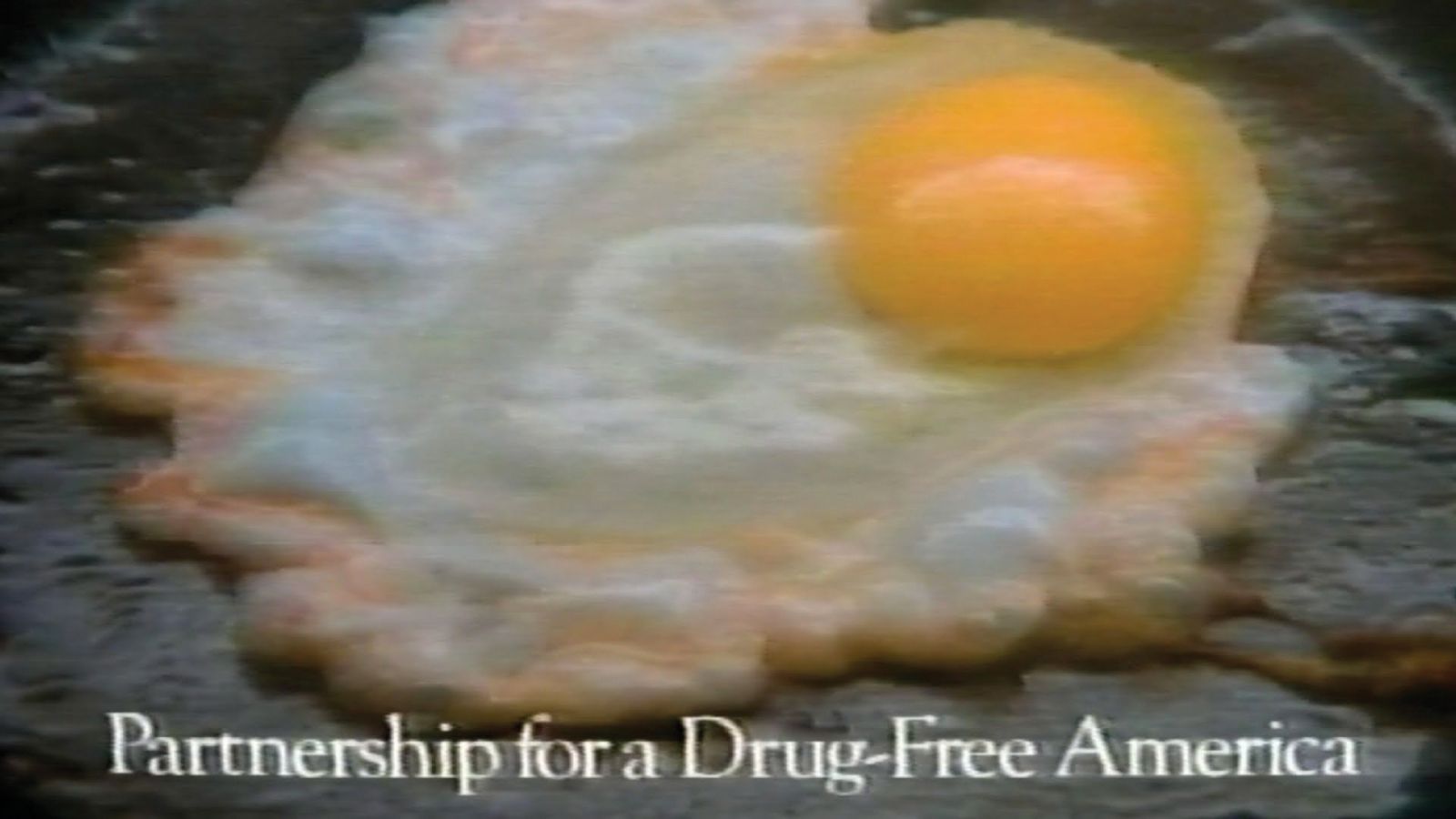
Remember the sizzle of our eggy brains in the frying pan? Or the meth addict’s terrifying house-cleaning jingle? What about the Teenage Mutant Ninja Turtles cooly reminding us, “Drug dealers are dorks!”—a cartoon ironically spawned by heavy marijuana users, or at least individuals with highly dissociative thinking. The War on Drugs even coopted our beloved cast of Saved by the Bell—“There’s no hope with dope!”—after Jessie freaked out having ingested too many caffeine pills. We were continually reminded by everyone from our parents to the lovable Scruff McGruff—D.A.R.E.’s anti-drug cartoon canine—that drugs are baaaaad and we’d inevitably be sticking syringes in our little arms if we tried one puff of Mexican skunk weed.
So I ask you: In the years since these PSAs hit the airwaves, what has happened to us Millennials?
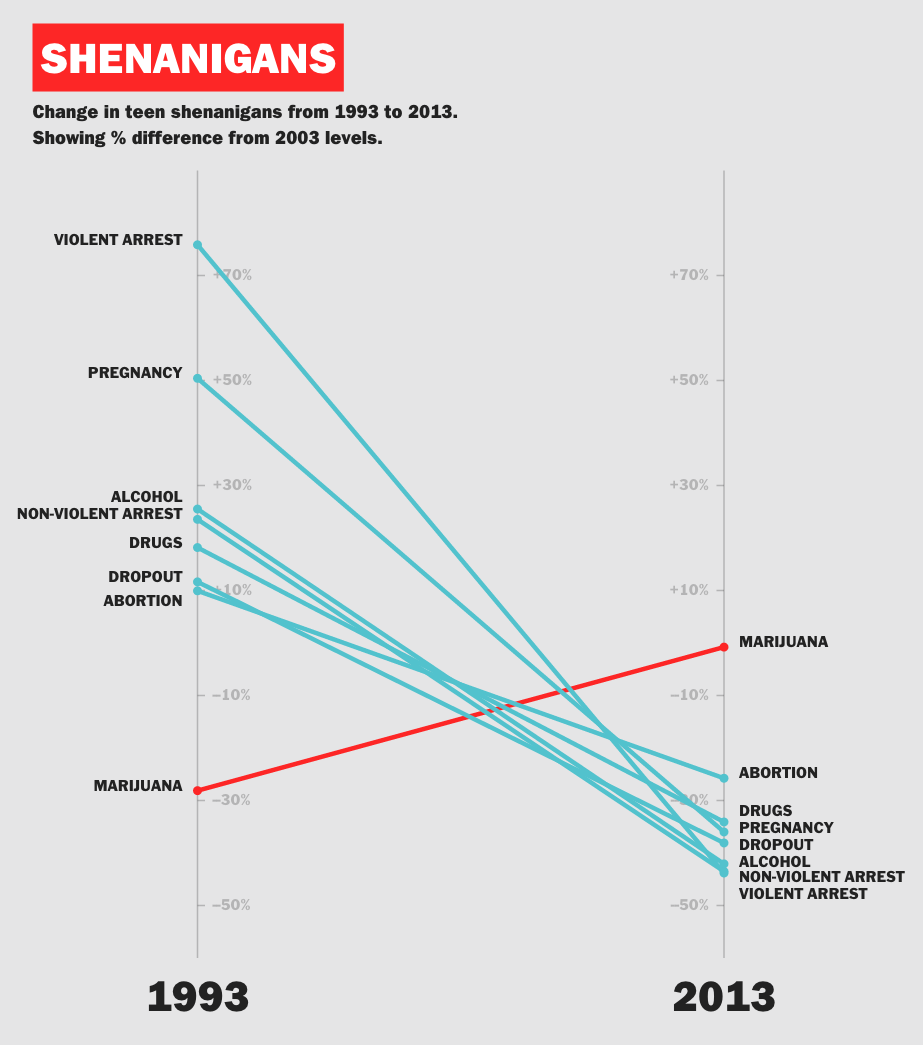
Well, the ads worked (or something did—Roe v. Wade and less unwanted babies being born, perhaps?—a discussion beyond the scope of this article). Illicit drug use, alcohol abuse, cigarette smoking, and a slew of other negative social indicators (e.g., teenage pregnancy, crime rates, dropouts, etc.) among Millennials are much lower than in previous generations. Vocativ (2015)—pulling data from the Centers for Disease Control (CDC), the National Institute on Drug Abuse, and the Department of Justice—illustrates just how well-behaved our Generation Y has been:
So what’s the problem here?
Two things, actually. First, I believe that our understanding of addiction is flat and selectively demonizes groups with less power in society. Second, I think that PSAs have been targeting the wrong perpetrators, that over the past few decades, much more insidious drug-peddlers have hooked Americans across all generations. And these pushers don’t operate from the shadows, but rather sell their dope openly, on TV even. I’m talking about something that kills more people annually than car crashes, something that kills more people than all illicit drugs combined. I’m talking about good ol’ corporate, doctor-prescribed narcotics.
I’ll begin by qualifying my position. I worked as an addiction specialist for over two years at a non-profit methadone clinic in San Francisco. I managed a caseload of roughly 50 people who had been (or still were) heroin-users. Methadone—an opioid that occupies the same brain receptors as heroin but without the same sedation or euphoria—is the pharmaceutical equivalent of kicking the can down the road. In essence, it replaces one substance with another, but most importantly it allows people to live stable, normal lives. Without the threat of withdrawals, they can maintain jobs, take care of their families, and go on about their business.
I was struck by the fact that some of my clients were just like me—young, ambitious, from loving families—and were a far cry from the grotesque “Faces of Addiction” we’ve seen pop-up in our Facebook feeds. Where were the festering blisters on their faces? Where were the signs that they were not to be trusted under any circumstances? What was heartbreaking is that my clients—mainly respectful and civic-minded individuals—had an acute awareness of society’s appalling concept of an “addict” and were self-conscious about it. Many had done time in prison for the non-violent crime of having a disease, and the shame of having been addicted to heroin dripped from their stories, as if they were trying to atone for having fallen off one of society’s most jagged edges. It reminded me that our concept of addiction is weighed heavily against lower income groups such as the homeless and minorities, groups with comparatively less power in society.
Faces of Addiction
It’s incredibly ironic that the War on Drugs and the subsequent mass incarceration of non-violent offenders—a policy that continues to disproportionately affect poor and minority people—was ignited by President Nixon, a notorious alcoholic. And I wonder how we would view addiction differently if PSAs had been created in the image of the rich and powerful addict?
Here’s what I mean:
Show us the Wall Street executive snorting lines of uncut Columbian off his mahogany desk and believing he’s invincible before rolling the dice with your grandmother’s stock portfolio.
Show us the bored, bony, Bel Air housewife who exercises for three hours a day and spends her weekly allowance from her overworked, philandering husband on a daily bottle of Veuve Clicquot while Maria or Svetlana raises her kids.
Show us the flush-faced politician who writes scathing polemics about drug-users while nursing his OxyContin addiction in a gated community. (Ahem, Rush Limbaugh.)
Show us the 22-year-old marketing manager in New York who blacks out every weekend on $15 cosmos and can no longer achieve orgasm unless she’s on mollie.
Show us the lead engineer in the Silicon Valley tech firm who pops Ritalin to code all night and keep up with the increasing demands of his employer.
Show us the millions of Americans who turn to sugary, fatty, comfort food—treats that were marketed to them on TV—to iron out life’s little speed bumps and then ask their doctors about one-pill solutions to their subsequent obesity, high cholesterol, high blood pressure, acid reflux, and heart ailments.
The point is that there’s always been an element of privilege to our concept of addiction. Poor addicts provoke contempt and disgust, while hard-partying wealthy addicts inspire TV specials and book deals. It’s all very unfair as we’re sold the bogeyman of “the marginalized other”—the dirty, disgruntled addict—to distract us from our own troubling habits nurtured by powerful forces.
This phenomena is intimately connected with my second argument. I believe that the biggest perpetrators of addiction, disease, and death are not the drugs that PSAs warned us about, but rather legally prescribed medications.
It’s no secret that the U.S. government has a cozy relationship with Big Pharma. Time (2015) writes a telling exposé on the new Deputy Commissioner of the FDA, Dr. Robert Califf, who believes that the U.S. needs less regulation in the development of new drugs, including the loosening of the approval process and a slackening of the post-market oversight. Given the number of drugs and devices that are recalled annually after causing serious injuries and death (e.g., Vioxx, Phen-fen, Propulsid, Zyprexa), and given the number of multimillion (and multibillion) dollar lawsuits annually, how can one of the top regulators of the FDA—an organization meant to safeguard the public interest—believe in less regulation?
The Centers for Disease Control (CDC) reports that since 2009, drug overdose deaths have overtaken those from motor vehicle crashes, and the trend has continued since then. In 2013, drug overdoses were the leading cause of injury death claiming 43,982 lives, nearly three times as many people as homicides. Of those drug-related deaths, 22,767 (51.8%) were from prescribed drugs, more deaths than from all illegal drugs combined.
A majority of these lives were lost due to two classes of medications: opioids, also known as painkillers (e.g., OxyContin, Vicodin), and benzodiazepines, a class of anti-anxiety drugs (e.g., Xanex, Valium, Ativan). Opioids are by far the biggest offender:
The CDC reveals that in the U.S., the cost of prescription opiate abuse was $55.7 billion, including lost workplace productivity, healthcare, and criminal justice
Opioids were involved in 71.3% of all prescription medication overdose deaths in 2013
Each day, 44 Americans die from painkiller overdoses, and in 2013, nearly two million Americans abused them
And yet, when asked about reasonable prescription limits in a PBS (2013) interview, a CDC representative reports that,
Very few states have laws requiring specific steps when exceeding daily dosage limits for all prescription painkillers…The existing limits do not place major constraints on prescribing.
Returning to the larger issue of high-volume prescriptions for all drug classes (not just painkillers), why is this happening? Two reasons: doctors are paid and patients are heavily marketed to.
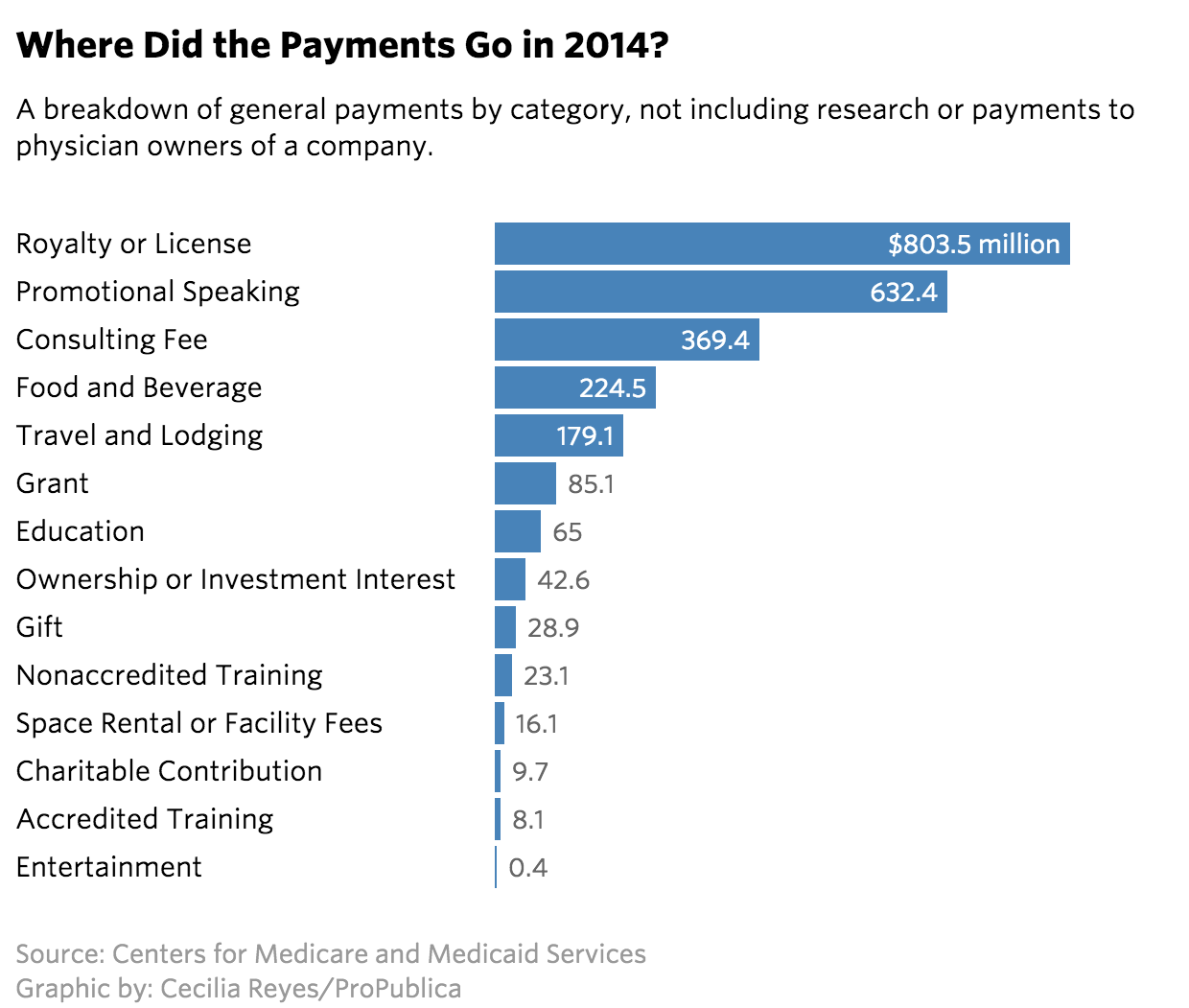
First, between August 2013 and December 2014, doctors received $3.53 billion for consulting, speeches, travel, and meals from pharmaceutical companies, and this is only in disclosed payments. ProPublica’s “Dollars for Docs” (2015) project tracks not only how much Big Pharma is spending to woo doctors, but also calls out the greatest offenders:
Second, it’s interesting that since 1997, pharmaceutical companies have been able to hawk antidepressants, diuretics, antipsychotics, anesthetics, muscle relaxants, corticosteroids, antihistamines, and boner pills, among others, all on television and public billboards as if they were benign deodorant or salad dressing. This isn’t the way it should be. Europe has banned this practice—also referred to as direct-to-consumer advertising—and it’s easy to see why: it’s widely abused. As the old saying goes, “Don’t make the doctor your heir.” In a similar vein, why would we let entities that profit from our sickness—real or imagined—sell drugs to us? There’s a clear conflict of interest between private enterprise and public health. Companies rely on making money, not on making people well, and it’s in their financial interest to convince people to take drugs. Plain and simple.
Every once in a while, Big Pharma receives a slap on the wrist and a small, modest bite is taken from their profits. GlaxoSmithKline had to pay $3 billion in 2012 for false advertising, paying kickbacks to doctors, and making misleading statements on the label, among other charges. Pfizer, Johnson&Johnson, Abbott Laboratories, and Eli Lilly have all had to pay settlements of over $1 billion in recent years on similar charges (Source: Wikipedia).
Despite all of this, the industry remains defiant and committed to increasing their profits. Bloomberg (2015) reports that there were 63 million prescriptions for ADHD drugs last year, with adults taking 53% of them. Shire’s Vyvanse, an amphetamine-derivative approved to treat both children and adults, celebrated an 18% uptick in sales last year and CEO Flemming Ornskov noted gleefully that in 2017, this drug will be used to treat binge-eating! Ornskov adds that,“Sweden is one of [their] fastest uptick markets, even beating the benchmarks for the U.S.” The use of drugs should not involve a desired “expansion of markets” at all. Manufacturing an ever-increasing pool of pill-ready patients is not in the interest of public health.This is the problem.
I can go on about the racial and socioeconomic biases of American drug laws; the alarming explosion of Americans taking pills; the increasing power of drug cartels in the face of punitive attitudes toward substance (ab)use; and even why a more accepting attitude toward marijuana use has been good for society. Instead I’ll close with some glimmers of hope. Here are my recommendations to ameliorate some of the damage done by the misguided War on Drugs (WoD):
Decriminalize all drugs. Let’s take illegal drugs out of the shadows to disempower cartels, to save money on non-violent crime prosecution, and to get people with addictions the help they need. The Cato Institute has countless studies on the failed WoD, including an examination of the effects of decriminalization in Portugal, where drug use overall is decreasing, the government is saving money, and most importantly, people with substance abuse problems are treated as medical patients rather than social pariahs. There are countless indicators that the libertarian position on drugs is a strong one, and my clients at the non-profit clinic in San Francisco would have benefited greatly from time in treatment rather than time in prison.
Ban direct-to-consumer advertising for Big Pharma. The only people that should be telling us what to put into our bodies are doctors and nutritionists, not marketers.
Appoint impartial doctors and scientists to lead regulatory agencies such as the FDA, not corporate insiders. This is a no-brainer. We need independent-minded experts with a commitment to safeguarding public interest, those who won’t be swayed by “old friends” or the sparkling arsenal of lobbyist treats from Pfizer, Merck, and all the others.
Take care of your own mental and physical health and avoid relying on one-pill solutions.Of course there are medical conditions which warrant medication and surgery. I’m not Amish or a Scientologist, but I do believe that if Americans took more pride in being healthy, we’d all be better off. Less addicted, less sick, less judgmental, and happier.
Here at PharmaJoy, we’ve helped our customers conquer depression, anxiety, obesity, ulcers, hypertension, infertility, schizophrenia, impotence, rapid heart palpitations, cold hands, body dysmorphia, arachnophobia, and more! After three incredible years in business and an outstanding relationship with the FDA, we are proud to release our greatest achievement yet in the continued quest toward the pharmaceutical mastery of the human condition: Enamorex®. The Love Pill.
So how does it work?
PharmaJoy’s patented formula works with your brain to stimulate feelings of romance! It targets activity in your A10 cells—also known as your LovePlex Matrix®—select cognitive areas which have been scientifically associated with love, including the ventral segmental area (VTA), the caudate nucleus,and the nucleus accumbens. These dopamine, norepinephrine, oxytocin, and testosterone delivery systems are associated with reward, craving, and motivation. We tailor-make Enamorex® based on your past history of relationships—jealousy behaviors, selective proclivity, and overall interest in sex—for the perfect solution to your woes in love!
So who’s right for Enamorex®?
Are you afraid that you’ll end up sad and alone? Have you recently suffered a breakup or a noted pause in your romantic feelings for your life partner? Or perhaps you have taste in the type of person which doesn’t please your parents?
Enamorex® is here to help you gain total control over your romantic destiny!
Meet William—a 37-year-old startup-founder living in a studio apartment in San Francisco. Although this modern Romeo exudes the kind of confidence to make kings blush, finding his Juliet through online dating hasn’t been easy. From OK Cupid to Coffee Meets Bagel, from Tinder to Cuddlr, he simply felt unable to find love amidst the long hours spent wooing venture capitalists for funding. One day, however, this young entrepreneur took his relationship future into his own hands! Rather than being half-interested in his kangaroo court of online dates, he enlisted his data-wizard friends to analytically evaluate the most eligible of his prospects. Once they reached a decision, William started taking Enamorex® to fully appreciate the bright future in front of him!
“Before Enamorex®, I would have stumbled on this objectively perfect specimen and would not have been able to appreciate her potential! Bridgette is my one-and-only supporting cast in my hopes and dreams! In that vast pool of eligible bachelorettes and my own weighty career ambitions, I needed help, and I’m so grateful that I finally feel neuro-chemically fulfilled.”
– William, happy customer
Meet Jessica—a 29-year-old barista at an artisan cocktail bar in Brooklyn. She’s been with her boyfriend Channing since she was 23, initially attracted to his status as a lawyer, since she herself had harbored ambitions to go to law school. They fell in love, married early, and she eventually found out that he’d received his law degree from a fly-by-night, for-profit online degree program, and was virtually unemployable. The allure was gone. She knew that a divorce would be costly and ill-advised given her ballooning student loan debt from the Arts Institute Program where she was enrolled in her fifth year, so she decided to fall back in love with her husband and asked her doctor about Enamorex®!
“This is, like, a total miracle drug! I just, like, wanted that old spark, you know? This pill has made all the difference! Channing and I totally watch Netflix together again. ”
– Jessica, happy customer
Meet Lisa—a gorgeous 39-year-old magazine intern living in Omaha, Nebraska. She’s terrified of getting too close to people. After experimenting with girls for several years, buying thick-rimmed glasses, and getting several tattoos in courier font, she realized that she really seeks the love and approbation of her parents who are patiently waiting for grandchildren. Foreseeing the complications of coming out as a lesbian to her family, she decided to try Enamorex® instead.
“All of that stirring in my loins used to only come from girls. But now I take a pill and get to choose a partner who pleases my parents. For anyone in gay conversion therapy, I’d really recommend Enamorex® as a supplement. I’ve been with a man for four months now and fingers crossed that he’s the one!”
– Lisa, happy customer
Whatever your romantic needs, Enamorex® is there to help you through it. Check out more successes on our Facebook page and if you’d like your story featured, please use #Enamorex for your chance to win an unforgettable vacation for two!
What do people typically seek from their professional lives? You may hear responses such as “fulfillment” or “autonomy,” “meaning” or “personal satisfaction.” More often than not, the response pays thought not only to an individual’s talents, but to a larger aim as well—to do good in the world. As if by nature, most of us harbor an aching desire to make a difference, to leave our communities a little bit better than we found them. While the will to exact positive change is evident in the hearts of people, there is a troubling lack of benevolent careers that pay enough for someone to survive and raise a family. Why is there such a discrepancy?
Like many of my peers, I dipped my toes into several professions after graduating from college. My most rewarding jobs included being a teacher, a freelance writer, and an addiction specialist, but the compensation for these positions was severely lacking.Many jobs that are absolutely essential to society pay pauper-wages, careers in fields such as education, social work, home care, medical assistance, childcare, small farming, construction, and more. This decreases the number of people who go into these important lines of work and makes our infrastructure more tenuous. Without those who provide our food, shelter, medicine, childcare, and schooling, our society would collapse into disorder and desperation. And yet they receive next to nothing for this essential labor, which causes many to turn to public services such as food stamps and General Assistance (GA). Locked into this grueling treadmill of poverty, these people burn out, become sick, and in turn, aren’t able to raise healthy families.The cycle continues.
I hit my breaking point working as an underpaid addition specialist for two years in San Francisco. I was the valedictorian of my high school and I’d graduated summa cum laude from Berkeley with degrees in psychology and sociology. I had other job options, but I’d wanted to give back to a community of people in need, to do the right thing. I had a caseload of over 50 clients with a high turnover of colleagues. It quickly became clear that I’d either need to marry into money—how passé for a self-sufficient, well-educated woman—or seek a better-paying career. I chose the latter.
In recent years, I doubled my salary when I became an SEO manager at an online marketing company. I wrote and edited online articles with the purpose of driving people to morally dubious, for-profit education clients, entities that have contributed to the explosion of student loan debt. I justified this to myself on the grounds that it was for education, so it couldn’t have been all bad, right? My desire to “make it” economically pulled the wool over my eyes and I felt spiritually bankrupt in the process. To my old company’s credit, they gave me free reign to create research-backed infographics that told the truth about wealth or gender inequalities, that explored careers in clean energy or medicine. These messages didn’t exactly align with the company’s desire to attract new students for client “diploma mills,” but they let me have my virtual soapbox to air all manner of issues important to me. For that, I am very thankful. They let me be me, even if I did get laid off one month after receiving a perfect performance review.
C’est la vie.
As a freelance writer, I still occasionally write articles for online marketing companies. Why? Because I love to write and I need to eat. These are the people who pay for my work. Plain and simple.
So why does our society offer such limited options for those with big hearts who don’t want to live in poverty? Are the astronomical salaries of defense contractors, corporate lawyers, investment bankers, lobbyists, and other ethically unsavory professions a reflection of our priorities as people, or is this simply a case of historical Wealth and Power protecting their elevated status, an ossification of the status quo?
I’ve seen evidence for both sides.
First, American priorities seem entirely out of whack. A handful of people in the U.S. have more wealth than the entire GDP of impoverished nations such as Sierra Leone, Ecuador, and Liberia. Our annual defense budget ($637 billion projected for 2015) is more than enough to feed and educate every child on earth, and yet our government callously fills the coffers of our defense contractors without addressing the real root of our nebulous War on Terror: a lack of access to opportunities in developing countries. Take care of basic needs for people, and the scourges of modern society seem to clear themselves up.
If we had a real interest in curbing violence around the world, we would have stopped building weapons which further escalate conflict and started investing in the hearts and minds of our purported enemies. This is not to neglect the countless non-profit organizations and other groups supporting infrastructural projects across the world. The issue is that a disproportionate share of the wealth is funneled into militaristic as opposed to humanistic ends. We should be paying people to do something better than shooting a gun. A majority of civilians on both sides of the conflict recognizes that building schools and providing basic services is better than building weapons or military bases, and yet we’re manipulated into believing that occupying other countries against their will is somehow for our protection and their benefit. It’s shameful.
We can’t continue pursuing the same militant strategies which have only fueled the flames of anti-Americanism in the Middle East and around the world. Our interest in other countries has been justified on the grounds of “freeing the people” from oppressive regimes or spreading democracy. It’s curious that we only pursue these “noble efforts” in countries that are of strategic interest to us for resources (e.g., oil reserves in the Middle East), corporate development (e.g., United Fruit Company in Central America), or otherwise. Where are our strides to end tyranny against the North Korean or the Nigerian regimes? The horrors of these countries are well-documented, but we do nothing. And then the American government goes and shakes hands with the oil-rich Saudi Princes, the leaders of a country where women still can’t drive and there are regular beheadings stemming from a misuse of Islamic law.
Another problem is that many Americans, likely exhausted from mind-numbing careers, seem to value entertainment above edification. We pay our actors, pop musicians, and athletes exorbitant sums for delighting us in the Coliseum of Mass Media while our schoolteachers and caretakers struggle to save for retirement.
There is ample evidence that American priorities are somewhat misguided, and it’s not entirely our fault. In fact, we’re behaving very rationally given the system into which we’re born: one where life’s meaning can be artificially constructed by the amassing of goods and power.
To that point, Wealth and Power have a history of safeguarding privileges for themselves and for their heirs. There are more millionaires in the Kangaroo Court of our country, the United States Congress, than ever before, and there are countless examples of people jumping between public service and private companies to bestow benefits on the other. Companies can pay for the election of representatives of their choosing, especially in the wake of Citizen’s United which enables businessmen to unleash unlimited campaign contributions. Our “public servants,” on the other hand, continue to pass legislation which protects incredibly low capital gains and corporate taxes for society’s most entitled people. There are some well-meaning politicians who strive to serve the larger public, but they are increasingly rare as Wealth becomes more and more politically prescriptive in the outcomes of elections.
So how do we change a society embroiled in political pseudo-conflicts, Republican versus Democrat, which always leaves the same wealthy entities in power? Grassroots movements such as Occupy Wall Street have the murmurings of creating change, but the lack of leadership in orchestrating demands extinguished the flames of revolt too quickly. What is the tipping point of a revolution? When will enough people stop watching the hypnotic shadows on cave walls and become privy to the real forces directing their lives?