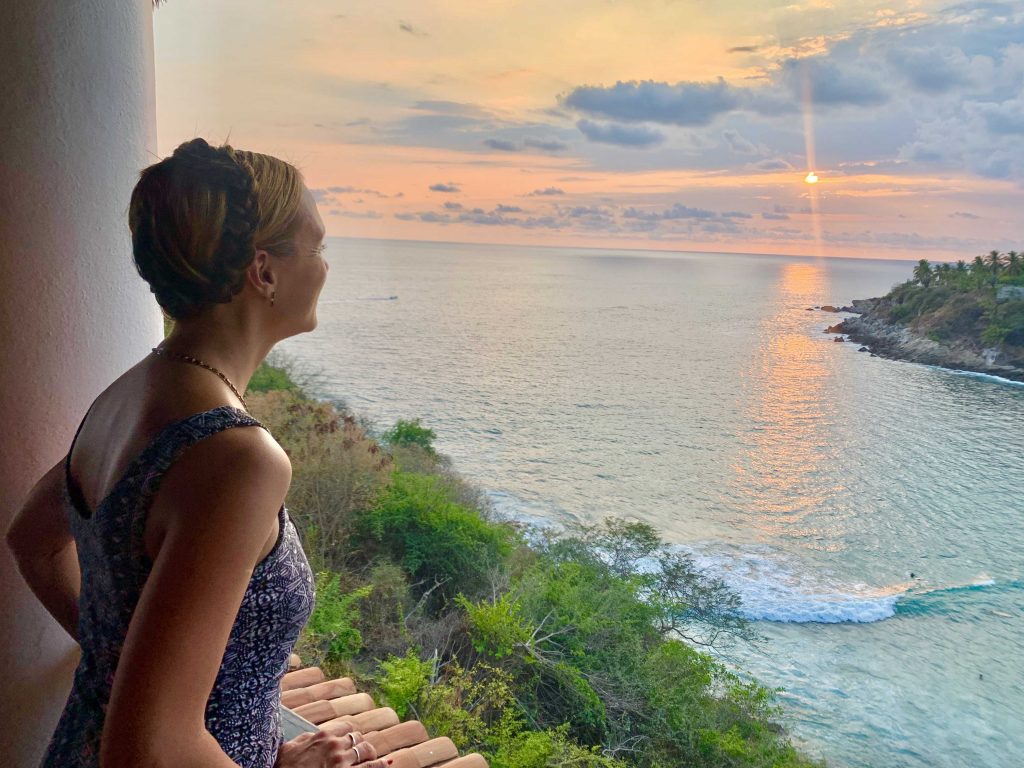
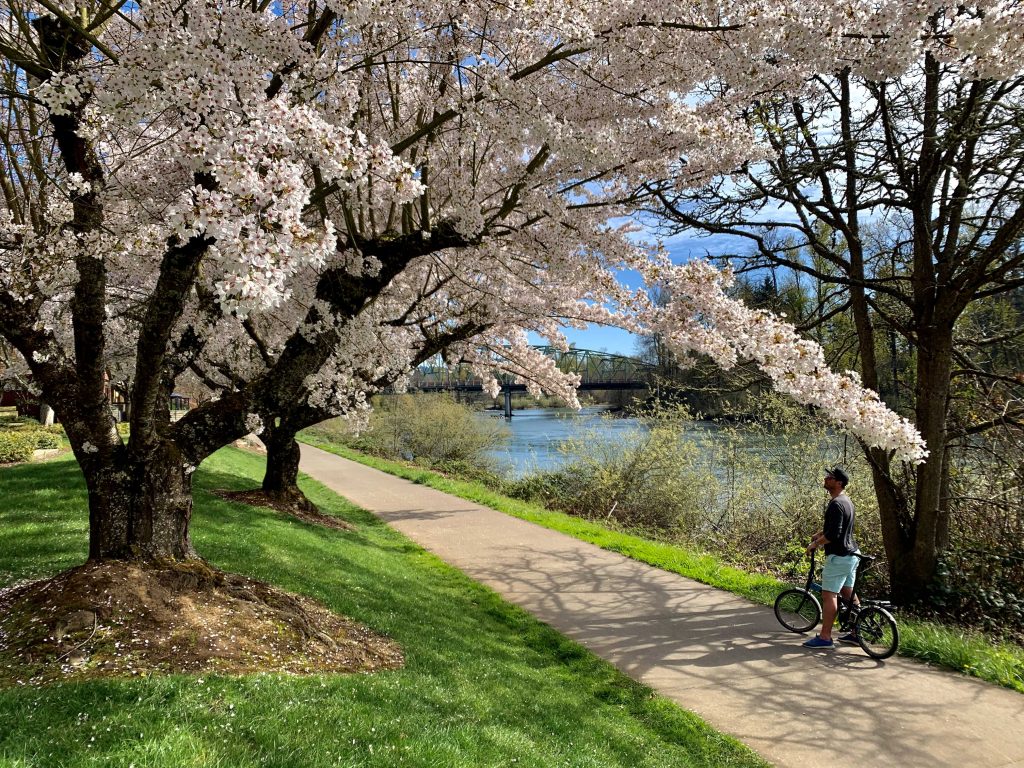
The best decision I ever made was not where I went to college, the career I pursued, or whom I married—it was the one-year roadtrip my spouse and I took to figure out where to buy a house.
This dream was brewed in 2015 over many Malbec-drenched nights in San Martin de los Andes, the Patagonian lake town where Jon and I lived for 5 months. Very early on in our relationship, we’d moved from San Francisco to Argentina—the country abroad that was European enough for Jon and Latin American enough for me.
After a few months in Buenos Aires, we were ready for somewhere cozier and greener. Following a random conversation at a dog park in our Belgrano neighborhood, we were convinced to move to a place we’d never heard of on the border with Chile.
Because San Martin was so friendly and picture-perfect, Jon and I hatched a plan to explore a variety of midsize American cities when we returned to the States. We made a short list of what appealed to us: we wanted a university town with abundant nature, progressive values, kind non-pretentious people, and a solid bike infrastructure.
On our roadtrip, Jon and I stayed with family or in AirBnBs to get a feel for the local hospitality. We especially loved Fort Collins (Colorado), Asheville (North Carolina), and St. Pete/Dunedin (Florida). Those towns spoke to our bike-loving hearts and leftist ideals. They also had excellent breweries.
Some people are lucky enough to be born where they belong—Jon and I were born seeking that feeling, living abroad and traveling widely through our 20s. The opportunity to choose Eugene (and now, also Yachats) has allowed me to become who I am. Planted in a east coast soil, I wouldn’t have flourished in quite the same way. I enjoyed a wonderful upbringing in Laguna Beach, California, but the appearance-obsessed culture, traffic, and desert landscape never quite fit me. I’m a hiker attracted to wide open spaces, mossy fern-filled forests, and King Tides.
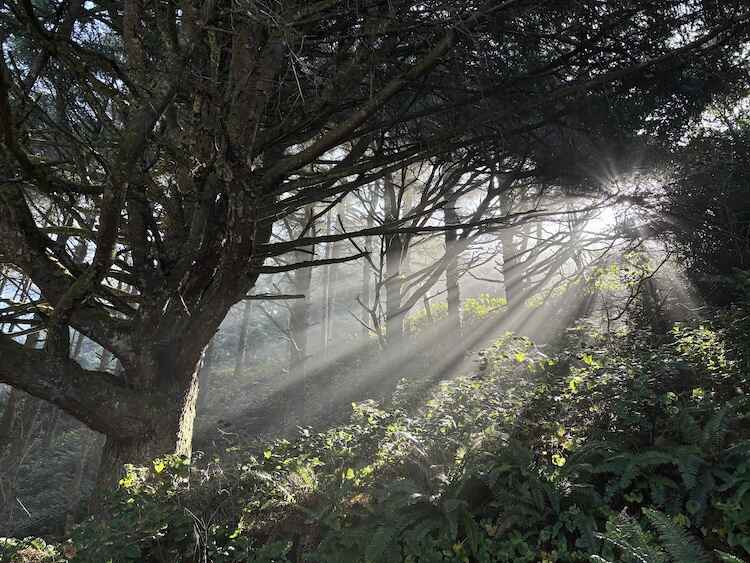
Cape Perpetua, Oregon (October 2025)
I love the wildness of Oregon, especially on the coast. The surf is powerful and unpredictable, carving lush inlets around capes and natural bridges through lava rock tide pools. Sometimes the rain and wind are so intense they drown out conversation or blow you off your feet. It’s not for everyone, but it’s absolutely the place for me.
For those who have the means, starting with the question where do I want to be? allows everything else to fall into place. I’ve lived in London, Niigata City (Japan), Porto Alegre (Brazil), San Francisco, and many other places along the way.
When you choose a place, you’re adopting an aesthetic and a group of people with shared values and customs. You get a local government, land-use laws, specific tap water, and seasons. You inherit an area’s decisions about how much public space to protect versus how many “No Trespassing” signs you see. More than any other variable, your environment shapes your opportunities and future.
In my experience, being a small fish in an enormous pond (especially as a young adult) pays off—I had incredible job opportunities in San Francisco for several years. It may be tempting to move to a more affordable state such as Texas or Missouri to afford a 3,000-square-foot house, but with that change comes decreased tax bases and wages. Low local taxes may mean fewer public spaces and vast privatization of the most desirable, beautiful land—the areas along mountain ridge-lines, rivers, and lakes are open only to wealthy landowners and those who can afford private club memberships. If you choose to be the big fish in a cheap state, you may also find your financial situation shrinking relative to the rest of the world. (It’s easier to travel abroad with California wages, for example, rather than those from Oklahoma.)
I still carry parts of everywhere I’ve lived with me. I adopted the Japanese custom of shoe removal and the Brazilian/Argentinian ritual of drinking maté. I regularly cook Southeast Asian dishes, and for a while, I asked questions with a Londoner’s polite upward inflection. And perhaps no place sticks with me as much as Mexico: I speak the language, spend 4-6 weeks there every year, and my personal style, art, and home decorating have embraced the bright palettes of Chiapas, Oaxaca, and the Yucatan Peninsula.
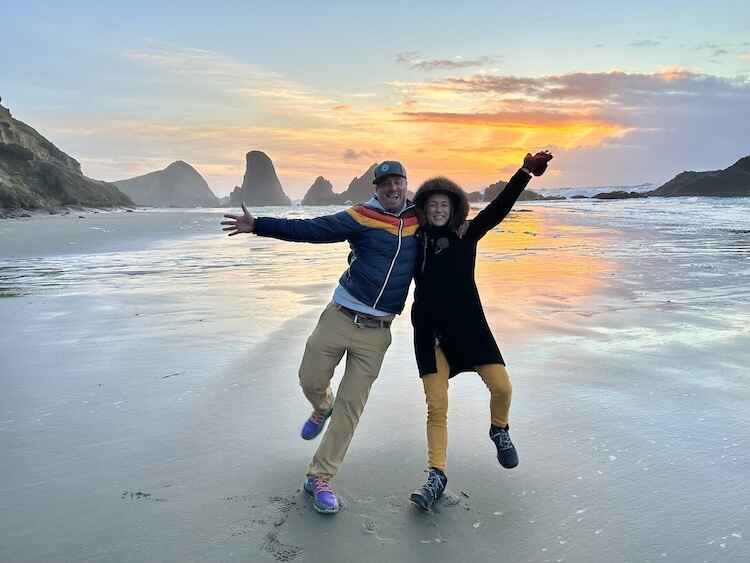
Seal Rock, Oregon
In my life, I’ve fallen in love with at least as many places as people. Laguna Beach, Berkeley, San Francisco, San Martin de los Andes, Oaxaca City, Annecy (France), Eugene, and Yachats. Every time it happens, my priorities shift. Everything flows from your surroundings. Don’t let your boss tell you where to live, if you can avoid it. It’s a privilege to choose where you lay your head each night. Find that place you love and see who and what else fall into place.
Since moving to Oregon five years ago, I’ve hit a wall every mid-February. The glow of the holidays carries me through most of the dreary winter, but after weeks of unabated rain, I flee the Pacific Northwest to soak up precious vitamin D to get me across the early spring finish line.
In 2020, I went to Oaxaca for a month, barely making it out as the pandemic was upending international travel. This year, I confess that in my desperation for sunlight, I flew straight into the heart of Covid country. Yes, folks: I visited my old stomping grounds on the Gulf Coast of Florida.
Playing it safe on the Venice Fishing Pier, Florida
I knew that the Covid protocols in Governor Kate Brown’s Oregon and Ron DeSantis’s Florida would be vastly different. (I once got yelled at in Eugene for walking along an empty residential sidewalk in the rain without a mask on.) But just as these areas occupy opposite poles of our country’s landmass, so too have their citizens’ responses to this pandemic.
In Oregon, indoor dining has been banned or severely limited since the pandemic began. The Governor has assigned risk levels by county according to case numbers and local businesses comply. At least in Eugene, everyone wears masks indoors and most people wear them outdoors, too. Oregon has been among the top five states in containing the pandemic and keeping the death toll low.
In Florida, indoor dining is at full capacity, bars are open, and hardly anyone wears masks. When going indoors, some Floridians simply pulled their shirts over their noses. Many people, including service workers, had masks dangling around their chins or with their noses exposed. Life in Clearwater, Treasure Island, Venice, and Nokomis seemed pre-pandemic, as if nobody had changed their lifestyle at all.
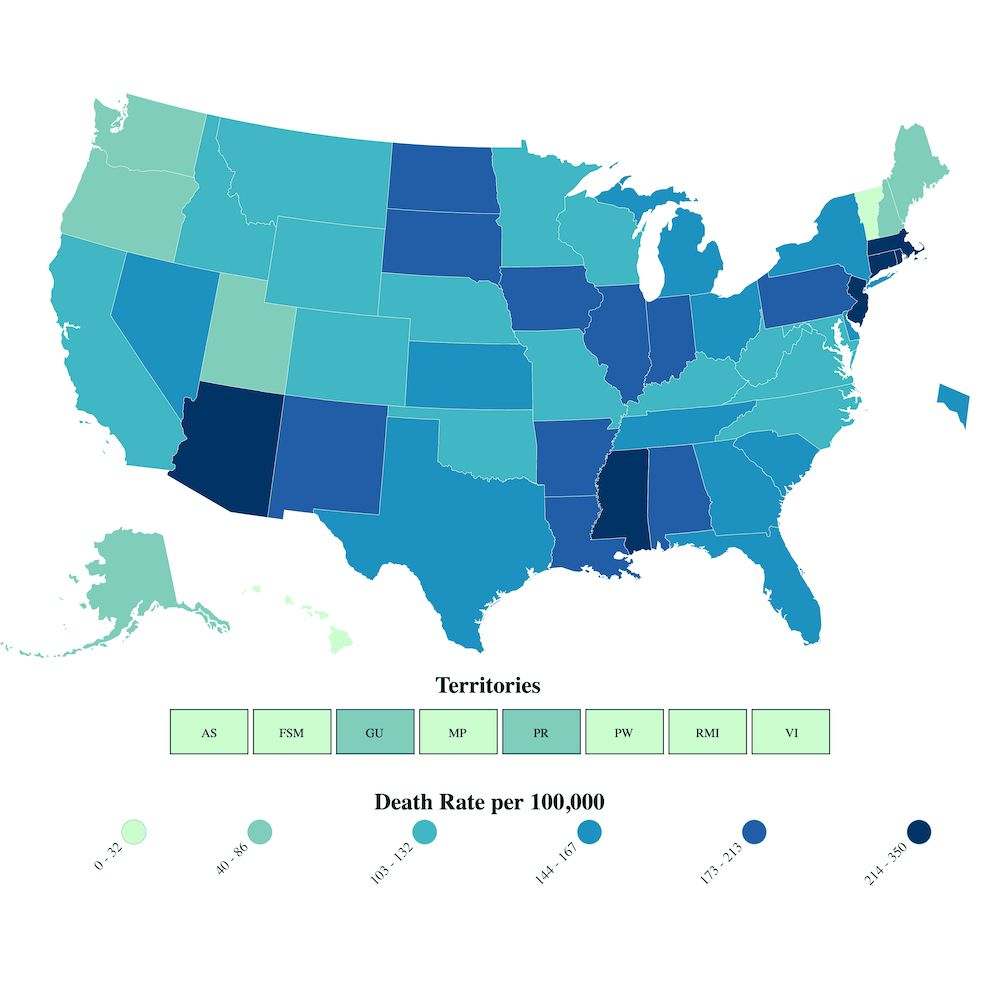
These two different approaches are reflected in our state outcomes (CDC 3/4/21):
Cases per 100,000 in Oregon (since 1/20/20): 3,700
Deaths per 100,000: 52
Cases per 100,000 in Florida (since 1/20/20): 8,767
Deaths per 100,000: 144
Deaths per 100,000 people (CDC 1/20/20-3/4/21)
Coming from progressive Eugene, Florida felt like absolute chaos. It took me a few days to shake my low-key anxiety. I imagined the stew of Covid particles swirling around the mouths of tanned senior citizens. They guzzled their cocktails and threw their heads back in laughter, spewing viral clouds to their wrinkled neighbors. Why didn’t anyone in the Sunshine State seem to care—especially those who would be most vulnerable to the disease?
I wanted to ask Floridians if they’d known anyone who had died of the disease, or if they even thought about it at all. It was an alarming contrast to my home state. Covid has consumed the lives of most people I know in California and Oregon. My friends and family have stayed home, worn masks, canceled plans, put off travel, socially distanced, quarantined after short trips, and signed up for grocery delivery services. It felt deeply unfair that Floridians were being so cavalier while Oregonians had made countless sacrifices. I haven’t seen most of my family and friends in over a year at the recommendation of Dr. Fauci and my governor, but here I realized that some parts of the country have hardly adjusted their lives at all.
Nokomis Beach Biweekly Drum Circle (2/24/21)
Florida has lost more people per capita than roughly half of all states. That doesn’t seem too bad—especially given their large elderly population—but consider one major caveat: there’s strong evidence that Florida’s Covid-19 numbers could be an undercount. Rebekah Jones, a former state data scientist and whistleblower from Tallahassee, claims that her supervisors pressured her to change the state’s infection data. She launched her own data dashboard (Florida COVID Action) and her home was raided by armed police on December 7. They seized her equipment and terrified her children. (As of March 4, 2021, her dashboard indicates that the state death and case counts are underreported by a few thousand and tens of thousands, respectively.)
Assuming the truth falls somewhere within that range, Florida’s cases should be much lower given the state’s significant sunshine advantage. Sunlight has been shown to rapidly denature the Covid-19 virus on surfaces. Humidity has also been shown to potentially slow the spread.
I’m much more comfortable at home with the high levels of social trust and mask-wearing, but with Florida’s retirees partying like it’s 1999—and not seeming to suffer—what has this all been for? Is it better to protect as many people as possible—at any cost and to the detriment of businesses and people’s mental health? Or would a more balanced approach be appropriate?
I felt a swelling mix of resentment and envy toward the careless hedonism of Floridians. My selfishness told me that even if I did catch Covid, I’d likely have a mild case or even be asymptomatic because I’m young and healthy. My pro-social side reminded me that I wear masks and make personal sacrifices not for my own well-being, but because I don’t want to be the person who unknowingly transmits a deadly disease to someone else.
Last April, I wrote a piece titled “America’s Other Disease,” which proved to be prescient. Back then, we’d only had 213,000 confirmed cases across the country. (As of March 4, we’ve suffered 28.51 million confirmed cases.) I suggested that our country’s individualism would prove an impediment to mask-wearing. In Americans’ twisted sense of personal freedom, covering one’s face to prevent the spread of disease is too much of an inconvenience for many. If only Covid-19 could be traced to male impotence, for example, we’d likely eradicate the disease in a month.
As vaccinations become more widely available, the daily threat and anxiety surrounding Covid should begin to abate. I do wonder about the long-term psychological impact on Oregonians and folks from more cautious states. How many people will fear the presence of strangers in the post-pandemic era? How many will continue to feel depressed and become shut-ins? How many relationships will suffer from the stress of long-term confinement? Will these effects be justified by our relatively low death-count?
Anyone who has lost a friend or a member of their family would say yes. I’m proud of Oregon’s response to the disease and recognize how many more people we would have lost given Governor Ron DeSantis’ approach.
And just this week, Governors Greg Abbott (TX) and Tate Reeves (MS) have lifted their mask mandates and business restrictions. We’ll see how these “leaders’” commitments to toxic individualism play out. Is it really so difficult for folks to wear masks? Half-a-million dead Americans and their families certainly don’t think so.
Less than 24 hours before the U.S. closed the border with Mexico, I returned from a month-long trip to Oaxaca. For two weeks, I tried in vain to bump up my flights after hearing rumors of the imminent closure of my country, but it was impossible to reach the State Department or the three airlines handling the legs of my travel.
March 16, 2020: View of Playa Carrazilillo in Puerto Escondido, still untouched by COVID-19
Nobody anticipated how rapidly COVID-19 would disrupt human civilization. This highly contagious coronavirus has already killed more than 17,000 people around the world. My ability to get home in the midst of this unprecedented chaos was uncertain.
On March 18, after a turbulent flight from Puerto Escondido to Mexico City, I boarded a budget-friendly Volaris plane bound for LAX. A woman with four small children occupied the row behind me and we waited for our flight to depart. One hour passed, then two hours. We pulled out of the terminal and into a maintenance area. The plane’s babies soon grew restless—echoing the impatience of our newfound passenger community. Several episodes of Bojack Horseman later, we were told our flight was canceled and a bus pulled around to take us back to the terminal to collect our luggage. It was almost 11:00 pm.
A group of male passengers in the back shouted in Spanish, “Nobody is getting off the plane! We all paid good money to be here and we deserve to get to LA for our jobs and families!” This minor insurrection was short-lived as the majority dutifully exited to the baggage claim, passed through customs, and to the airline counter. Volaris put us up at the nearby Fiesta Inn and issued us tickets for the following afternoon.
At this point, I knew the border was likely to close soon and prepared myself to be stuck in Mexico City. Since I was out of pesos, I paid the hotel bar for two craft beers with my credit card, grabbed a bucket of ice, and went to my room. I tried to rebook my connecting flight home (which I was going to miss) and the hotel I’d already paid for in LA. Neither of these could be changed or refunded. Goodbye $370.
The following day, I put on a mask and arrived early at Mexico City International, one of the largest airports in the world. I hoped that the U.S. wouldn’t close the borders so travelers like me wouldn’t be stranded far from home during an escalating crisis. I was in for a few surprises.
After wandering around the countless “Dufry” (duty-free) Shops, I heard my name announced over the intercom. I rushed to the gate and the plane was boarding more than an hour before take-off. I was relieved I’d made it since passengers (many of them from the previous day’s canceled flight) had already queued up.
I went to the counter and discovered that I’d been selected for a random search—a policy for international flights to the U.S. Two uniformed women with gloves proceeded to take apart both my carry-on bags and pat me down thoroughly in full view of my fellow passengers. Some gawked at my Zapotec tapestry gifts and ziplock bags of shirts, dresses, and underwear splayed on the large plastic table. All of my electronics were rubbed with small cloths and run under a chemical-detection sensor. Even if the crowd couldn’t see the twisted indignant frown underneath my mask, they could sense the fury in my eyes. This embarrassing exhibition took five full minutes.
I was so angry and flushed that I was afraid I’d set off the fever-detecting gun as I boarded the plane. I revealed these fears to the agent and he re-explained the American policy of random searches, pointing the laser thermometer at my forehead. I told him in Spanish it would be more humane to conduct the searches behind a curtain. He smiled and told me to have a good flight.
I sat down in my old seat in front of the row with the woman and her four children. I’d seen at least 30 more people behind me who needed to board the plane, but the process had ceased. My stomach dropped as I saw two agents in orange vests board the plane and talk to the pilot. The attendants gathered their belongings and headed out the aircraft door. A voice came over the loudspeaker and announced that we didn’t have clearance to land in LAX and everyone needed to get off the plane.
Outcries erupted as people angrily dragged their large bags down from the overhead compartments and began to file out.
This is it, I told myself. I’m going to be stuck in Mexico for the duration of this crisis—and I’m going to make the best of it. I haven’t yet explored Mexico City and COVID-19 isn’t a huge problem in the country. I miss my friends and family, but what else can I do? All events and trips I’d been planning at home are canceled anyway. Perhaps I can find a deeply discounted AirBnB in a cute neighborhood. Roma? Condesa? Maybe Coyoacán to pay tribute to Frida Kahlo? As long as I have reliable Wifi, work will not be an issue. And there are worse places to be stuck than a world-class city…
A couple of excruciating minutes later, an attendant announced that we’d just received word from LAX: we had been cleared for departure.
As smiling passengers filed back into the plane—our hearts all beating a little faster—there were rumors we’d be detained for lengthy questioning about our disease status. Others said that the plane might have to return to Mexico mid-flight, depending on what orders came down from the Trump administration.
I had my alternative plan, but I was restless and my stomach ached after drinking a glass of non-bottled water from the attendant. Dammit. I know better than that. Had my good luck finally run out on this budget Mexican airline? Would I start throwing up and get detained as a health hazard? I knew that vomiting wasn’t a common symptom of COVID-19, but I wouldn’t be allowed on my next flight in that condition, especially if I developed a fever.
I took a few breaths and reassured myself that the anxiety surrounding getting home was more likely the culprit of my stomachache. I began to feel better, settling into my seat in front of the children. A few book chapters and “Orange is the New Black” episodes later, we landed in LAX.
Nobody knew what awaited us on the other side of those doors, whether we’d be able to get off the plane, or if we did, whether non-citizens would be sent back to Mexico City. Traveling amidst a pandemic and widespread border closures was uncharted territory for all of us.
Thankfully, we all got off the plane and headed to immigration. I flew through customs without any problems, pulling down my mask to be identified at the various checkpoints. LAX was deserted, apart from a few travelers. The majority didn’t even wear masks—including the security guards, shopkeepers, and restaurant workers—but there were a few young women donning full-body condoms: long pants, long sleeves, hats, gloves, masks. They would wipe down every surface vigorously with antibacterial cloths before sitting down. I felt slightly underprepared with my flimsy mask and realized that being on my country’s soil presented more of a COVID-19 risk than being in Mexico did.
March 19, 2020: My first view of the U.S. after a month away (LAX)
All of the airport restaurants had only half of their tables open and staggered seatings to practice social distancing. Although I’d read about the changes from afar—the event cancellations, the “shelter in place” orders, the sudden loss of 15-20 percent of our economic activity with forced closures—this new corona-world provided a startling contrast to my life less than a week ago. Oaxaca City and Puerto Escondido were sublime—seemingly untouched by the madness of this pandemic. Stateside it feels as if I’ve landed in the wrong dimension of my old reality.
On Planet Oaxaca, my days were spent wading in warm turquoise water, watching some of the world’s best surfers. I learned about the region’s rich cultural diversity, wandering city streets and admiring the Zapotec art, exploring lush National Parks, tasting mezcal, and eating/drinking to my heart’s content at the region’s best restaurants for $10-$15.
It feels as if I’ve abandoned paradise for a disease-hobbled prison, but this is the country where most of the people I love are held captive. I’m so grateful I hit this wave just right, indulging my curiosity and senses, bringing back fresh eyes and my appreciation for what I take for granted in Oregon. I’d successfully leapfrogged the end of the gloomy season and now everything is bursting with spring color. I spent my first full day tending my indoor plants, yard, and garden, basking in the sun and crisp fragrant air.
March 22, 2020: Social distancing along the Willamette River in Eugene, OR
This experience made me realize that a paradise is temporary if it can’t be shared with loved ones. Although I met some good people in Puerto and I’m grateful to speak the language, I was an island staring back at the burning shores of my home, tracking the cascading viral havoc through my electronic screens.
I’m here now, fresh off of one of the best trips of my life—tan, healthy, happy, bearing lots of gifts. Life feels on pause but it can’t shake my optimism that having the world united behind a common enemy holds incredible potential. Not only is the global community focused on the same problem, but this experience is giving individuals a renewed perspective—the time and space to consider what we hold most dear. The breakneck pace of our normal self-imposed busyness leaves little room for precious reflection or gratitude. We’ve been forced onto a different path and it won’t last forever. The best we can do is roll with it.
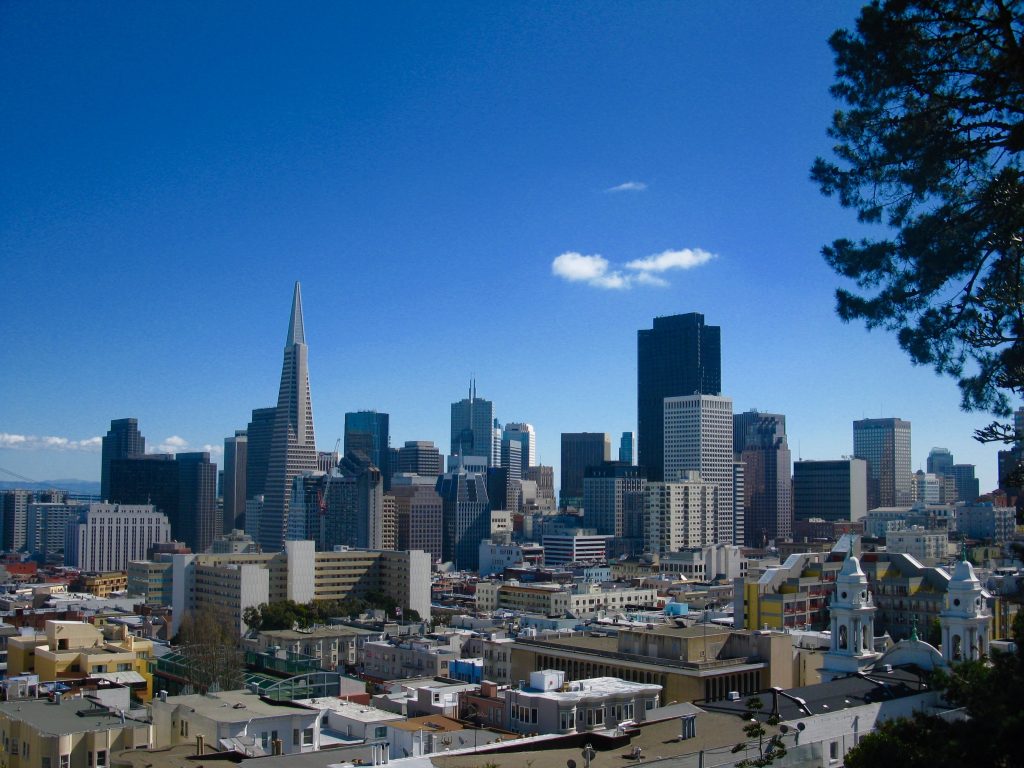
There’s something intoxicating about constellations of city lights along a bridge or skyline. I stand in awe of these concrete, steel, and glass cathedrals of industry—the banks, the department stores, the tech companies, the historical structures—tracing the tops of their buildings, creating a jagged key of the unique angles from where I stand. It’s moments like these that make people forget the smell of skid row on a hot afternoon or paying half one’s salary to rent a hovel. As the glitz and grime rose in tandem, one day I woke up and San Francisco—my Gold Medal City—was no longer my home.
Skyline from Russian Hill in San Francisco (2012)
Gold Cities are the major metropolises of the world: New York, Tokyo, London, Singapore, Hong Kong, Paris, Cape Town, Buenos Aires, Sydney, Rio de Janeiro, etc. These places have made it. They have achieved global relevance due to their density. They are crowded with structures, machines, events, wealth, and bodies—the ingredients of a dynamic financial and cultural economy. They are marvels of human achievement but can be cold to the touch, gilded and exclusive, blind to strangers. They are littered with wide eyes and empty pockets, company cars and expense accounts.
Just as many New Yorkers bemoan their love/hate relationship with their home, I grew tired of the coarsening demeanor of San Francisco. What had once been a nice place with open arms and a beating heart was going into cardiac arrest after a binge of evictions. Tent cities sheltered the displaced. Little boys with computer science degrees masqueraded as businessmen and fancied themselves the emperors of modern Rome.
What’s left when teachers, janitors, families, and artists can no longer afford apartments in a city? A one-bedroom (747 square-feet) in SF goes for $3,683. Oligarchs with fuck-you levels of wealth have multiple homes while most people are stuck on the unending treadmill of rent. The bigger houses are, the less they get used.
San Francisco also now leads the nation in property crimes and theft. Residents are desperate and hardened, some of them addicted to opiates and other drugs. The gritty underbelly and exorbitant cost of living in a Gold City push people out—or like me, they leave voluntarily. And having developed a palate for good food and culture, a village wasn’t an option. I opted for what I call a Silver City—a welcoming mid-sized town with sufficient density to cultivate some of the best features of a San Francisco or New York.
Silver Cities are accessible and comfortable for musicians, writers, and other artists who grow with the region as they shape it. These places are often college towns in the Goldilocks zone of affordability, amenities, and social mobility. They are more casual, amenable, and sincere than Gold Cities, with less traffic and materialism.
Overall, in Silver Cities, wealth has not overwhelmed the culture. Those with few resources can still shape the area with their relationships and creativity. These community members are producers and participants. By contrast, grandiose Gold Cities contain awe-stricken consumers and ossified power, where wealth dictates what’s seen, what matters.
I’ve traveled around 42 U.S. states, visited dozens of cities, hundreds of towns. Our Gold Cities—among the largest metro areas in the country—include San Francisco, New York, Los Angeles, Seattle, Chicago, Washington DC, Houston, Austin, and Miami. There are even some larger cities (>200,000 people) that still feel like Silver Cities on the ground: New Orleans, Portland, Boise, Philadelphia, and Minneapolis come to mind. And then there are the real Silver Cities, which often receive the creative spill-over from their larger counterparts: Eugene, OR—the town my partner and I chose to call home—is my favorite example with its thriving university, beer culture, bike-friendly streets, vibrant parks, and weekly community market. Other Silver Cities I’ve visited include Fort Collins, Flagstaff, St. Petersburg, and Knoxville.
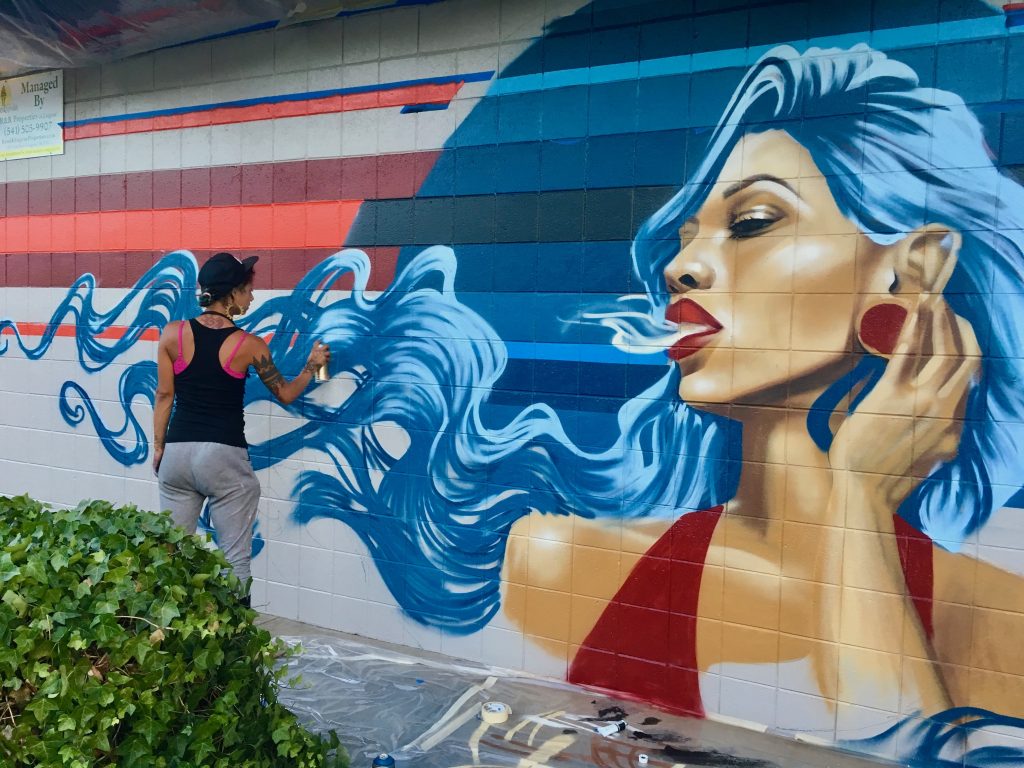
Rachel Wolfe-Goldsmith painting a mural two blocks from my house in Eugene, OR
Not every place fits neatly into these categories, of course. Some long-time residents of Gold Cities like New York might consider the Village or Park Slope their own cozy Silver Community. However, there is a big difference in the energy on the ground from a visitor’s perspective.
When the creatives and other locals leave Gold Cities—the artists, teachers, long-time residents—there’s a palpable void that new wealth can’t fill. Silver Cities stand to benefit from the exodus and receive these people with open arms.
A new friend told me that Eugene peaked in 2014 when the downtown had been revitalized but everything was still affordable. I suppose one person’s Silver is another’s Gold, depending on their experiences, income, and other opportunities. Maybe one day I’ll wake up and feel Eugene flirting with Gold status. After all, we are hosting the World Athletic Championships for track and field in 2021—the first time this international event has come to the United States. In preparation, Nike billionaire Phil Knight is rebuilding the historic Hayward Field and the construction of new hotels and other facilities is rampant.
I just know that right now, to me, Eugene feels perfect—snugly in the zone of world-class culture at a fraction of the Gold price. Friendly, not too crowded, and so damn beautiful.
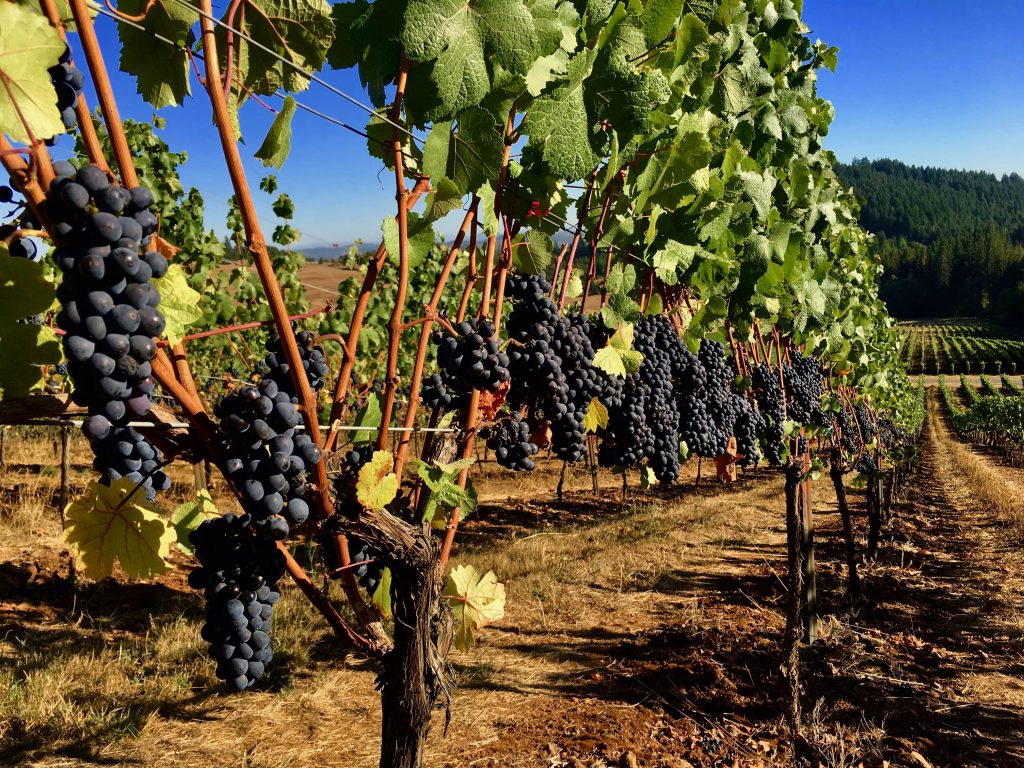
Pinot country is 20 minutes from Eugene, which is in the southern Willamette Valley
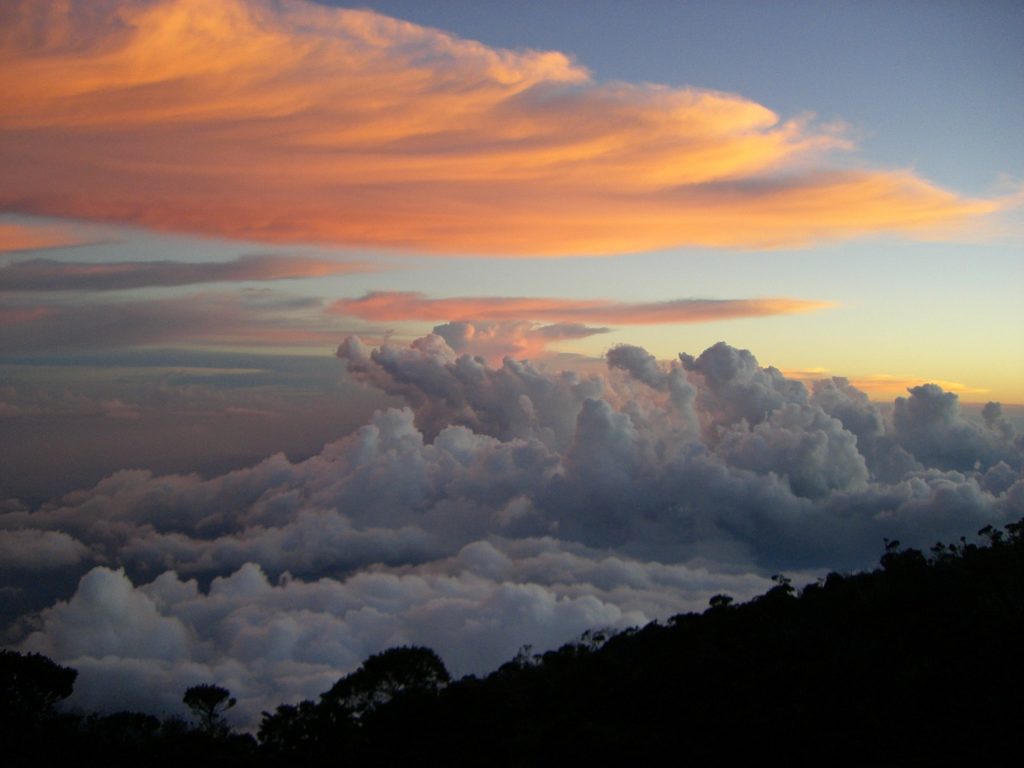
View from Mt. Kinabalu in Borneo, the highest peak in Malaysia
After finishing undergrad at Berkeley in 2006, I felt that graduate school was inevitable. Many of my peers had secured spots in law school, medical school, and various master’s degree programs at coveted universities across the country. It wasn’t a matter of if Cal students were attending graduate school; it was treated as a matter of when.
I looked at my fellow 22-year-olds and admired how they seemed to have everything figured out. There were some students with finance and business backgrounds who even scored six-figure salaries as consultants fresh out of their undergraduate programs. (Of course, little did they know that they would be the first to be taken to the chopping block in the Great Recession of 2008.)
Rather than joining this flock down the well-worn paths of graduate school or the U.S. job market, I decided to take a chance. I went to the on-campus travel agency and discussed my desire to live abroad with a young clerk. She showed me some flyers about various European and Latin American countries, but when she mentioned the three-week Trans-Mongolian Railroad trip across Asia, my eyes lit up. I put down a deposit for the following May. I planned to bounce around Europe for a year before catching my train in Moscow all the way to Beijing.
I didn’t realize that I’d just made a decision that would determine the next four years of my life.
I asked the agent about securing work in Europe; I was lucky enough to have full-tuition scholarships and worked as an RA to pay for my room and board, but I was cash-poor. The agent told me about the British BUNAC program for recent college graduates, which would allow me a six-month work visa. I applied and picked up my documents later that week.
Shortly before my graduation ceremony, I met with my friend Ivan at a restaurant on Telegraph Avenue for lunch. I asked him to choose a number between 1 and 30. He chose 15, so later that day I bought a one-way ticket to London for June 15th.
That was 13 years ago and I never looked back. One week after I landed in London, I’d secured a flat, a job, and even a Dutch boyfriend who introduced me to a nice group of friends. For six months, I worked as a waitress at Hard Rock Cafe—the first one in the world—and as an editor for a small record label, helping them create the liner notes for their CDs. I met all sorts of new friends—a music professor from Syracuse, a South African martial arts instructor, and an Eton graduate turned punk rocker who attended classes with Prince William.
I didn’t know anyone in London when I bought that one-way ticket; I just jumped with an open heart and an open mind. The experience of moving abroad alone into an unknown future was challenging and humbling, but it was also integral to building my confidence as an adult; if I could land in a world-class city with nothing—no place to live, no job, no friends—and build a life for myself, I could do anything.
With the deadline approaching for my British work visa, I applied for a teaching position at an eikaiwa (a private English conversation school) in Japan, hoping I could defer my start-date until after my Trans-Mongolian trip. Unfortunately, they wanted me to start in February after a training program in Tokyo, so I never did take that train across Asia, but I did live in Niigata City, Japan for over two years.
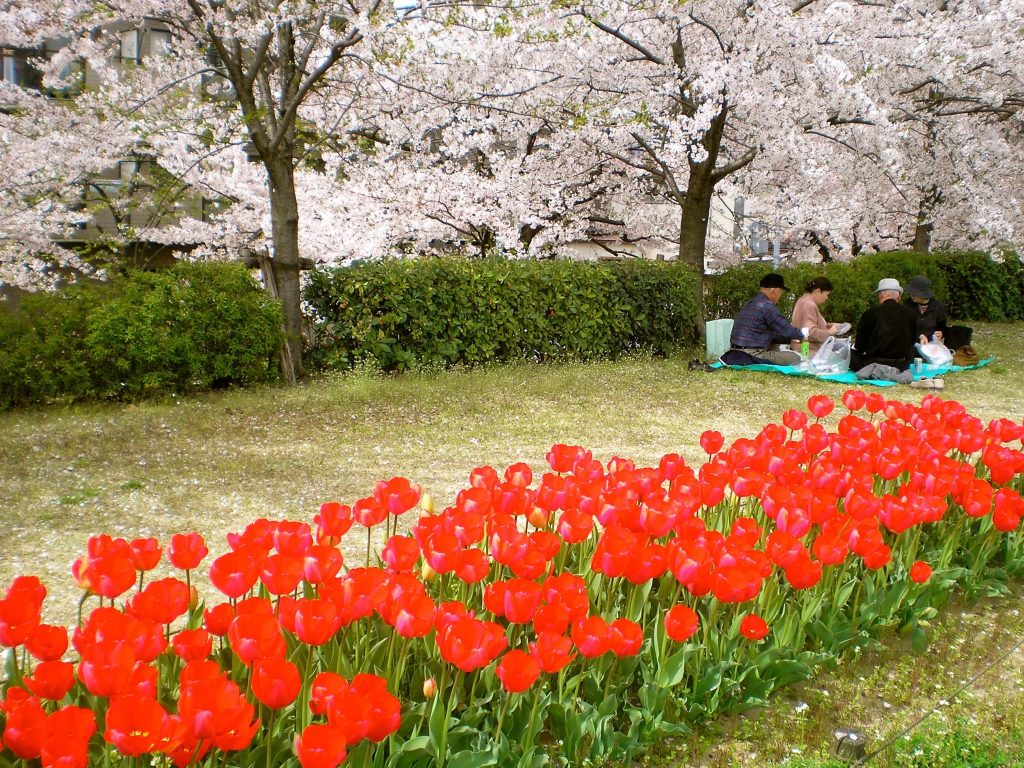
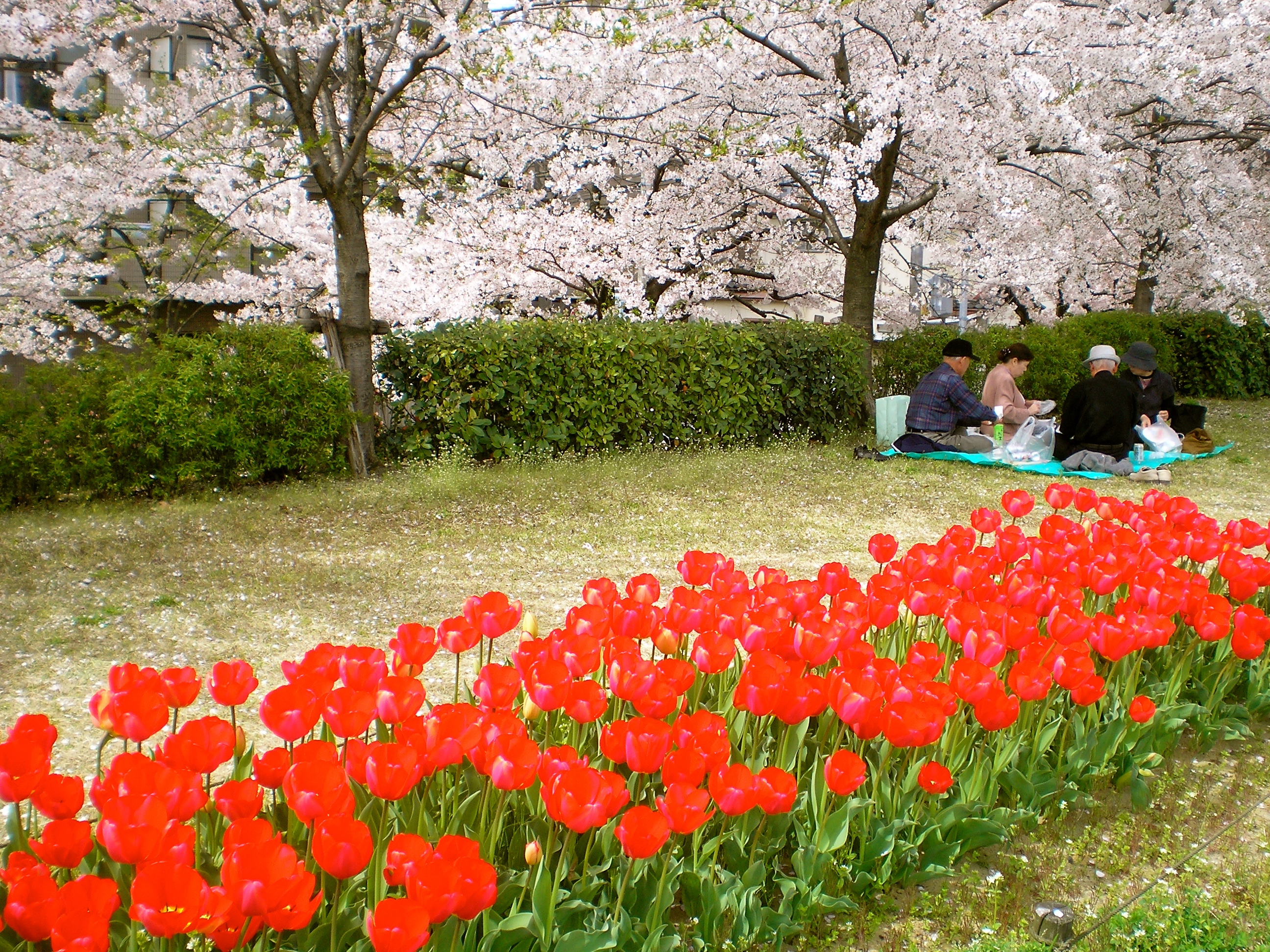
Ohanami party in spring (Niigata City)
Niigata is known for having the best rice and sake in the world. It’s relatively rural, although my city had over one million inhabitants. My students and the small group of gaikokojin (foreigners) were very welcoming. My company had arranged my housing and helped out with navigating municipal bureaucracies. For example, there were 7 regular types of trash, plus several more categories for uncommon items such as used batteries. They all had inscrutable labels, but learning that trash sorting system actually opened my eyes to how wasteful we are in the U.S.
I also admired how orderly Japanese homes and customs were, how graffiti was non-existent, and how even the (very few) homeless lived in immaculately constructed box homes with sliding doors and a mat to keep one’s shoes.
Japanese society is communal-minded, while Americans’ me-first mentality is reflected in our disrespect for public property, littering, and crumbling local transportation. We prioritize individuals over the group and although I’d learned about these two types of societies in college classes, experiencing them first-hand was transformative for my thinking. One of my favorite parts of living abroad was cultivating a new basis of comparison for everything I took for granted about people and societies.
In Niigata, I met my boyfriend Paulo, a Brazilian post-doc and oral-maxillofacial surgeon. He was also a talented musician and had learned much of his English from Bob Marley and Pearl Jam. He was finishing his program and heading back to Porto Alegre, Brazil.
I’d spent my last few months in Japan learning how to speak Portuguese so I could communicate with Paulo’s family, but before following him to South America, I wanted to explore Nepal and Southeast Asia with some of the money I’d earned. It had been years since I’d taken any serious time off of work or school and there’s a special pleasure that comes with full-time immersive travel with no definitive end.
I planned most of the trip on the fly and I’d recommend that others do the same. Being comfortable with the unknown and refusing to overplan my travel came with great rewards. The internet can only take you so far with the way it privileges certain content; for the best recommendations, it’s always better to ask around. For example:
I had no idea that my new friends on Nepal’s Annapurna Circuit would recommend a multiday trip down the Mekong River.
I had no idea my new friends in northern Thailand would recommend the Gibbon Experience, a series of ziplines between treehouses in the deep jungle and a non-profit that defends forests from slash-and-burn policies.
I had no idea my new friends in Angkor would recommend Malaysia’s gorgeous Perhentian Islands.
After this unforgettable trip, I set off for Brazil and traveled widely for many months while working remotely as a ghostwriter. Although that relationship didn’t work out, I was beaming with confidence after several years of living and traveling abroad.
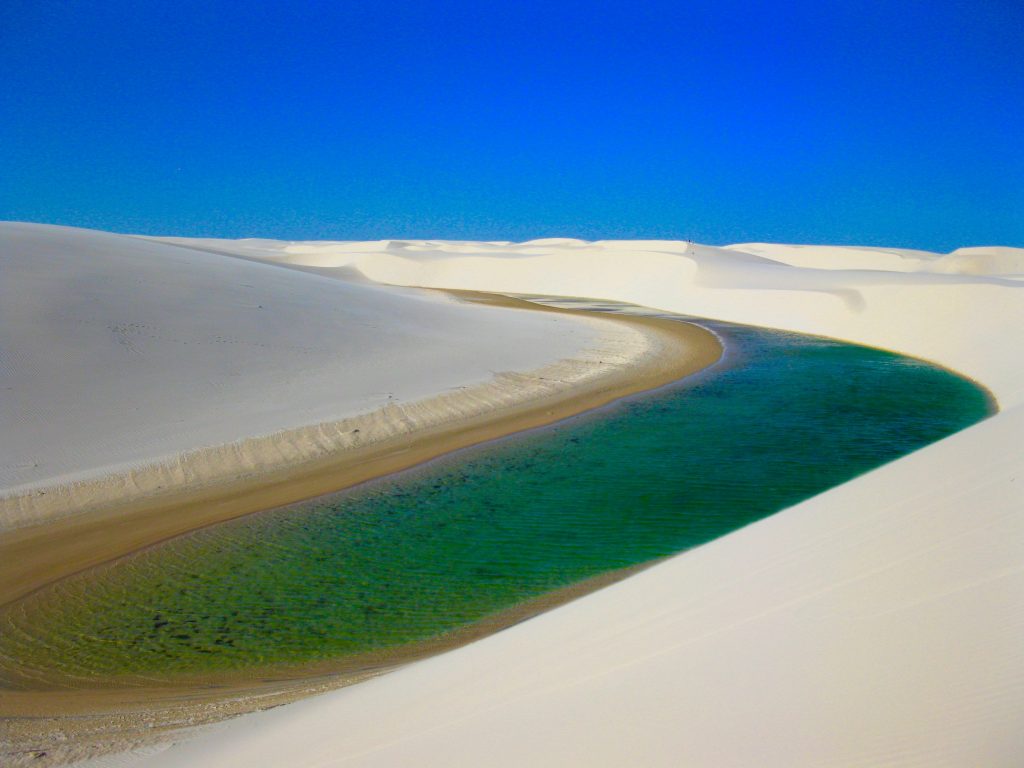
Lençóis Maranhenses, where hundreds of miles of snaking crystalline dunes collect fresh rainwater you can drink (northeastern Brazil)
In early 2010, I moved to my favorite U.S. city where most of my closest college friends had been working since graduation: San Francisco.
At that time, I worried that I’d forfeited several years of career growth for travel and it would take me a long time to catch up. And at first, this was true. For several weeks I slept on a friend’s couch until I found a waitressing job at a nice restaurant to get on my feet. A couple of months later, I found a job as an addiction specialist in a non-profit clinic, where I worked unhappily for a couple of years—underpaid and overstressed.
But then it happened: I secured a position as a managing editor at a Silicon Valley tech company and “caught up” to where I would have been career-wise if I hadn’t traveled at all. I’d kept up my paid and unpaid writing over the years and essentially was hired on my Twitter feed, blog, and ghostwriting samples.
That was seven years ago and I’m now the chief content officer of a company started by the same director who first hired me in the Bay Area. I work remotely, so while continuing to develop my career, I lived in Argentina for ten months and took a one-year road trip all over the U.S. with my now-husband to figure out where we wanted to settle down. (We bought a house in Eugene, Oregon a few years ago and still love it here.)
If I hadn’t traveled after my undergrad, I wouldn’t have developed the language skills, resilience, adaptability, deep knowledge of other cultures, creativity, conscientiousness, and professional confidence I have today. If I had jumped straight into graduate school, I would have developed an expertise, but having a niche—not to mention crippling student debt—would have only constricted my choices. For example, I’ve observed that many of my friends with PhDs end up taking positions in Bumblefuck, Nowhere (NO) for tenure-track positions. Nobody wants to live in Bumblefuck.
I encourage everyone—especially in their 20s—to work abroad and travel with abandon as much as possible before settling into a more typical path. It’s harder to wander in your thirties when parts of life have already ossified. That house, career, family, and graduate school can wait.
You’ll be much richer the experience because if I’ve learned one thing, it’s this: ditching life’s little road map shapes extraordinary people.
When I share my Great American Road Trip idea with people, I get this question more than any other. The short version of my story is that my lover-turned-husband and I took a one-year road trip around the U.S. to discover the place we wanted to call home.
Jon and I had burned out on living in San Francisco, where we had to sprint just to stay in the same place. Before leaving the city, he paid $1,600 per month for a single bedroom in a Fort Mason house in 2014. These days, it’s even worse and some of the world’s brightest people would gladly offer a pound of flesh to secure very basic accommodations in the area.
Not too long after we met in SF, Jon and I moved to Argentina together for ten months. I had just started working remotely for Sechel Ventures, a tech company based in the Bay Area, and Jon decided to finally write his novel,All Starships Go to HEAVEn.
After this experience living internationally, we knew we could thrive in a life on the road and we cooked up a dream: rather than letting our employment dictate where we would live, why not choose the city that felt right and go from there? What could be more important than loving where you spend your days?
We bought an orange Honda Fit, the “Fireball” and drove east from California for a cousin’s wedding in Fort Collins, Colorado—our first stop.
Before our Great American Road Trip, Jon and I had envisioned the features of our dream city. We wanted:
A progressive college town with plenty of hiking and camping nearby
Ubiquitous bike lanes and ample bike parking
Nice, non-pretentious, diverse people
A cute downtown with murals and tangible artistic energy
A world-class craft beer scene
Local leadership we could trust to make decisions as we would, being thoughtful about new developments, supporting public education and health, making recycling a priority, and fostering a vibrant environment for creatives
A place that wasn’t quite on other people’s radar
In other words, we wanted a really great party before everyone had arrived. We had our work cut out for us.
Gorgeous Mural By Rachel Wolfe-Goldsmith in South Eugene
During our Great American Road Trip, we went through 25 states, hitting as many National Parks as possible and staying mainly in AirBnBs. While most hotels have the same predictable sterility, the most highly rated AirBnBs are created with pride and reflect specific tastes, hospitality, and culture. They’re a glimpse into a community’s way of seeing the world, and the amount of care these hosts put into their home’s amenities and local recommendations is moving—it reminds me that we all crave human connection and the opportunity to help others. The rewards of being a good person tickle our chests and bring a warm glow to our heads. And nowhere did our chests tickle and our heads glow more than in humble, magnificent Eugene, Oregon.
Since there weren’t many AirBnBs around, I’d found a three-week sublet on Craigslist in south Eugene. The tenant, Rachel, who had grown up a few hours away in Hood River, was teaching English in Japan for the summer—coincidentally near Niigata, the city I’d lived in for over two years in my early 20s. She loved yoga, gardening, and something called “ecstatic dance.”
Before we sent her our payment, she texted a considerate video message. She was wearing brightly colored athletic gear and a welcoming smile.
“Hi Jocelyn and Jon! I wanted to give you a feel for the place. Right now, there’s a bit of construction going on since the owners are building some new cottages.”
She panned the camera over new concrete foundations and piles of dirt.
“The workers don’t get started too early, but I just wanted to let you know there may be some noise. Thank you for reaching out and I hope this works for you!”
We arrived several days later to meet Rachel in person. Her cottage was spotless and had several Japanese tapestries adorning her walls.
One of the first things she said to us was, “I feel very comfortable having you in my space. I’m happy you contacted me.”
After giving us a brief tour, Rachel grabbed her bags and headed out toward her car.
“One more thing,” she said, handing us the keys with a smile. “The Saturday Market is downtown today. It’s a longstanding Eugene tradition and you should check it out. The bike path will take you most of the way there.”
She pointed to a paved treelined path, waved goodbye, and headed to Portland to catch her transpacific flight.
After unloading our backpacks, we removed our bikes from the back of the Fireball, unfolded them, and set off north toward downtown on a protected bike path far removed from any cars.
After passing under a tunnel along a rushing creek, a large, grassy park with a short fence emerged on our left with dozens of happy dogs chasing each other at full speed or cooling off in one of the four kiddie pools around the perimeter.
On our right, skateboarders ollied from the kicker of a large kidney bowl with colorful graphics. It was flanked by large trees and more grassy open space. We passed joggers in bright clothes and sunglasses as we rode by the Amazon Community Center and Pool. We continued along the smooth asphalt and the brand-new athletic fields of Roosevelt Middle School rose from the right.
We got to our first road and cars on both sides stopped immediately to let us cross toward South Eugene High School—one of the best public schools in the state—with its football field, volleyball courts, modern architecture, and small parking lot surrounded by trees.
After nearly 14 blocks of a carless path straight out the door of the sublet, the road opened with a separate bike lane heading north on High Street, which would take us the last ten tree-covered blocks toward downtown.
After years of biking aggressively through San Francisco, I noticed how patient Eugene drivers were. Pedestrians, runners, and cyclists seemed to rule the roads and nearly every street had a bike path and signage reminding cars to watch out for us.
Eugene was also the greenest town I’d ever seen. It’s surrounded by verdant Douglas firs, maples, pines, oaks, junipers, and alders. The city streets are lined with apple, plum, cherry, and chestnut trees. Almost everyone farms or gardens, and the saying goes you can throw seeds anywhere and they’ll just grow. The moisture, rich Willamette Valley soil, and healthy ecosystem support thousands of native (and non-native) plant species.
Fern-filled Mount Pisgah Trail
When we hit downtown, we saw large crowds of people walking west toward an open marketplace with white canvas overhangs. There were bike racks everywhere, so we locked up and headed into the throng.
The countless stalls stretched out several blocks, overflowing with colorful pottery, jewelry, clothing, greeting cards, leather goods, and paintings, as well as fresh meat, local cheeses, fruits and vegetables, flowers, plant starts, and and a local brewery cart. The central courtyard hosted several ethnic food areas, bakeries, and coffee shops. A small stage in front of long, communal tables thrummed with psychedelic rock, as people of all ages bobbed their heads while dining on kabobs, burrito bowls, and Thai stir-fries.
The Eugene Saturday Market is held downtown every Saturday from April through November. It started in 1970, and now hosts around 150 vendors, who migrate indoors in December to the Lane Events Center—the annual “Holiday Market”—adding several artisans from around the state and country for full weekends. There’s one main rule: the people selling the goods must have harvested or made them.
Our First Saturday Market in Downtown Eugene, 2015
I’d enjoyed plenty of farmers’ markets, craft fairs, and other non-traditional shopping experiences around the world, but I’d never seen anything quite like this.
First of all, Eugenians looked very different than people from other cities. Most women wore their hair very short, very long, or asymmetrically. Bright colors mingled with earth tones, tattoos covered exposed skin, facial piercings abounded, and elaborate metalwork clung to the earlobes and collarbones of men and women alike. I noticed lots of hippie dandies, brown leather boots, Ducks gear, and neon athleto-leisure wear from North Face, REI, and Patagonia.
The people also acted differently. There were no hurried, tunnel-visioned pedestrians wearing ear buds. Everyone’s gazes were up and their defenses were down. They were engaging with the flesh-and-blood world, acknowledging others in the present, seemingly unconcerned about the future. The collective hive was positively mindful, which felt foreign and anachronistic. It was as if I’d unearthed a secret world of old-timey neighborliness, an impression that was confirmed when we rode our bikes back.
Unbeknownst to Jon and me, Kathie and Eric Lundberg (the owners of the Amazon Cottages development where we were subletting) had sent an email blast to the community asking everyone to say hello and welcome us during our stay. Residents came to the cottage to introduce themselves with handwritten notes; bushels of fruits, veggies, and herbs from their gardens; and fresh-baked breads.
Who does that? Like many twenty-first century city-dwellers, I’d never spent much time with my roommates—let alone my neighbors. Nobody in San Francisco seemed to forge relationships with people living on the same block. People were just too “busy.” This city is so goddamn neighborly that four-way stops frequently inspire an awkward dance of driver smiles and friendly hand-gestures.
For the following three weeks, we explored towering waterfalls, old lumber roads leading to stunning vistas, meadows of wildflowers, and the forested cliffs along the jagged Oregon coastline with its powerful surf. We enjoyed the U of O campus, live music, downtown art installations, world-class wineries, and family-friendly breweries.
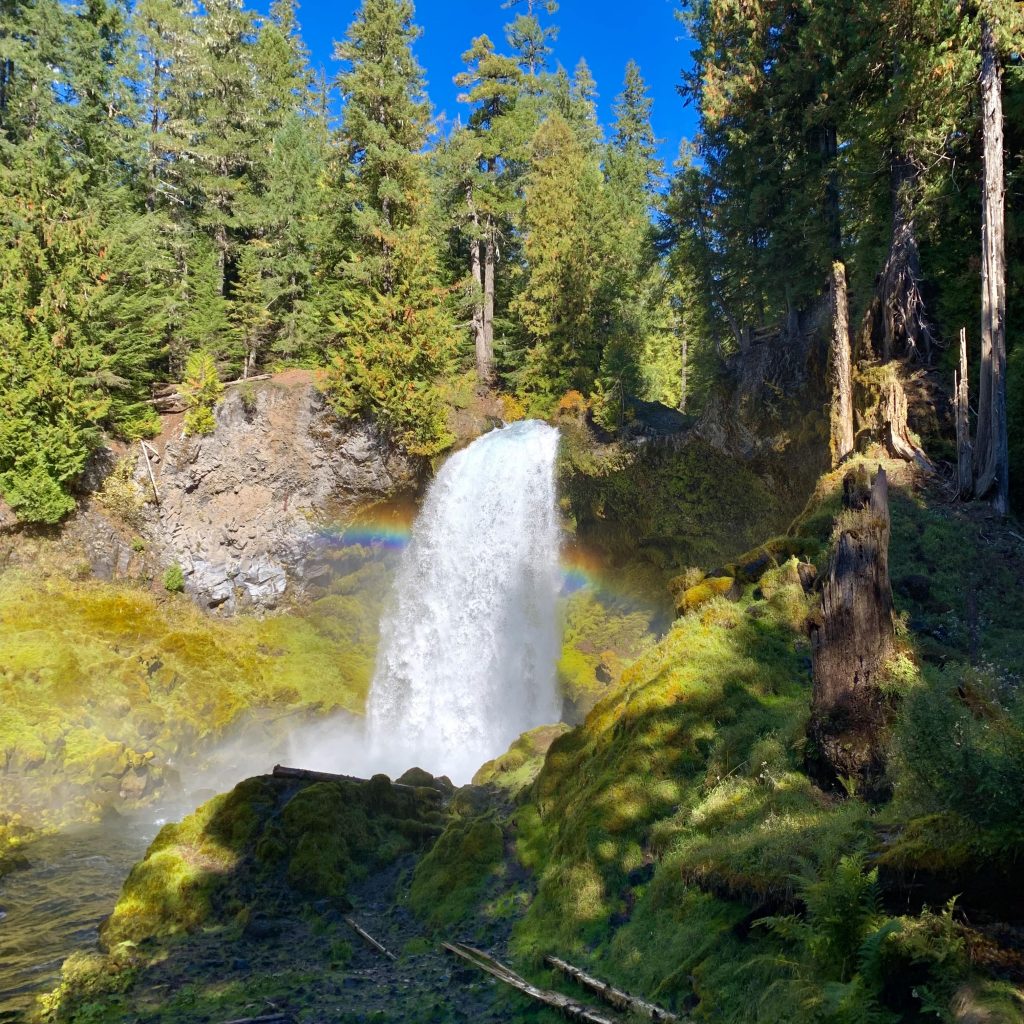
Stunning Silver Falls State Park
Everything felt accessible, non-pretentious, affordable, creative, natural, and genuine. When we shared our story and mentioned that our next stop would be Bend, most locals told us we’d like it much more than Eugene.
Our last day in town, we rode our bikes across the Willamette River to the annual Art & Vineyard Festival, which attracts artisans and winemakers from all over the state. It was the Fourth of July and we happily discovered that fireworks laws are much looser in Oregon than in California. A rock band played 70s and 80s classics as Jon and I drifted between the craft stalls, beers in our hands.
Our mood was bittersweet. We’d enjoyed an unforgettable few weeks in Eugene and cooked dinner for Kathie and Eric Lundberg the night prior, finding them to be kindred spirits and people we’d love to call neighbors. They were among the people who believed Bend would be a better fit for us “big city” California folk with its art galleries, wealth, collection of fellow transplants, and most of all, its rumored 300 days of sunshine.
The following morning, we left Eugene with open hearts and minds, excited to reconnect with my old college friend and his family, who had graciously offered to let us stay at their house along the Deschutes River while they took a summer trip.
The drive to Bend along the McKenzie River and through the winding Cascades is spectacular. The west side of the mountains is lush with ferns and small roadside waterfalls. It’s often raining until the zenith of mountain pass, which makes way to a much sunnier, drier landscape in the east.
Bend was just as everyone had described it: manicured, naturally beautiful, and replete with wealthy young families—many of whom I’d wondered how they’d made their money. It reminded me of Aspen or Laguna Beach—nature- and outdoor sports-loving towns with well-heeled smiling white people. They had a carefree country club saunter and a zeal for new bistros and yoga studios.
Bend is a lot of people’s idea of “making it,” but it wasn’t ours. Eugene is much rougher around the edges. For one, it has a serious homelessness problem and attracts a lot of runaway youth. Some are inspired by the city’s history of celebrating rebels and eccentrics. Ken Kesey, author of One Flew Over the Cuckoo’s Nest, was from this area and his “Merry Pranksters”—many of whom still live in Eugene—were immortalized in Tom Wolfe’s The Electric Kool-Aid Acid Test.
The city also has a lot of support for people who have fallen on tough times, including a free luggage/backpack storage by the bus station and the White Bird Clinic’s medical, dental, and psychiatric services. Eugene even pioneered the CAHOOTS (Crisis Assistance Helping Out On the Street) program—a mental health group dispatch used in place of the police when appropriate—which was recently celebrated in The Wall Street Journal for saving the city money and being more humane.
Eugene’s Immaculate Downtown Bus Station
Eugene emits love and compassion, and you can practically hear the city’s heart beat. People understand that taxes are integral to the future of their children’s education, their family’s healthcare, and their community’s infrastructure and culture. Similar to many Oregon towns, it’s fiercely protective of its forests, lakes, and rivers. Promoting a green economy, protecting endangered species, preventing overfishing, recycling, and sourcing food sustainably all rank highly among people’s civic priorities. People are unhurried and generous, and I can trust a majority of the city’s leaders to promote policies I support: a more humane criminal justice system, funds for the arts, and thoughtful land use, among many others.
In 2017, we bought a house in the Amazon cottages community where we first subleased, and last year, I married my lover at the local Sweet Cheeks Winery.
My fiancé Jon and I have spent the past eight months exploring the US, deciding which outdoorsy small town we want to call home.When my friends inquire about the curious American subcultures from our travels, one place sticks out in my mind like a giant bovine erection: welcome to Hurricane, Utah…the gateway to Zion National Park.
Pronounced “Hur-a-kin” by the locals—an effort to mimic the accent of early settlers from Liverpool—this Mormon mecca was established as part of Brigham Young’s program to bring agriculture to southern Utah. It remains today one of the more conservative towns in the state, a refuge for Colorado City defects and a polygamy-friendly community.
Jon and I wandered the aisles of Davis Food & Drug at the perimeter of town, observing a group of four women in dull pastel ankle-length dresses who were discussing the menu for their 15 children. Lone men in collared shirts spoke of “bleeding the beast,” code for collecting welfare to make the US government atone for its sins. Two blonde teenage boys in overalls walked into the grocery store and spoke slowly with glazed eyes. I realized that their dreamy remove wasn’t influenced by booze or pot like normal kids their age: they were simply sheltered to the point of dullness. And everyone in Hurricane spoke this way, as if through the fog of an all-consuming ideology. Yes, the community was impeccably clean, safe, and replete with law-abiding drivers, but something seemed amiss in the uncritical constitution of this population. That was until we met Steve Ward, of course: the swashbuckling, tattooed owner of Barista’s restaurant.
While driving into Hurricane, we hadn’t even realized that we’d passed the most controversial establishment in all of Utah. From the distance of a half-mile, a towering pedestal at the center of town came into sight. As we got closer, we could make out the silhouette of a giant animal. And finally, it became clear. The tallest structure in Hurricane, UT was a marquee with a gargantuan copper sculpture of a bull. And this wasn’t just any bull: this animal donned a magnificent, conical cock with pendulous testicles. Try to imagine this sculpture at the center of a very conservative, very Mormon town. Did I mention that this is across the street from the local high school?
We arrived at our AirBnB, and were immediately warned about Barista’s. Mary—our lovely and piously Mormon host—told us to avoid the place at all costs. While giving us a tour of the sparkling apartment adjoined to her home, I took note of maudlin wall-hangings with phrases like “Once in our home, always our friends.” Her graciousness did not extend to Mr. Ward, however, the town’s most infamous business-owner. She cautioned that not only were Barista’s prices astronomical, but Mr. Ward was a brutish misfit who should be ejected from the community. I decided to investigate the place online, and was delighted to have stumbled upon not only an impassioned local controversy, but also upon some of Yelp’s most entertaining reviews in the country.
I kicked off my research with an article from the Spectrum (March 2015), which reported that the citizens of Hurricane had gathered 600 signatures to shut down Barista’s for “unscrupulous business practices and a hostile attitude toward patrons.” Steve Ward countered that the residents of Hurricane were “haters” and he wasn’t going anywhere. He added that, “The reason [the citizens] don’t like the bull is because they know it’s beautiful and amazing.”
Michelle N. (Fahy, Ireland): Horrible service. Despicable, disrespectful, jerk of an owner.
MK (San Diego, CA): I would rather get anal warts than eat here. Avoid this restaurant at all costs. Food tastes like it was made with horse shit that was fermented in the expired beer that they serve.
Lane R. (Salt Lake City, UT): The owner came out of the kitchen and told me to “get the f#%* off his property.” Then he physically threatened me. Weird. Very weird. Do yourself a favor… DON’T
Jamie Kay DeWitt, a local in Hurricane, posted screenshots of some sophomoric exchanges she’d endured from Barista’s Facebook manager:
Most curiously, St. George News reported that Barista’s had removed the large member from the copper bull in March of 2015. The young news anchor said solemnly, “The penis has drawn national attention for the controversy stirred over its rather large size.” For the next month, the bull cock was proudly on display atop Barista’s bar counter. My takeaway from that article was Steve’s wife Pam Ward exclaiming, ”We will be here”—and here she banged the table—”until”—bang!—”the day”—bang!—”we die.”
One month later, Death and Taxes (April 2015) declared that the castrated bull had its penis reattached, and Steve Ward proclaimed, “I’ve got people coming from all over the world and they’re like, ‘Where’s the penis?’ I’ve got people coming from North Carolina, I’ve got people from China…I put the dick back up for my customers because they want the dick. My customers like dick.” Even the LA Times (June 2015) got in on the action at this point, and we learned that Ward had spent $130,000 on this irreverent local icon.
Needless to say, I resolved to meet Steve Ward while we were in town. I arrived at the restaurant, marveling at the bull’s controversial member from every angle, and was met by this family-friendly marketing at the front door:
Notice how the picture with young Camile Vera from Baha [sic] California was posted around the same time as the reattachment of Hurricane’s infamous penis in April 2015. I moved to the side of Barista’s and was greeted by a woman in daisy dukes telling me cutely that I must “Enter in rear.”
I dutifully entered Barista’s rear, and there he was: Steve Ward in the flesh—the veritable don of national controversy. I only wish I’d gotten a better look at the phrases tattooed across his forearms as he sauntered to my table. After examining the beer list, I asked, “How did you secure a license to serve beers over 4 percent?”
For those of you who haven’t been to Utah, they have some unusual liquor laws to accommodate their Mormon ancestry. First, there’s the “Zion curtain,” the omnipresent bar rule which shields vulnerable patrons’ eyes from the process of pouring alcohol. That’s right: in Utah, if alcohol is served, it must be poured behind a barrier. People can drink booze and even order a “side car” of liquor if they want to make a drink a double, but Utah’s citizens aren’t adult enough to witness bartenders in the act of pouring alcohol. Second, beers from Utah are predominantly 4 percent alcohol and under, even more traditionally heady brews such as IPAs.
It seemed a mystery that Barista’s was serving beers over 4 percent, and so I inquired about the licensure. Without cracking a smile, Mr. Ward leaned in conspiratorially and whispered, “I had to take the town mayor into the alley and rough him up a bit.” Not skipping a beat, I cleared my throat and said softly, “I think I read about that exchange in your Yelp reviews.” Mr. Ward laughed like a stoned schoolgirl and took my drink order. Given Barista’s reputation for serving expensive, subpar food, I’d resolved to make this a drinks-only occasion.
There were three other tables sitting in the restaurant. Steve Ward posted up in a central location, scanning the room. He proceeded to shout at my fellow diners across the room,“Hey! Yeah, you three. Do you need anything…? You good? Ok. Cool…What about you over there? Yeah, you… You cool? All right.”
I’d never witnessed this peculiar strategy of customer service. Efficient? Yes. Disruptive to diners? Absolutely.
He returned to my table with a non-apologetic grin and put my first real Utah IPA in front of me. Although it tasted expired, I thanked him politely and asked where he was from originally. He leaned in, his sour breath stinging my eyes, and muttered with a wink, “I’ll tell you later back at my estate…” I abruptly declined the invitation, and Jon came in shortly afterward. Not surprisingly, the dynamic changed once my fiancé was present and Stephen Ward suddenly was all business.
A few weeks after this encounter, I wonder how long Barista’s will endure and whether they’ll be forced again to castrate the copper bull to appease local sensibilities. What Hurricane’s residents didn’t seem to appreciate is that Steve Ward’s transgressions gave that community their bogeyman, a figure against which they could define their own values in opposition. As much as the glassy-eyed blonde teenagers at the grocery store didn’t seem to know life outside of their town, the area was given purpose and meaning in organizing against a local business owner who didn’t fit their mold. More than anything, I wonder what Steve Ward gets out of it. Sure, Hurricane is situated at the base of Zion National Park, and sure, Steve’s family once owned a hotel in town, and sure, Ward claims to be worth $2.8 million as a result of his business (St. George News, “No Filter” April 2015). More than anything, I think Ward gets off on being the local contrarian who is pushing that ossified Mormon community into the realm of 21st century sex and ostentation. Whatever the outcome, he’s leaving an indelible mark on Hurricane, UT and continues to thrive as an antihero. At the very least, he’s ridden his copper bull into my archives of American countercultural history.
San Martín de Los Andes—a remote village in Patagonia and my home for the past five months—defies description. I’ve puzzled over this opening sentence for the past 10-15 minutes, trying to pin down this place’s character and even in my native language, I’m like a stuttering teenage boy in the presence of divine beauty, afraid of assigning merely secular words to such majesty. And this is from someone who has lived on four continents and traveled throughout the world for the greater part of the last 10 years. There’s no denying I have a healthy basis of comparison, and there’s something ineffably special about this Swiss-style town replete with chocolate shops, cervecerias, and artisan craftworks embraced by an amphitheater of lushly forested mountains along the eastern finger of a beckoning lake. And that’s only the beginning.
San Martín de Los Andes, Thank you Google Maps
San Martín’s most prominent feature, the Lago Lácar, flouts categories of color. Like an iris, the lake sways from raincloud gray to milky turquoise depending on the light and the wind. The town bus terminal is one block away from the beach where men sweat through 5 v 5 soccer, and today, the water is donning her finest military blues. It seems a fitting tribute to José de San Martín—the Argentinian general from whom the village derives its namesake—a demigod who liberated much of South America from the Spanish colonizers in the 19th century. The sun ricochets off the water like stray bullets off a decorative shield, and it’s as hypnotizing as watching fire. Above Lácar rises a forested skyline—a voluptuous woman of trees laying in repose on her side—and even in the dead of this July winter, people fill the lakeside benches to talk, picnic, and sip on hot yerba mate.
It hasn’t all been Malbec and roses, though. I was here during a natural disaster that made international news.On the evening of April 22nd, 2015, the Calbuco Volcano erupted casting a thick plume of ash over San Martín from over 100 miles away.
Calbuco Volcano, April 2015
At 11:00 am the next morning, it was still pitch-black outside, and it was difficult to breathe. I checked all of our timekeeping devices thinking there must be some kind of glitch in the Matrix. How could the sun still not be up when it was nearing noon? In fact, all of the sun’s rays had been blocked out by an opaque cloud of particulate matter that was steadily blanketing everything in sight. In the words of my boyfriend, “This is some biblical, Armageddon shit!” Indeed it was, and it’s been the only day in my life that I feared the sun would never rise.
Before and after the Calbuco Volcano eruption, April 2015
The community, however, faced the challenge with aplomb and immediately began clearing ash from the streets. The volcanic substance, also referred to as tephra, is supremely absorbent and becomes so heavy with water that it’s been known to collapse houses. It’s important to clear it quickly, especially from vulnerable rooftops.
All of this was explained to me by the town’s many seasoned volcano professionals. I learned that in 2011, the Puyehue Volcano—this one much closer than Calbuco—erupted and suffocated the area in meters of ash…meters…forcing the closure of the area’s largest airport in Bariloche for over a year, a devastating blow given the area’s heavy dependence on tourism. Can you imagine wading through waist-high volcanic ash? In 2015 however, the sun did rise on April 23rd, and the townspeople filled the streets donning colorful bandanas over their noses and mouths, laughing at how mild this was compared to the last eruption.
Since this was my first brush with a volcano, I had no idea what to expect. Friends on Facebook witnessed the death of technicolor in my photos during those first few days, and lamented that, “All of the birds and animals are going die!!! So sad.”
Roses dusted with volcanic ash, April 2015
Well, I didn’t really believe that, actually. This was certainly no 79 A.D. Vesuvius, and although I was worried about the airport being open in time for my best friend to visit the following month, I remembered how other volcanically active regions not only survived eruptions (e.g., Hawaii, Indonesia, Naples), but thrived in their wake. To that point, it’s been nearly two months since Calbuco blew its impressive load, and new plant growth is everywhere, nourished by the fine minerals of the tephra which will continue to cultivate new life for years to come. Nature’s not-so-subtle changing of the scenes, this time with a happy ending.
Speaking of life, did I mention that this area is a bird-watcher’s wet dream? I learned that three biogeographic regions converge here—Andean forests, high mountains, and Patagonian steppes—each with distinct avian species. In fact, S.M. de Los Andes hosts the annual South American Bird Fair in November, the premier event of its kind on the continent. If you’re like me, you can identify maybe a handful of birds including common seagulls, pigeons, and pelicans, but let me tell you: there exist citizenries of strange, feathered creatures I’d never imagined. There are spring grass parrots with fire-engine red bellies which create jubilant flash-mobs of squawking;there are tall, gray and yellow birds with footlong beaks which irrigate verdant lawns with their worm-prodding; and there are brown sparrows the size of soccer balls which dig through trashcans and shriek when startled. I am no bird-watcher, but even I took notice of the chirping, trilling, twitter of the village’s omnipresent avian choir.
Patagonian parrots, Downtown S.M. de Los Andes
Birds haven’t been the only ones to treat this area as a sanctuary. Before becoming San Martín, this area served as a winter refuge for the Puelches, an indigenous tribe that raised horses on the eastern slopes of the Andes. In 1898, it was taken over in a territorial dispute between Argentina and Chile, and various settlements and agriculture began to sprout along the lakeshore. In 1937, Lanín National Park was created, stymieing development and protecting the natural environment for generations to come. That early preservation of this region in Patagonia is the reason it still feels unadulterated more than a century after its founding.
I have yet to speak to the village’s most impressive feature: its societies. And I use the plural of the word intentionally. Sure, San Martín boasts impossibly friendly human inhabitants, but there are also roving gangs of healthy mutts and cats everywhere. It’s not uncommon to see a pack of five collarless dogs racing euphorically up and down the sandy lakeshore. I contrast this with what I witnessed in Mexico or Nepal, for instance, where ownerless animals were normally sickly, losing fur in patches, depressed, and malnourished. But not in this Patagonian Shangri La for domesticates. Here, the dogs and cats are affectionate, rock vibrant coats, and don’t live in need, even if some of the long-haired dogs have dreadlocks around their hindquarters which bob—rather adorably—as they frolic. The thing is that there’s abundant fresh water at the lake, kind people, and enough organic compost from Argentina’s legendary “asados” (barbecues) to feed them. I’d never lived in a place where salubrious dogs and cats roamed as free citizens.
Lago Lácar, one of the local canine citizens
And finally, the human society. Here’s a recent story which sums up the bonhomie of San Martín for me: a pair of Belgian filmmakers, Paulina and Damien, were here last month collecting footage of grassroots communities. They were on a budget, and decided to stay with our dear friend Daniel whom they’d found through Couchsurfer. Their first night in town, Daniel put together a dinner party and prepared “carne relleno,” a thick, tender steak wrapped around garlic and red peppers, salted and baked in a decadent red wine broth. The dinner party raged past 3:00 in the morning—as many dinner parties do here—and it slipped out that Damien’s 30th birthday was two days later. Wondering how we could make it special for our new friends, we rallied a group of 10 and hosted an epic asado to celebrate. Everyone played instruments and feasted on tender meats, fresh bread, and birthday cake from an awesome local bakery. Now that’s the type of community I want to be a part of: one where strangers can roll into town and have a barbecue thrown in their honor two days later, as if among old friends.
For me, a person who has lived wandering from country to country for years, it’s the first time I’ve really felt at home anywhere since fleeing my mother’s coop. The Argentinians have a phrase that sums up the kindness and warm cheer of the people here: “re buena onda,” or very good vibes. I’m grateful for the buena onda here and I’ll do my best to pay it forward.
Thank you, San Martín de Los Andes. You’re hard to leave and impossible to forget.
NOTE: Scroll down to the last three paragraphs if you’re pressed for time and want to know why Argentina does medical care better than the United States. If you’re interested in the arresting tale of this bloody shirt, enjoy the ride.
Last Saturday, Jon and I went to El Catedral de Almagro, a dimly-lit warehouse with antique furniture, high ceilings, and abstract artwork. The corrugated tin walls, barrel tables, and huge papier-mâché human heart suspended above the bar lent the space a unique vibe, and the tango-savvy crowd felt right at home. Every night, El Catedral invites people for lessons in the national dance of Argentina. Jon had promised that we’d learn before leaving Buenos Aires, and we’d loosened up our limbs with a couple of cheap bottles of wine before hitting the dance floor.
A live band complete with an upright bass, a cello, an accordion, several guitars, and a piano took the stage just after 1:00 am. Parties in Argentina don’t get going until the early hours of the morning, as people are prone to eating dinner around 10:00 or 11:00 pm. Jon and I conversed with travelers from Switzerland and Germany, and the crowd began to thin out after the band finished around 2:15.
We were across town from our apartment in Belgrano, but we had our bikes for us waiting outside. Traffic was sparse at this late hour and it was a balmy 80 degrees.
We didn’t realize it at the time, but we started heading out in the wrong direction, and before long, Jon had gotten too far ahead of me on Rivadavia Avenue, a relatively busy thoroughfare with no bike lanes. I accepted that I was completely lost and figured I’d just meet Jon at home, asking passersby the general direction of Palermo, a neighborhood with which I was more familiar and felt confident I could navigate. After about 25 minutes of following the advice of these kind, inebriated strangers, I’d found a familiar path which I took all the way northwest, back to our Belgrano apartment.
I walked in expecting to see Jon with his feet propped up on the table, maybe enjoying an episode of M*A*S*H* or a TED Talk on paranormal activity. To my surprise, the apartment was dark and empty. It was 3:15 am.
I took a quick shower as relief from the heat and sticky exercise, and when I emerged, there was still no sign of Jon. The clock hit 3:45. I walked out onto our balcony to look up the street, and checked on a baby pigeon in a nest to the left of our bike storage area. As usual, the neighbor’s cat was eyeing the little bird, but had never mustered the courage to jump the gap which was two stories above the sidewalks below. I tried to read, but my mind kept drifting as I looked up and down the streets. By 4:30, I decided to check out the route from El Catedral on Google Maps. I’d figured he’d probably gotten a flat tire and had to walk the rest of the way. Once I determined that the entire journey was projected to take less than two hours on foot—and this was by the hypothetical “Google walker” who was no match for Jon’s rapid ambulation—I began to get worried. Ok, not just worried. I panicked. It was 5:15 and the sky was starting to get light, and there was still no sign of Jon.
I ran downstairs to speak with the security guard of our building who tried to assuage my fears. We jointly made a plan to call the police at 7:00 am if Jon still hadn’t turned up.
It was 6:10 and the sky was brightening. My imagination visited all of the usual dark places of an ambiguously bereaved (and hysterical) girlfriend. Accident. Robbery. Kidnapping. Senseless beating or murder. Leaning over the banister, I finally spotted a figure making haste toward our building. He was tall, wearing a blood-spattered white shirt, and walking a bike. I ran downstairs to meet him.
Here’s what happened: after we’d gotten separated on the journey home, Jon had hit a pothole on his bike which threw him over the handlebars. His chin, taking the brunt of the impact, had split open as he hit the ground, and he also sprained his right wrist. His arms were covered with nasty cuts and contusions. Two witnesses called an ambulance which drove him to the hospital. When he arrived, medical staff asked for only two things: his name and his age. They stitched up his chin and treated his wounds for free. In the United States, this treatment could have cost him over $3,000. According to the New York Times, it can be over $2,000 for three stitches and around $1,000 for a short ambulance trip, a ride that was free 30 years ago, even when wounds aren’t life-threatening. In fact, if we were at home, I would have considered taking a needle and thread to him myself, or calling one of my friends who’s a doctor.
The thing is that medical treatment is free in many countries, developed and developing. A friend shared with me recently that in his home country of Brazil, medical staff won’t allow people to leave before they receive the treatment they need, free of charge. It’s a proactive view of health that makes people more likely to get the care that keeps them healthy and productive. Many Americans can attest that in any medical situation, emergency or not, even the case of the insured, the first question isn’t, “How can we get this person the treatment they need immediately?” The first question is often, “What will this cost and will my insurance cover it?”
That is not the kind of country we should be.
Solution: This is a no-brainer. Medical care is something that everyone needs in their lives and shouldn’t be performed for outrageous profits. If a hospital in Argentina can give a man an ambulance ride and medical treatment for free, emergency rooms in the U.S. should be able to do the same. This isn’t a radical idea. It’s the humane thing to do.
Take a stroll through any urban district in the United States and you’ll find abundant evidence of a mass disrespect for shared, public facilities and areas.
Our subways, busses, and building facades are often covered with graffiti and filth.
Gutters are clogged with trash and refuse.
Public libraries are sometimes the only option for the homeless seeking a place to bathe.
Many children view public school as an obnoxious necessity rather than a privilege and disrespect the classrooms, books, and teachers that serve them for low pay.
Public institutions have a reputation for being inefficient and the officials are often characterized by malaise rather than pride in one’s community.
Everywhere you turn there are examples of Americans simply not treating their public, shared space with any measure of care or reverence.
In my opinion, there is a fervent individuality, a “me-first” mentality that pervades the American conscience and makes it difficult for us to think in terms of the collective good. My mother told me that littering used to be an even bigger problem in the 1970s and 80s, and at least by that measure, Americans have improved. It’s generally condemned to throw one’s trash on the ground, but there are many other ways we can refine the cleanliness and care of public space and institutions.
I found that a communal mentality is endemic to the Japanese people, both in their personal groups and with respect to public space. They are continually aware of what is best for the larger good, what is best for the group. It is uncouth and unusual for people to act selfishly or without regard for the rights of others. As a result, the streets and public transportation are efficient and clean; graffiti is rarely a problem sparing a few non-conformists; there’s a generalized respect for education and the role of public school teachers; and public services are carried out with care and pride in one’s community.
I lived in Japan for two-and-a-half years, and there were several instances where this communal consciousness became readily apparent. The most obvious example, of course, is the Japanese tradition of removing one’s shoes before entering another person’s home. There are some restaurants, dressing rooms, and temples which also have this policy, and the message is the same: I will remove my shoes out of respect for this space to keep it clean for others. Japanese schoolchildren contribute to the cleaning of their classrooms and take up chores collectively. This ritual not only promotes a communal attitude in the completion of a shared task, but also teaches children that shared space is to be kept clean and respected. There is no better illustration of this public-mindedness than sharing a meal with Japanese people. First of all, it is a custom for someone else to always fill your cup. If you are eating with Japanese people and are sharing a pot of tea or a carafe of sake, your dining companion will ensure that your cup remains full. Also, when the food is eaten family style, nobody will take the last bite of anything.
The most heartwarming (and heartbreaking) of these instances, however, was with the Japanese homeless. I should note that homelessness is not nearly as big of a problem in Japan as it is in the United States, and most people who do live outside have some form of mental illness. In Niigata City where I lived, there were a few homeless people who took up residence in the train station walkway elevated from the road and protected from the rain. Each person had a clean, well-constructed cardboard box home with a sliding door. These people would always leave their shoes outside of their box before entering, and would never disturb anyone passing through the train station. It was amazing that even the most destitute of people constructed their living quarters so as to not impose on the public, as if anything less would be undignified, unseemly, and collectively irresponsible. Despite their poverty, there was respect for shared space and an awareness of others.
Solution for the U.S.: We need to get our children more involved in the consciousness and maintenance of public space. Whether it’s a park or beach cleanup, repainting graffitied walls, tracking one’s carbon footprint, or spending more time at centers of communal activity (e.g., libraries, civic organizations, universities), there are many ways to ensure that future generations exercise a greater respect for our shared facilities.