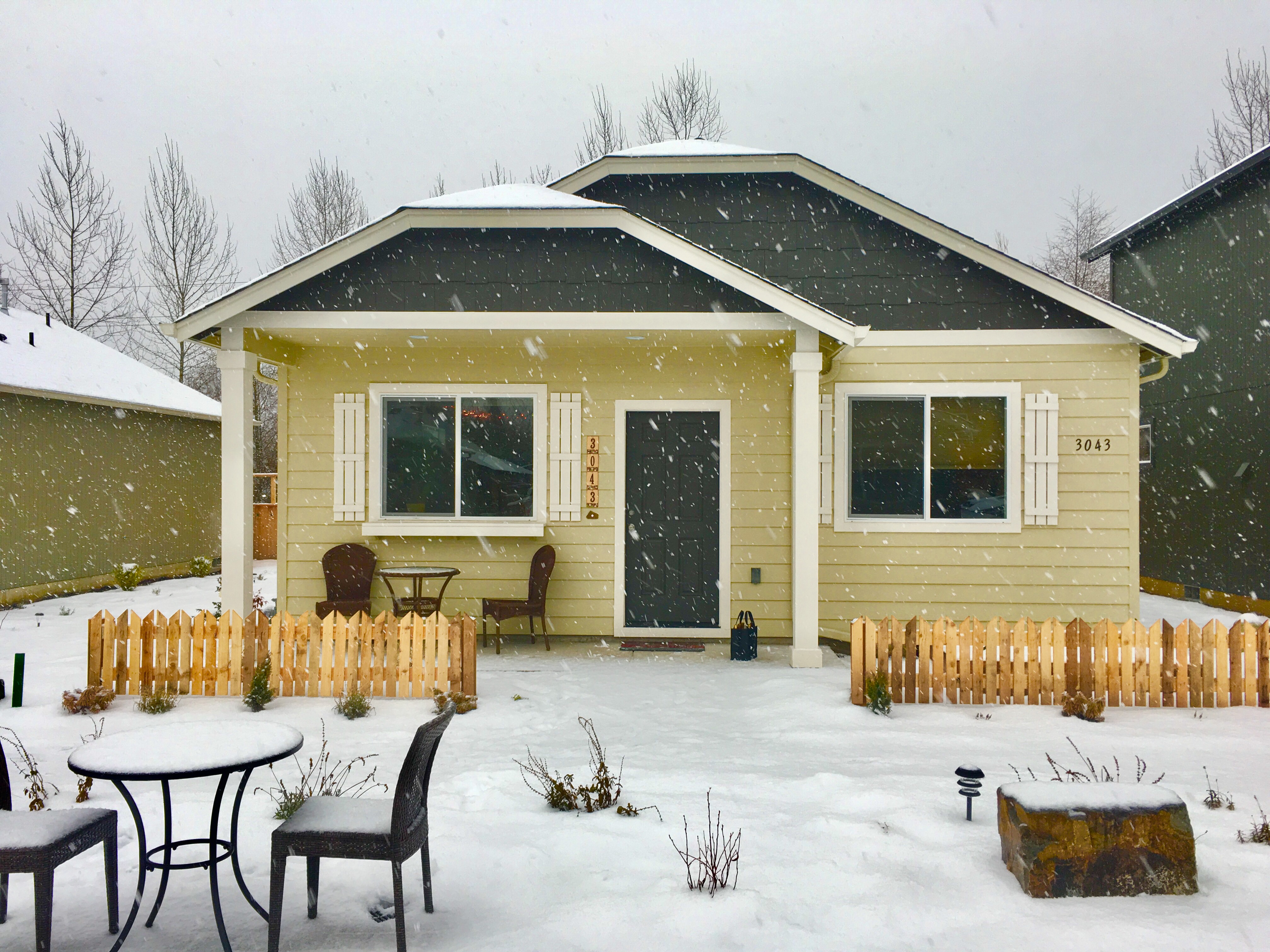
On the day of my 40th birthday, I finally conceived. I’d been waiting for many years, saving money, dreaming up names, thinking of everything I would buy for her, and preparing for the day when she would come into my life. She’d arrived! Yes folks, it’s true: a few months ago, I bought a beach house in my favorite place in the world: Yachats, Oregon.
View from the south shore of Yachats
“YA-hots” is a glowing artistic beacon among miles of untamed coastal forests. Eight years ago, this town’s siren song ignited my cultish devotion and my manic scramble to spend as much time here as possible.
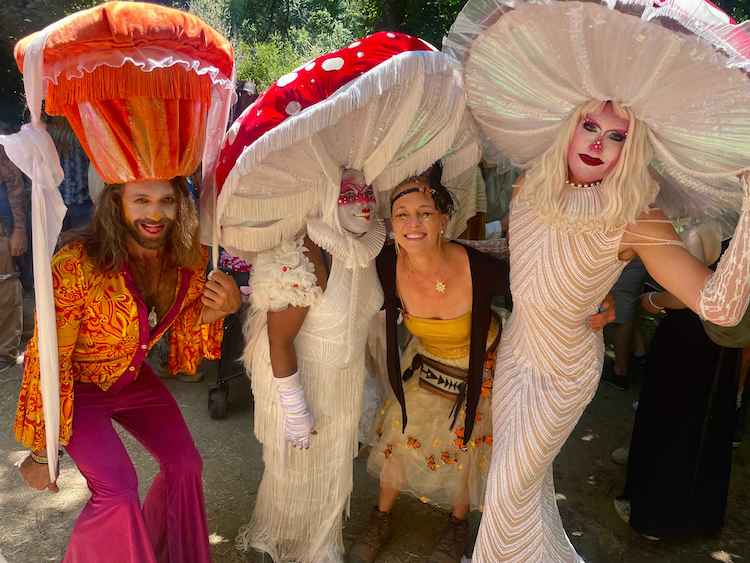
This creative town is known for its culture, whether it’s the La De Da Parade or the iconic Mushroom Festival. Poor in AirBnBs and rich in local community, the stringent laws regulating short-term rentals have protected Yachats from becoming yet another place everyone visits but nobody lives in. Folks here are woodsy and worldly, many having lived elsewhere and let this town’s hooks sink into our cheeks.
Every Saturday since late May 2020, a group of 8-20 locals gathers on Highway 101 between the C&K Market and the Green Salmon Coffee Shop to demonstrate for racial justice. They’ve been doing this since the murder of George Floyd; they stand on that stretch of road week after week with their signs—rain or shine—when many tourists are cruising that part of the 101.
Yachats reminds me of what my hometown Laguna Beach, California may have been in the 1950s: a sparsely populated coastal haven that attracts artists and fishermen alike. A big-hearted progressive community that hasn’t let the wealth overwhelm the culture. A friendly small town where residents and visitors can’t help but walk around with huge grins, greeting one another for simply sharing the pleasure of a beautiful place and time.
The Pacific Ocean hits differently up here. In Laguna, the sea served as a calming backdrop in a monotonous series of perfect days—in Oregon, the violent spectacle smashes giant driftwood onto the rocks, shaking you by the lapels, exclaiming, “You silly mortal bitch! You’re gonna die someday! Do something with the time you have left!“ A thick, matcha latte foam makes the rocks slick on the roughest days of the King Tides, and sometimes the air is so cold and wet I want to wear snowboarding goggles.
In summer, the Oregon coast’s call can be softer, soothing even, but she still refuses to be ignored as a benign background. She never fails to wash my heaviest thoughts away. I love it here with an intensity historically reserved for my middle school crushes.
The Yachats River flows into the sea through a lushly forested amphitheater. To the south is Cape Perpetua State Park, a magnificent stretch of evergreen buttes, tide pools, and mind-boggling rock formations such as Thor’s Well—a collapsed sea cave roughly 20 feet in diameter, host to the churning tides. To the north is a seven-mile unbroken stretch of beach you could walk all the way to Waldport, the next town up.
View from the Cape Perpetua Rock Shelter
I remember the day when I decided to buy a house here. I was reading a book on the Yachats State Park’s main beach. Suddenly, a bald eagle with a giant fish in her mouth grazed by my blanket, with a hungry (and possibly robbed) seagull in hot pursuit. I’d never been so close to the iconic American bird with its angry eyes and hooked beak. In my journal, I wrote about my intention to buy a house and ultimately start an artist residency for others to share in this slice of sublimity. There was something about that bald eagle that hatched my modest American dream.
However, the story of how I got here isn’t as interesting as what’s to come. Take a breath here because it will be jarring if you aren’t familiar with what’s in store for the Oregon coast.
Breathe in…and out.
One more time…in…and out.
Did you do it?
Great. You’re ready.
The fact is that someday, perhaps tomorrow morning or 300 years from now, the Pacific Northwest will be annihilated by a 9.0+ earthquake and drowned in the subsequent tsunami.
Wait…what?
In 2015, The New Yorker published an article titled “The Really Big One” that spelled out in no uncertain terms the future of my favorite region. According to Kenneth Murphy, the director of FEMA’s Region X, which includes Oregon and Washington, “Our operating assumption is that everything west of Interstate 5 will be toast.” There’s no way to sugarcoat the unstoppable wrath of the Cascadia Subduction Zone—and there’s a one-in-three chance it will happen in the next 50 years.
You’d think that this seismologic uncertainty would throw some freezing seawater on my obsession, but it hasn’t. There are natural risks living anywhere—wildfires, hurricanes, tornadoes, floods, droughts, avalanches, blizzards, volcanic eruptions. We’re all on the same train, moving at different speeds. How and when we get to our unavoidable destination is a matter of luck and some careful preparation.
Also, the instability of the land is a double-edged sword: it’s formidable and chilling to contemplate but it inspires me to feel gratitude and create art. Seizing the day takes on new urgency with imminent destruction looming on the horizon. It’s terrifying and electric, moving me to act and make my time count. And it’s one of the reasons I want to make an artists’ residency here—whether you’re looking down the barrel of an angry sea or the Cascadia Subduction Zone, mortality is always top-of-mind. The threat is abstract and distant enough to not paralyze me in fear. Rather, it brings to the forefront my creative impetus: I’m pushed to write and paint and hike and dine and dance and dream, and most importantly…to build community.
Better to have loved and lost it all in a 1,000-year tsunami than to have never loved at all, yes? Or consider this: what if everything goes right? The threat of destruction may keep our creativity burning but the disaster doesn’t come to pass for centuries to come.
No matter what happens, I’m fortunate to feel such a deep sense of love, purpose, and connection. Everyone, please welcome Casa Roma Simone to the world. She’d love to meet you, and I’d love to have you.
My friend Sooz has an expression that perfectly encapsulates Eugene, Oregon: it has “a high tolerance for harmless weirdnesses.” This city actually encourages eccentricity, and that’s one of my favorite things about it.
Consider our annual S.L.U.G. Queen contest: since 1983, the Society for the Legitimization of the Ubiquitous Gastropod has chosen an unofficial goodwill ambassador who “rains” in the spirit of environmentalism, free thought, creativity, and counterculture. They don fabulous costumes and volunteer in the community, planting trees, reading to children, organizing events, and engaging in other ceremonial responsibilities. They have names such as Scarlett O’Slimera, Marie Slugtoinette, Eugenia Slimesworth, Slimebledore, and Bruce.
Eugene is full of unusual haircuts, tattoos, and sartorial choices. People’s style runs the range: goth, Harajuku, hand-sewn, Patagonia chic, van-dweller, RPG costuming, Mennonite pioneer, daytime pajamas, grunge, preppy, and hippie camouflage (i.e., tie-dye). It rains constantly, but you can always tell the out-of-towners: they’re the ones with the umbrellas.
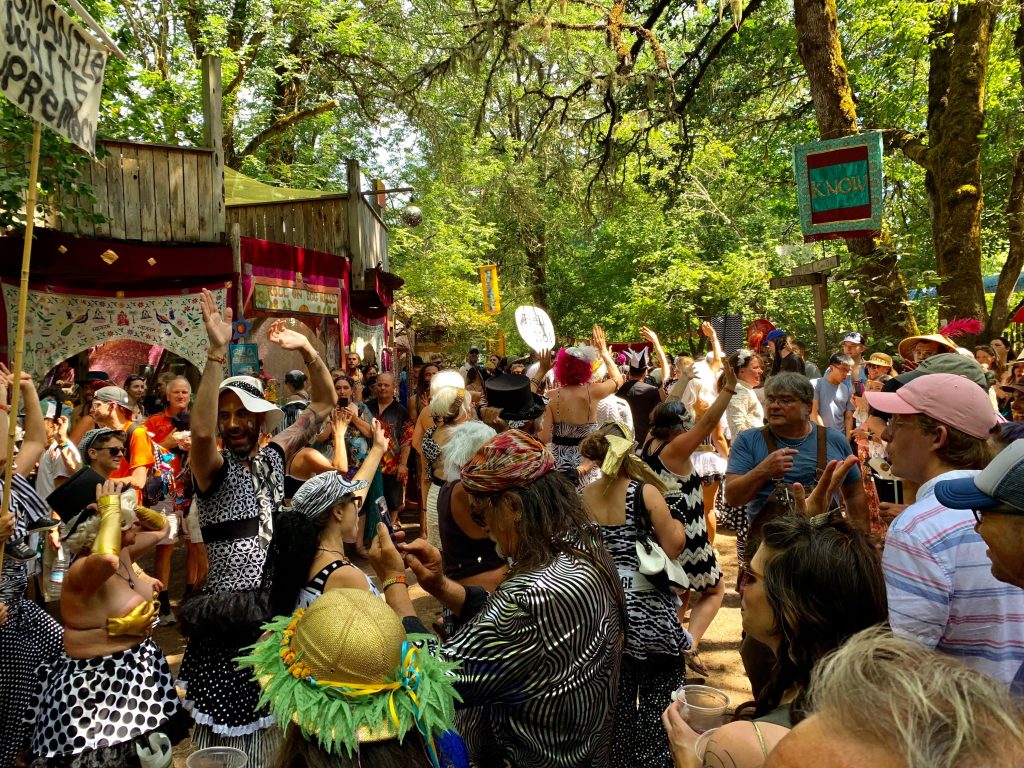
Oregon Country Fair (2023)
Sure, it’s got the unique features of other cities, such as goat yoga, amateur improv, weed snobs, astrologers, crystal enthusiasts, naked bike rides, multiple ultimate frisbee programs, Star Trek Live Theater, and a healthy appetite for hallucinogenics, but this town is extra. We have human foosball, the PSILO Temple (for mushroom trips), nude river beaches, Ferret Agility Trials, and several of the original Merry Pranksters. I once saw a person walking downtown in a full suit of armor in spring—perhaps to ward off the metric tons of pollen that flood this verdant valley from the “Grass Seed Capital of the World.” A Eugenian even crafted the world’s largest rubber band ball—175,000 in total, with sponsorship from Office Max.
Have you ever heard of Irish hurling? Yeah, we have a team for that, too. The Willamette Valley Nomads Hurling Club is one of 11 teams in the northwest. I’ve watched several videos of this sport, which involves players passing, carrying, hitting, or bouncing a small ball across a pitch almost twice as large as a soccer field. Envision lacrosse players bouncing the ball on their scoop-shaped sticks (hurleys) if they ran more than four steps. The rules are still an enigma to me—just when you think you understand what’s going on, a dude kicks the sliotar (the small leather ball) as far as he can—but I love that Irish hurling enthusiasts can call Eugene home.
It’s also legal for women to go topless here, one of a handful of American cities with these protections. Relatedly, this town is one of the most sexually and gender-diverse places in the world. Trans, non-binary, queer, gender void, gender flux, polygender, novigender, xenogender—everything on, off, and around the spectrum of gender identity is represented here and typically welcomed. Among my friends, I count throuples, swingers, polycules, and ethically non-monogamous folks. We may lack racial and political diversity, but we humbly boast an incredible range of ways to relate to one another: the funky gamut of humankind we embrace.
For those itching to taste this anything-goes society, the Oregon Country Fair is the veritable Mecca of Weird. I’ve written about this radically inclusive annual festival—the amplification of the spirit that made my partner and I choose to move here. It’s experimental, pagan, vibrant, and wild, feeling ancient and futuristic all at once. The masks we all wear to fit into society come down in a cloud of eco-friendly glitter, and people’s better nature often shines through.
I wish all communities had more respect for innocuous differences—too many places try to legislate and enforce what they consider “normal,” and it makes everyone miserable and lonely in the process. Cruelty is considered free speech; violence is seen as a means to stealing political power; and Americans everywhere feel divided and victimized.
Imagine a country where differences weren’t pathologized but were treated with respectful curiosity and humanity, where love outweighs hate and fear. Eugene, at its best, is a microcosm of this, cultivating these harmless weirdnesses that live within us all.
Paddling a canoe through a flooded forest path, you come upon a half-submerged dragon sculpture. Its wooded scales crawl the length of a school bus through the lush vines and moss. Winter has quietly reclaimed Dragon Plaza, but the structures vibrate with the phantom joys of my favorite annual festival. Welcome to Oregon Country Fair in the off-season.
There’s no easy way to describe this 54-year-old event to the uninitiated. Sure, it’s a multiday festival of music, vaudeville, parades, art, and costumes—a midsummer celebration of tens of thousands of Pacific Northwest hippies (among others) set in a forest in Veneta, Oregon.
But to the elders, crews, camps, and Fair Families (by choice and by blood), OCF is a cherished ritual, a holiday, a reunion, an annual shaking of the dust off of one’s soul. Some folks rarely see their campmates or crew members outside of these hallowed grounds but come together year after year to set the pieces in motion.
Yes, Yes, Yes!
Oregon Country Fair feels more like a living organism than a festival, both in how it’s run and its centrality in the lives of many. An all-volunteer community of various crews ensures the land is free from winter debris, the signage is clear, the proper wristbands are distributed, the Honey Buckets are tended, the Ritz Sauna & Showers are ready to receive dusty Fairgoers, the stages have passed their soundchecks, the sculptures and other art installations are erected, the artisan and vendor booths are arranged, the event security is gentle (yet authoritative), and world-class medical professionals are on-hand 24/7 at the White Bird Medical Clinic.
At the event in July 2022, two miracles tested just how well the beautiful, diffuse all-volunteer chaos at Oregon Country Fair actually works.
On the Thursday night preceding the three-day festival, we were watching our friends perform on the Ritz Sauna & Showers stage. The Ritz is one of the most unique experiences at Fair. There are few opportunities in prudish America to gallivant around naked with fellow humans underneath gorgeous Haida-style carvings and the stars, listening to live music, where performers are often nude, too.
Jon had just finished a stint in the sauna when he had an intense urge to lie down. He knew it would be inappropriate to pass out among the multi-tiered, chanting, and swaying masses, so he exited the sauna and attempted to make it to the bench where I was seated with a friend enjoying the concert.
Suddenly, we heard a loud crack, and someone screamed, “He’s down!” The music stopped, and there was a lifeless body on the ground behind me. Our friend Jody shouted, “It’s Jon!” I rushed to his side, and there began the longest 20 seconds of my life. He was completely unconscious, bleeding profusely from a deep wound gushing blood above his left eye where his head had hit the bench. I thought he was dead. People regularly slip in the shower and lose their lives. I felt panicked and nauseous from all of the blood.
Naked Fairgoers stood around us when one man (Dr. Jeff) rushed over and began administering triage.
Jon’s eyelids began to flutter, and he awoke to Dr. Jeff holding a towel against the gash, me, and our friend Jody holding his hand. The Ritz immediately contacted the nearby White Bird Clinic. Within minutes, they had a team of medical professionals there to help transport him to the on-site clinic for evaluation.
When he was ready, Jon stood up with our assistance and was able to walk with the team. Dr. Andy, normally an ER doctor, was wearing a pink tutu, and another medical professional named Sarah accompanied us into a decent-looking surgical room. The team got to work quickly, giving Jon a complex, multilayered web of stitches that made him look nearly normal.
Since the gash was down to his cranium, I thought for sure we’d have to take an ambulance and our Fair would be over, but this all-volunteer team masterfully sewed up his face and gave us instructions for the subsequent days and weeks. Jon’s eye was swollen shut the following morning and black as a starless sky, but he could still work his security shift the next day and all days afterward. He was even in good spirits.
What was remarkable about this experience was not only the technical skill of the Fair Family volunteers but their attitudes: they expressed that they loved offering their professional gifts for free in this environment, removed from the normal hassles of billing and administration. They could practice the purest form of medicine absent these real-world constraints—they were there to take care of people.
And as a result, we received exceptional medical care in the middle of the forest at no cost. In a way, there was no better place Jon could have cracked his head open. Miracle number one.
The Iconic Chromatic Cat (2022)
The following day, I’d barely caught my breath from the night’s excitement, when another disaster struck: I bought cookies for some stilt-walking Fairgoers and dropped my wallet in the swirling dreamlike chaos of “The 8”—the infinity path along which Fair takes place.
I had $250 in cash, all of my cards, and ID—a real issue since I was leaving for Alaska the following week. I took a breath and decided not to let this misfortune ruin my Fair. Instead, I spent the next 36 hours wandering the 8, running into friends, letting my ears and eyes be drawn to parades and performances, spontaneous and scheduled.
Although Fair attracts tens of thousands of people, I remained confident that the grounds transport folks into another world where our better natures shine. In this realm beyond the mundane realities of the stock market and Twitter and taxes and wars, the loving essence of humanity reigns supreme. I treated this incident as if I’d lost my wallet in my own house. I had no doubt that it would eventually be returned to the Odyssey, the central lost-and-found station at the heart of the 8.
After a couple of days, my faith in the goodness of Fairgoers paid off: my wallet did turn up at the Odyssey, all of my cash and cards intact. Our second Fair miracle!
When I first camped at Fair in 2018, it was clear that the first weeks of every subsequent July would be dedicated to this annual event. There’s nowhere I’d rather be that time of year, probably for the rest of my life.
The joy of Fair is that for a few days, the masks come off, and a primordial joy erupts. This lush forest full of unique villages taps into parts of myself that are otherwise dormant. Xavanadu and Chela Mela vibrate with colorful art installations and themed parades. Energy Park educates us about renewable resources and the importance of conservation. The Ritz Sauna & Showers taps into our awareness that without our clothes, we’re all just animals of the same species, enjoying the pleasure of bathing after long dusty days wandering the 8.
Fairgoing Flaneurs (2022)
The labyrinthine paths connecting camps each carry their own magic. The spontaneity of connections, meeting eyes with strangers, lighting their smiles with my own, and knowing that we’re all in this moment together. I have the desire to be everywhere across the grounds all at once. The Fair spirit embodies free expression, creativity, acceptance, and love, but these words ring hollow next to the magic of walking the grounds in the thrumming hive of joyful performance. Sorrows feel drowned in an ocean of music, art, and elaborate costumes. The absence of rigid social constraints makes folks blossom, and the heaviness of worries is lifted. The ability to live in the present moment is restored, and overall, the magic of Fair is its humanity.
For me, these elements drastically outweigh many of Fair’s challenges: the messy logistics, generational politics, the ethical considerations of hosting the event on native Kalapuya lands, scattered accusations of colonialism and cultural appropriation, the overindulgence in drugs (mainly psychedelics), and the aggressive mosquitoes.
In reflection, OCF amplifies the core spirit that made Jon and I want to move to Eugene: the vibrant colors, experimental style, kindness, environmentalism, the low barrier to participation, the humble artists producing world-class work, the roughness around the edges like a beloved hardback book, the witchy and pagan vibe, and the radically inclusive community of the Pacific rainforest.
Our first Fair, embracing the whimsy (2018)
I lost my wallet in a crowd of thousands, and my partner got 7 stitches above his left eye—and it was still one of the best weeks of our lives. In the immortal exultation of one of my Fair friends: “Shit the fuck yeah!”
When I lived in San Francisco, I was a consumer of culture rather than a producer. I went to museums and live music shows regularly, soaking in some of the best talents in the city. Although I’d take pictures of paintings I admired or dance to funk and gypsy jazz, I was always one step removed from the artistic process—a respectful observer rather than a true participant. It never occurred to me to pick up my guitar and try to join a band, submit my own acrylic paintings to art galleries, or audition for a play; I was always more comfortable in an audience.
Eugene, OR has a much different relationship with creatives. If you have a desire to make something or perform—no matter how niche or obscure—you can find a loving supportive group of fellow enthusiasts.
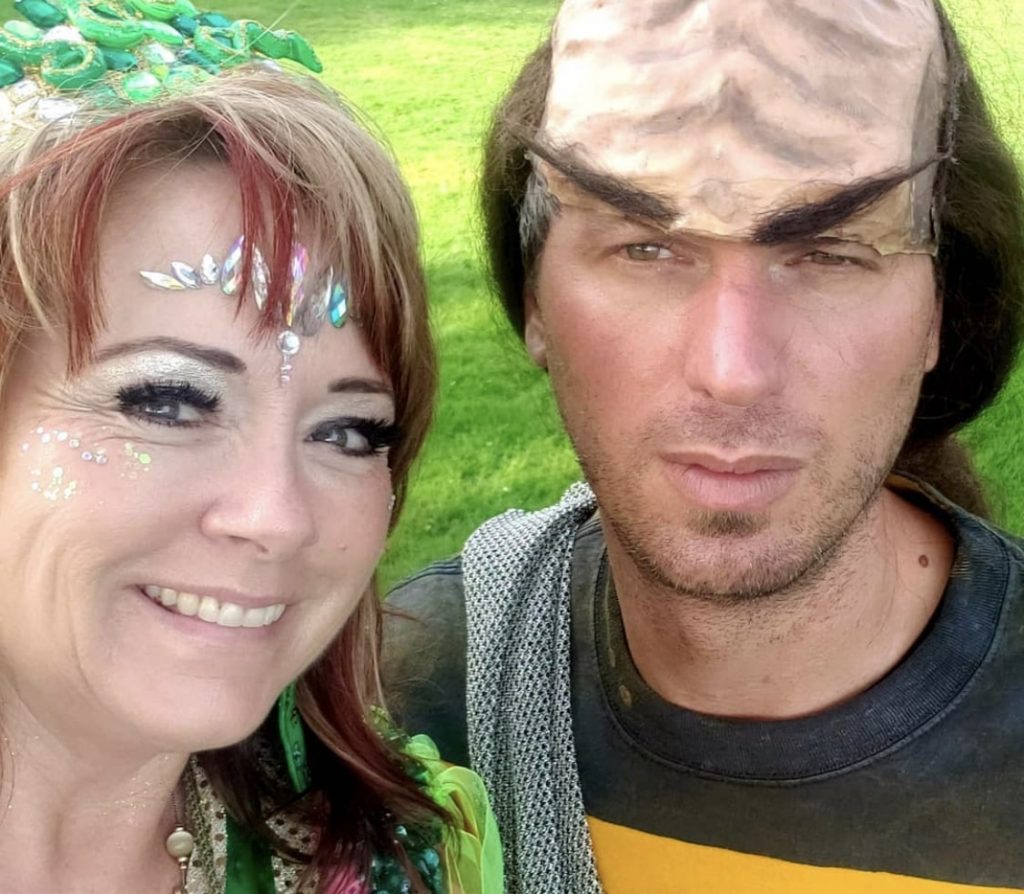
My husband, Jon, found a home in Star Trek Live Theater, a motley crew of Eugenians who looked up to the show’s trailblazing characters and utopian view of civilizations. Although I didn’t watch Star Trek growing up, the actors here bring a homespun tenderness to the stories. Since they’ve been performing together for years, it’s also a strong community of friends who see each other through life’s varied mountains and valleys—both the triumphant and the depressing moments outside of the stage.
Jon as Worf and the lovely local Slug Queen
Last Friday, on the invitation of the Star Trek Live sound engineer, Jon performed in the First Annual Edward Gorey Ball—a costumed celebration of dark art and poems. I hadn’t heard Gorey’s work until Jon would rehearse lines from “The Gashlycrumb Tinies” at home:
A is Alice, who fell down the stairs.
B is for Basil, assaulted by bears.
The ball was held at Spectrum, Eugene’s LGBTQ bar and one of the best spots for nightlife in the city. In addition to some readings and a bit of Gorey’s history, there were burlesque dancers, contortionists, and two cello players.
It was actually the juggler who inspired me to write this piece (for whom I’ll use the pronoun “they” to avoid assumptions about gender identity). Before their performance, they walked to the front row of the audience—long knives in hand—and warned the crowd that objects might come flying in their direction. The front row, bedazzled in black lace, dark sequins, and shiny leather, smiled and said it was cool.
The juggler took to the stage in a checkered harlequin costume. They began juggling three skulls to music. They dropped a skull once, twice—three times!—and every time, the spherical reminders of our mortality went bouncing into the front row as predicted. The juggler then picked up the knives and with great enthusiasm, tossed the blades into the air until one dropped and bounced into the front row. (Not to worry! Performance blades are dulled.)
What I noticed throughout this performance was how everyone cheered with loud encouragement every time the juggler made a mistake; it didn’t matter that skulls and long knives were literally bouncing into the shins of the audience. People just wanted the juggler to feel the love and keep trying.
That’s the creative lifeblood of this community—The Little Eugene That Could with her unflappable “I Think I Can” attitude. No matter your level of talent in any arena, there is a friendly audience waiting to cheer you on through your artistic process.
In addition to countless creative classes at the University of Oregon and Lane Community College, Eugene has:
Open Mic Nights for comedy, poetry, music, and performing arts
Toastmasters (a group to improve one’s public speaking)
Danceability (dance classes for differently-abled people)
Pub Science Talks (scientists lecturing at a brewery on something cool)
Multiple not-for-profit community theaters
Monday Improv (a beginning improv group that gathers weekly)
First Friday Art Walks (artists connecting with downtown businesses to put their work on display for the night)
The Saturday Market (the country’s longest-running weekly open-air market for artisans and farmers)
Sunday Learners Jam (an opportunity for beginning musicians to join a group at a local jazz club)
This list really only scratches the surface and a lot of these events are free or low-cost.
One thing I noticed about San Francisco was that the wealth had begun to stifle the local culture; not only had the city become unaffordable for teachers, social workers, and janitors, but it had pushed out a lot of musicians, painters, and performers as well. Some moved to Oakland—until that city also became out of reach—and now there’s a migration to midsize cities like Eugene, which has attracted many of Portland’s priced-out artists.
What happens to communities when culture is forced to leave? Sure, apps and tech are cool, but so is thriving artistic energy. That old art collective suddenly becomes a tapas restaurant; that dive bar with weekly open mics makes way for a swanky cocktail joint; that family-owned bookstore turns into yet another coffee shop which charges $6.50 for a pour-over.
The point is that the free market is not a good arbiter of culture. It’s designed not to expand people’s minds, but rather to play to their baser instincts: greed, status, indulgence, intoxication. There are few companies that would truly put cultural value (not to mention environmental or public health) above their bottom line. It’s not their fault; that’s just the way the system works.
Good art and culture aren’t always comfortable. They force people to stretch their presumptions and make space for a new perspective. This makes people more empathetic and generous, more galvanized in the face of injustice. The free market doesn’t have those objectives, although some companies would like to think of themselves that way and commodify culture to increase their bottom line.
Overall, when everyone is too damn busy on the endless hamster wheel of modern work, a city begins to die a little. People stop looking you in the eye and step over unconscious bodies in SoMa; tent cities of the evicted and mentally ill take over once-peaceful blocks; deaths of despair skyrocket as the city becomes both glitzier and grimier.
I’m grateful that Eugene has its heart in the right place. Many people who grow up here return after a few years living somewhere else. There’s just nowhere like it. Strong local leadership and shared values helped to steer Eugene toward embracing everything that makes life worth living: art, community, natural beauty, generosity, kindness, and simple pleasures.
Here, I won’t think twice about submitting my art to local galleries, picking up my guitar, or getting silly with an improv group. I Think I Can.
When I share my Great American Road Trip idea with people, I get this question more than any other. The short version of my story is that my lover-turned-husband and I took a one-year road trip around the U.S. to discover the place we wanted to call home.
Jon and I had burned out on living in San Francisco, where we had to sprint just to stay in the same place. Before leaving the city, he paid $1,600 per month for a single bedroom in a Fort Mason house in 2014. These days, it’s even worse and some of the world’s brightest people would gladly offer a pound of flesh to secure very basic accommodations in the area.
Not too long after we met in SF, Jon and I moved to Argentina together for ten months. I had just started working remotely for Sechel Ventures, a tech company based in the Bay Area, and Jon decided to finally write his novel,All Starships Go to HEAVEn.
After this experience living internationally, we knew we could thrive in a life on the road and we cooked up a dream: rather than letting our employment dictate where we would live, why not choose the city that felt right and go from there? What could be more important than loving where you spend your days?
We bought an orange Honda Fit, the “Fireball” and drove east from California for a cousin’s wedding in Fort Collins, Colorado—our first stop.
Before our Great American Road Trip, Jon and I had envisioned the features of our dream city. We wanted:
A progressive college town with plenty of hiking and camping nearby
Ubiquitous bike lanes and ample bike parking
Nice, non-pretentious, diverse people
A cute downtown with murals and tangible artistic energy
A world-class craft beer scene
Local leadership we could trust to make decisions as we would, being thoughtful about new developments, supporting public education and health, making recycling a priority, and fostering a vibrant environment for creatives
A place that wasn’t quite on other people’s radar
In other words, we wanted a really great party before everyone had arrived. We had our work cut out for us.
Gorgeous Mural By Rachel Wolfe-Goldsmith in South Eugene
During our Great American Road Trip, we went through 25 states, hitting as many National Parks as possible and staying mainly in AirBnBs. While most hotels have the same predictable sterility, the most highly rated AirBnBs are created with pride and reflect specific tastes, hospitality, and culture. They’re a glimpse into a community’s way of seeing the world, and the amount of care these hosts put into their home’s amenities and local recommendations is moving—it reminds me that we all crave human connection and the opportunity to help others. The rewards of being a good person tickle our chests and bring a warm glow to our heads. And nowhere did our chests tickle and our heads glow more than in humble, magnificent Eugene, Oregon.
Since there weren’t many AirBnBs around, I’d found a three-week sublet on Craigslist in south Eugene. The tenant, Rachel, who had grown up a few hours away in Hood River, was teaching English in Japan for the summer—coincidentally near Niigata, the city I’d lived in for over two years in my early 20s. She loved yoga, gardening, and something called “ecstatic dance.”
Before we sent her our payment, she texted a considerate video message. She was wearing brightly colored athletic gear and a welcoming smile.
“Hi Jocelyn and Jon! I wanted to give you a feel for the place. Right now, there’s a bit of construction going on since the owners are building some new cottages.”
She panned the camera over new concrete foundations and piles of dirt.
“The workers don’t get started too early, but I just wanted to let you know there may be some noise. Thank you for reaching out and I hope this works for you!”
We arrived several days later to meet Rachel in person. Her cottage was spotless and had several Japanese tapestries adorning her walls.
One of the first things she said to us was, “I feel very comfortable having you in my space. I’m happy you contacted me.”
After giving us a brief tour, Rachel grabbed her bags and headed out toward her car.
“One more thing,” she said, handing us the keys with a smile. “The Saturday Market is downtown today. It’s a longstanding Eugene tradition and you should check it out. The bike path will take you most of the way there.”
She pointed to a paved treelined path, waved goodbye, and headed to Portland to catch her transpacific flight.
After unloading our backpacks, we removed our bikes from the back of the Fireball, unfolded them, and set off north toward downtown on a protected bike path far removed from any cars.
After passing under a tunnel along a rushing creek, a large, grassy park with a short fence emerged on our left with dozens of happy dogs chasing each other at full speed or cooling off in one of the four kiddie pools around the perimeter.
On our right, skateboarders ollied from the kicker of a large kidney bowl with colorful graphics. It was flanked by large trees and more grassy open space. We passed joggers in bright clothes and sunglasses as we rode by the Amazon Community Center and Pool. We continued along the smooth asphalt and the brand-new athletic fields of Roosevelt Middle School rose from the right.
We got to our first road and cars on both sides stopped immediately to let us cross toward South Eugene High School—one of the best public schools in the state—with its football field, volleyball courts, modern architecture, and small parking lot surrounded by trees.
After nearly 14 blocks of a carless path straight out the door of the sublet, the road opened with a separate bike lane heading north on High Street, which would take us the last ten tree-covered blocks toward downtown.
After years of biking aggressively through San Francisco, I noticed how patient Eugene drivers were. Pedestrians, runners, and cyclists seemed to rule the roads and nearly every street had a bike path and signage reminding cars to watch out for us.
Eugene was also the greenest town I’d ever seen. It’s surrounded by verdant Douglas firs, maples, pines, oaks, junipers, and alders. The city streets are lined with apple, plum, cherry, and chestnut trees. Almost everyone farms or gardens, and the saying goes you can throw seeds anywhere and they’ll just grow. The moisture, rich Willamette Valley soil, and healthy ecosystem support thousands of native (and non-native) plant species.
Fern-filled Mount Pisgah Trail
When we hit downtown, we saw large crowds of people walking west toward an open marketplace with white canvas overhangs. There were bike racks everywhere, so we locked up and headed into the throng.
The countless stalls stretched out several blocks, overflowing with colorful pottery, jewelry, clothing, greeting cards, leather goods, and paintings, as well as fresh meat, local cheeses, fruits and vegetables, flowers, plant starts, and and a local brewery cart. The central courtyard hosted several ethnic food areas, bakeries, and coffee shops. A small stage in front of long, communal tables thrummed with psychedelic rock, as people of all ages bobbed their heads while dining on kabobs, burrito bowls, and Thai stir-fries.
The Eugene Saturday Market is held downtown every Saturday from April through November. It started in 1970, and now hosts around 150 vendors, who migrate indoors in December to the Lane Events Center—the annual “Holiday Market”—adding several artisans from around the state and country for full weekends. There’s one main rule: the people selling the goods must have harvested or made them.
Our First Saturday Market in Downtown Eugene, 2015
I’d enjoyed plenty of farmers’ markets, craft fairs, and other non-traditional shopping experiences around the world, but I’d never seen anything quite like this.
First of all, Eugenians looked very different than people from other cities. Most women wore their hair very short, very long, or asymmetrically. Bright colors mingled with earth tones, tattoos covered exposed skin, facial piercings abounded, and elaborate metalwork clung to the earlobes and collarbones of men and women alike. I noticed lots of hippie dandies, brown leather boots, Ducks gear, and neon athleto-leisure wear from North Face, REI, and Patagonia.
The people also acted differently. There were no hurried, tunnel-visioned pedestrians wearing ear buds. Everyone’s gazes were up and their defenses were down. They were engaging with the flesh-and-blood world, acknowledging others in the present, seemingly unconcerned about the future. The collective hive was positively mindful, which felt foreign and anachronistic. It was as if I’d unearthed a secret world of old-timey neighborliness, an impression that was confirmed when we rode our bikes back.
Unbeknownst to Jon and me, Kathie and Eric Lundberg (the owners of the Amazon Cottages development where we were subletting) had sent an email blast to the community asking everyone to say hello and welcome us during our stay. Residents came to the cottage to introduce themselves with handwritten notes; bushels of fruits, veggies, and herbs from their gardens; and fresh-baked breads.
Who does that? Like many twenty-first century city-dwellers, I’d never spent much time with my roommates—let alone my neighbors. Nobody in San Francisco seemed to forge relationships with people living on the same block. People were just too “busy.” This city is so goddamn neighborly that four-way stops frequently inspire an awkward dance of driver smiles and friendly hand-gestures.
For the following three weeks, we explored towering waterfalls, old lumber roads leading to stunning vistas, meadows of wildflowers, and the forested cliffs along the jagged Oregon coastline with its powerful surf. We enjoyed the U of O campus, live music, downtown art installations, world-class wineries, and family-friendly breweries.
Stunning Silver Falls State Park
Everything felt accessible, non-pretentious, affordable, creative, natural, and genuine. When we shared our story and mentioned that our next stop would be Bend, most locals told us we’d like it much more than Eugene.
Our last day in town, we rode our bikes across the Willamette River to the annual Art & Vineyard Festival, which attracts artisans and winemakers from all over the state. It was the Fourth of July and we happily discovered that fireworks laws are much looser in Oregon than in California. A rock band played 70s and 80s classics as Jon and I drifted between the craft stalls, beers in our hands.
Our mood was bittersweet. We’d enjoyed an unforgettable few weeks in Eugene and cooked dinner for Kathie and Eric Lundberg the night prior, finding them to be kindred spirits and people we’d love to call neighbors. They were among the people who believed Bend would be a better fit for us “big city” California folk with its art galleries, wealth, collection of fellow transplants, and most of all, its rumored 300 days of sunshine.
The following morning, we left Eugene with open hearts and minds, excited to reconnect with my old college friend and his family, who had graciously offered to let us stay at their house along the Deschutes River while they took a summer trip.
The drive to Bend along the McKenzie River and through the winding Cascades is spectacular. The west side of the mountains is lush with ferns and small roadside waterfalls. It’s often raining until the zenith of mountain pass, which makes way to a much sunnier, drier landscape in the east.
Bend was just as everyone had described it: manicured, naturally beautiful, and replete with wealthy young families—many of whom I’d wondered how they’d made their money. It reminded me of Aspen or Laguna Beach—nature- and outdoor sports-loving towns with well-heeled smiling white people. They had a carefree country club saunter and a zeal for new bistros and yoga studios.
Bend is a lot of people’s idea of “making it,” but it wasn’t ours. Eugene is much rougher around the edges. For one, it has a serious homelessness problem and attracts a lot of runaway youth. Some are inspired by the city’s history of celebrating rebels and eccentrics. Ken Kesey, author of One Flew Over the Cuckoo’s Nest, was from this area and his “Merry Pranksters”—many of whom still live in Eugene—were immortalized in Tom Wolfe’s The Electric Kool-Aid Acid Test.
The city also has a lot of support for people who have fallen on tough times, including a free luggage/backpack storage by the bus station and the White Bird Clinic’s medical, dental, and psychiatric services. Eugene even pioneered the CAHOOTS (Crisis Assistance Helping Out On the Street) program—a mental health group dispatch used in place of the police when appropriate—which was recently celebrated in The Wall Street Journal for saving the city money and being more humane.
Eugene’s Immaculate Downtown Bus Station
Eugene emits love and compassion, and you can practically hear the city’s heart beat. People understand that taxes are integral to the future of their children’s education, their family’s healthcare, and their community’s infrastructure and culture. Similar to many Oregon towns, it’s fiercely protective of its forests, lakes, and rivers. Promoting a green economy, protecting endangered species, preventing overfishing, recycling, and sourcing food sustainably all rank highly among people’s civic priorities. People are unhurried and generous, and I can trust a majority of the city’s leaders to promote policies I support: a more humane criminal justice system, funds for the arts, and thoughtful land use, among many others.
In 2017, we bought a house in the Amazon cottages community where we first subleased, and last year, I married my lover at the local Sweet Cheeks Winery.
I’m sitting in a rocking chair by the glow of the fire, listening to the logs crackle and fingers tap-dancing across my laptop keys.The living room window is flanked by a towering case of my favorite books and a Taylor guitar. I see thick snow clusters floating down outside into our garden. I sway my head gently to Macy Gray’s new album, her sensual voice an homage to her roots in jazz. I am utterly at peace because when I’m here at home in Eugene, OR, I’m unplugged from the world.
When I say ‘unplugged,’ let me be clear: not only do I lack internet and cable in the cottage, but I also haven’t had a cell phone plan since 2014. I’d dropped my carrier initially to move to Argentina for 10 months and I never found a reason to reactivate. My friends, family, and employer have long-since grown accustomed to not being able to reach me 24/7; they appreciate that I’ll respond once I’m online at a local cafe or a public library. And with wifi now ubiquitous throughout much of the world, it’s not difficult to find a connection when I need one.
From 2010 to 2014, I lived in San Francisco—ground zero for technological innovation. I loved the city, but I felt overwhelmed with my cell phone constantly at my side. Crushed by information and saturated with media. A gnawing feeling that my attention and time were never really mine to control and that I could be thrust forcibly into the infinite at any moment. The same feelings that people try to escape through digital detox camps and the like.
We’ve all been down that rabbit hole: the one that leads us from a text message to a Facebook vacation photo in Cambodiato a Google search for the name of that pink temple in Angkor to a Wikipedia article about the ancient stone making up the walls to a text message response, and so on. Seven minutes gone. With connectivity comes the possibility of continuous distraction—the pestering flak of text messages, pop-up notifications, electronic calendar reminders, and emails. Oh, the emails.
Constantly drowning in information without limits was taking its toll on me. I never seemed to have enough time to do the things I really wanted to do, the things I’d always included in my New Year’s resolutions: reading more books, playing the guitar, gardening, hiking, cooking for my friends, and writing for pleasure. Now when I come home, those are the only things in front of me, the welcome embrace of my chosen pastimes.
Free from text messages.
Free from checking email.
Free from pop-up notifications.
Free from Google news headlines.
Free from Twitter outrage.
Free from self-aggrandizing Instagram posts.
Free from Facebook check-ins.
Free from Netflix binges.
Free from self-promotion and distractions.
I can breathe again.
When people ask for my phone number, I have to explain that I don’t have one, which usually leads to a lengthier discussion about my lifestyle. Here are some answers to common questions I get about my disconnected home life:
How do you keep in touch with people?
The same way most people do: email, iMessage (for my fellow iPhone-users), WhatsApp, Facebook messenger, Skype, Instagram, etc. I even write letters by hand. I learned that our modern means of communication are not only plentiful but redundant. As tech companies compete for greater market share, there’s never a shortage of cheap, convenient ways to communicate with other people. The difference is that I have access when I choose.
What if somebody is running late and needs to contact you?
I deal with this the same way we all did pre-smartphone: I wait, usually with a podcast downloaded for offline listening. I’ve also noticed that people tend to make more of an effort because they know I can’t be reached; in SF, friends would sometimes cancel at the last minute or text about being late, as if the ability to communicate instantly with me diminished their accountability. That never happens anymore.
What if you can’t find an internet connection?
When cafes and libraries can’t be found, there’s always a Starbucks or McDonalds nearby with open wifi access.
What about all of the useful apps?
When traveling, I’ll download offline Google Maps, Yelp recommendations, or Trip Advisor lists prior to setting out for my destination. I spent most of 2015 road-tripping across the US and had no problems with this strategy.
What about emergencies? What if there’s a global disaster?
If it’s something pertinent to my local community, one of my neighbors will certainly knock on my door. If it’s not, there’s probably nothing I can do about it and I’ll find out soon enough. Dwelling on crises doesn’t help anybody. Case in point: one of the best decisions I ever made was to spend the entire 2016 election day hiking to various waterfalls in central Oregon, totally off the grid. Would it have been better for me to watch the ill-fated polls all day? No way.
What about your work?
I’m managing editor of Sechel Ventures LLC under two fantastic mentors. I’m grateful to have worked for this company for two years. My bosses are aware that they can’t always reach me and have faith that my ability to recharge offline at home ultimately improves the quality of my work. Plus, if the French can pass a ‘right to disconnect’ law establishing off-duty employees’ power to ignore work emails, I’m sure a similar rule could benefit many overworked Americans as well. (Not that it would ever pass in this anti-labor/pro-business country which has yet to establish maternity leave protections, a decent minimum wage, or solid PTO laws.)
What about news stories and other online reading?
I’ll load important reading onto my computer before heading back to the offline sanctuary. On a related note, I’ve always preferred periodicals to newspapers, films to cable TV series. When people take more time to produce something, it broadens the scope and improves the quality. Minute-by-minute media coverage is chewing gum for the brain.
What about Netflix?! What about other great TV shows?!
I get this question a lot, and yes, I’m probably missing out on some popular culture here, although for my must-sees like Samantha Bee, John Oliver, and South Park, I’ll stream them on my computer at the Bier Stein, a local beer bar within walking distance of my cottage with 26 rotating taps, delicious food, and fast wifi. There are worse ways to consume media.
This lifestyle isn’t for everyone, and there are certainly times when I wished I had web or phone access and didn’t. But for me, these sporadic nuisances can’t outweigh the freedom to focus on what’s really important to me: the simplicity and peace of mind at home.
Tamolitch Blue Pool, the water collected from an ancient waterfall, is so clear you can see down 30 ft. By the way, this picture has nothing to do with the story below. It’s just one of the cool-as-fuck things about this state.
“Oh, it was so miserable! Falling down into pig shit and being zapped by that damn electric fence!” Doris howled at her memory, tears of laughter gullying down her cheeks.
Doris and Mike were our introduction toOregon—the hallowed haven for misfits, hippies, and enthusiasts of the great outdoors. They’d built their dream home in Roseburg, a quaint town known as the “Timber Capital of the Nation,” and hosted several rooms in their custom home on AirBnB.
I was struck immediately by the amount of art in the home—landscape oil paintings, a Japanese-style heron mural with cherry blossoms, Iraqi onyx countertops, abundant tile mosaics, expertly painted plaster leaves and fruit along the trim of each room—and I discovered that lifelong painter Doris had made everything herself. Mike was a master carpenter and builder, and this mid-60s couple had created everything in their home apart from the basic framing. It had been an empty canvas for their combined talent, and it was beautiful.
They’d built a scenic chicken coop and a large garden with peppers, corn, tomatoes, various lettuces, and marijuana, which has been legal here for recreation since 2015.
As longtime hosts for international guests, they’d accumulated a large collection of delicious wines and cordials from around the world, which they shared on the night Doris told her tragicomic story about falling into ankle-deep pig shit. She even brought out her delicious pot-infused, chocolate chip cookies, which had been cross-hatched for dosing purposes. She explained that a quarter was perfect to combat pain, a half to feel slightly euphoric, and a whole to have a good night. We stayed up late conversing with Mike, Doris, and a pediatric cardiologist from Nicaragua living in Portland. We even played with Mike’s handmade gas-can guitar with brilliantly colored designs, and finally fell into a restful sleep induced by good company and cheer.
The next morning, Doris made omelettes from her coop’s fresh eggs and vegetables from the garden. The delicious eggs had shells of seemingly unnatural hues, light blue and speckled creamsicle, colors which had been obscured by the tradition of their boring white or brown supermarket counterparts.
It was then that I really fell hard for this state and decided to come out of the closet to my family: I’m an Oregonian trapped inside the body of a Californian. For those of you unfamiliar with my life’s trajectory, I’ve lived all over the world—six months in London, two-and-a-half years in Japan, nine months in southeast Asia, six months in Brazil, ten months in Argentina, and plenty of shorter trips and adventures in between—and it’s miraculous to have traveled the globe several times over in search of a home, and to return to the Pacific Northwest to find it.
Yes, it’s crunchy as fuck here. Yes, it’s rained a fair amount since we arrived, especially for summer. And yes, according to my friend Patrick of “Van Bun” fame, the Tinder pickings are slim, but this is the closest to Eden that I’ve come in 34 years, and I’m not about to let it go.
Scott Lake in Sisters, OR. And ditto about “cool-as-fuck” note in pic above.