Teflon Don & American Impunity

“Teflon Don” describes our ex-president perfectly: he’s artificial, toxic to our system, and despite the best efforts of our prosecutors, incredibly slippery to convict. 

Why has Donald Trump been able to avoid serious legal trouble for decades? His lies and crimes seem palm-to-forehead obvious to most Americans: 

  • The self-described pussy-grabber has been accused of sexual assault by two dozen women. 
  • He publicly asked Russia to hack Hillary’s computer in July 2016, soliciting the help of a foreign government to win an election
  • He’s screwed over countless contractors in his business dealings.
  • He defrauded his own charity.
  • He asked Georgia Secretary of State Brad Raffensperger to “find 11,780 votes”—one of many targeted attempts to overturn the results of the 2020 presidential election.
  • He inflated the value of the Trump Organization’s assets to secure a loan, and deflated it when calculating his tax liability.
  • He incited an insurrection against the U.S. Capitol on January 6, 2021 based on his Big Lie.
  • He stole top secret documents from the White House, including intelligence secrets and nuclear information, which he refused several times to return.

And many, many more.

Before Trump became a politician, he was relatively shielded from legal consequences by his wealth, which could buy the most ruthless lawyers. Now, it’s even harder to pin down Teflon Don for another reason: indicting a former president would hurt our national pride.

When Richard Nixon was forced to resign for the adorable crime of orchestrating a break-in on the DNC Headquarters, he was pardoned immediately. It was unconscionable for the most powerful man in our country to face legal repercussions. Also, American presidents are generally reluctant or unwilling to admit errors. (President Obama was an exception, and he was excoriated by right-wingers for “humiliating a superpower” with his apologies.) 

It’s assumed that taking basic accountability will make the United States appear weak or unstable in the eyes of the world. In other words, we are crippled by our own arrogance and self-righteousness. Similarly, has Trump ever sincerely apologized for anything

In this vein, there’s a less-discussed undercurrent of fear in prosecuting Trump. Bringing this former president to justice would expose the darkest parts of our national consciousness. He embodies the worst of the American character: unfettered greed, entitlement, dishonesty masked with a smile, toxic ambition, aggression, racism, hubris. If we arrest him, it would be an indictment of our country’s ugliest tendencies and dealings with the world. 

Here’s the thing:

  • Like Trump’s ruthless attempts to overturn the 2020 presidential election, the United States has helped overthrow democratically elected leaders in Iran (1953), Guatemala (1954), Brazil (1964), Chile (1973), Venezuela (2002), Haiti (2004), Egypt (2013), and others to consolidate its own power and interests.
  • Like Trump and his father’s racist refusal to rent their properties to Black tenants in the 1960s and beyond, the United States has a long history of segregation and redlining baked into its land usage.
  • Like Trump’s repeated insistence that “executive privilege” shields him from any legal consequences, the United States assumes that its “exceptionalism” allows it to get away with actions other countries can’t.

Are we strong enough to turn that scrutiny inward? To admit that winning at all costs isn’t a healthy inclination? To acknowledge that like Trump, the United States has screwed over a lot of people?
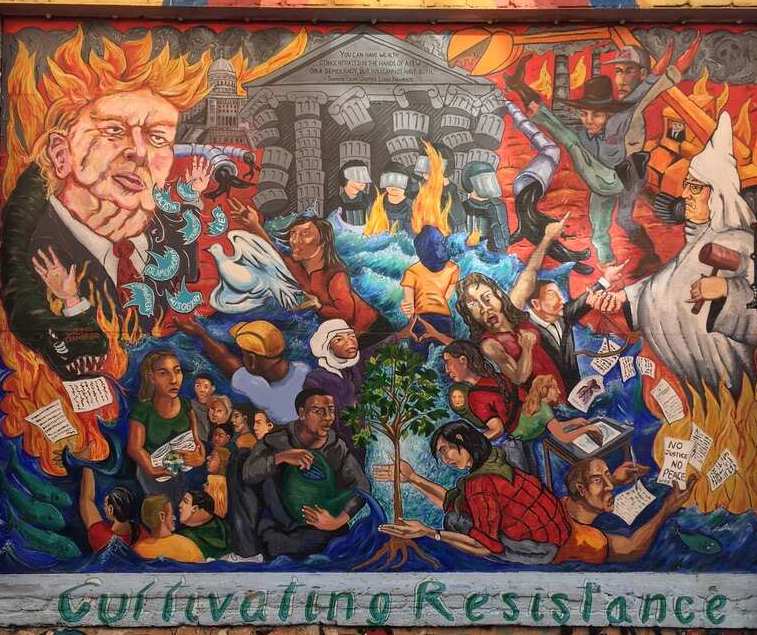
Trump’s bullshit has weakened our country (artist unknown, San Francisco, 2017)

There are varied reasons why some Americans are against indicting Trump. One argument is that not all crimes are prosecuted in the interest of “preserving domestic tranquility and institutional integrity.” Another states that prosecuting Trump would set a dangerous precedent, where the non-ruling party would target their opponents relentlessly in the White House. (I’d argue that this already happens.) Still others say prosecuting Trump will make him into a martyr and “there will be riots in the streets!”

These are all valid concerns but taken together, they don’t outweigh the importance of preserving our legal system’s integrity—letting a powerful person get away with so many obvious crimes sets a dangerous precedent.

Many of Trump’s own cronies have been indicted or imprisoned for acting on his behalf: Michael Cohen, Paul Manafort, Rick Gates, Michael Flynn, Roger Stone, Elliott Broidy, George Papadopoulos, Steve Bannon, and Allen Weisselberg, not to mention the growing tally of Trump superfans who are now in prison for the January 6 Insurrection. 

Is it just a coincidence that Trump pals around with so many accused and convicted criminals?

The United States needs to swallow its pride and do what’s right: bringing a powerful criminal to justice takes more strength than cowing to threats of violence and division. The rest of the world is watching, and they will cheer in the streets when Trump faces the consequences of his crimes. 

Let’s show them that we’ve grown and matured, that we are worthy of being the international stewards and role models we have always imagined ourselves to be.

America’s New Political Parties: The Martyrs vs. The Denialists

In this divided era, I’ve noticed two general camps among my fellow Americans. These groups aren’t simply “conservatives” and “progressives”—these categories actually transcend political affiliation, counting members of both the Left and the Right in their ranks. The difference I’ve observed is related to how people are processing this era of uncertainty, turbulence, anger, and violence.

American turmoil and chaos (JMW Turner, The Snow Storm)

First, some people feel intensely aggrieved about marginalization, a group I’m calling the Martyrs. These folks may feel persecuted by the “mainstream media” and don’t feel adequately protected in an era of social change. They may fear the dissolution of the traditional family, the persecution of men at the hands of the #MeToo Movement, or the declining influence of white Christians. 

Alternatively, Martyrs may feel outraged by pervasive racism, sexism, and homophobia, seeing everything through the lens of various oppressed groups. Demographic characteristics and identity are always at the top of mind for these folks, regardless their political affiliation.   

 The second group comprises those who want to move beyond divisions based on race, gender, sexuality, and culture. I’m calling them the Denialists. In this group, folks may claim to not see race, gender, or sexuality. They may contend that “Generation Wuss” has hijacked the narrative and the persecution Olympics are futile. They may be disgusted by the constant self-victimization of individuals based on immutable attributes and bemoan the chipping away of First Amendment rights by the PC enforcers.

On the other hand, people in this camp may have grown weary of the constant categorization, division, and outrage. They may want to turn down the heat of the social justice rhetoric and authoritarian tendencies on both sides of the political aisle. And ideally, in “denying” differences between individuals, they may be seeking unity and mutual respect among various groups.

It’s wild how Americans with radically different political positions may end up in the same camp. 

The Martyrs see difference and persecution everywhere. Their political beliefs guide the categories they consider to be most oppressed. On the Left, these groups may include BLM activists, feminists, and queer progressives. On the Right, these groups may include MAGA enthusiasts, gun-loving crusaders, and anti-choice religious zealots.

The Denialists, by contrast, do not see difference and persecution everywhere. They may be blind to historical inequalities and bigoted, or they simply may have grown frustrated with the constant maelstrom of demographic dissection and identity politics. They may consider themselves beyond the separation between individuals in a philosophical sense. These folks range from wealthy business owners who find politics bad for business to libertarians to pagan spiritualists who see the unity of all people and things.

I find myself wavering between these two camps. I recognize that the Martyr position is exhausting, divisive, and unsustainable. I’ve also observed that the most rabid supporters of various causes often don’t even belong to the oppressed group in question. For example, why did predominantly white Portland, Oregon become ground zero for the BLM Movement? Or why are so many anti-choice legislators men who will never be forced into pregnancy?

The Denialist position, on the other hand, is ripe for abuse. By choosing to deemphasize the differences among people, folks might forget to consider personal, social, and institutional biases. There is a history of injustice against women, People of Color, those with disabilities, and LGBTQIA+ folks baked into every aspect of our lives. That does not go away when we don’t talk about it.

Can these deep-rooted problems be best addressed by Martyrs screaming about them or by Denialists ignoring them? The answer, for me at least, lies in the middle of these present extremes. 

Jesus Doesn’t Like Your AR-15

When an American myth fed to our kids collapses, what sound does it make? 

Is it the wail of an immigrant child, separated from her parents in a detention center? Is it the explosion of a U.S. drone strike on an Afghani wedding party? Is it George Floyd’s last breath with a cop’s knee on his neck? Is it the mechanical hum of minimum-wage workers packing goods into Amazon boxes? Is it the gurgled pour of white wine into an exhausted mother’s coffee cup? Is it the roar of a hurricane made invincible by global warming? Is it an exasperated chant behind a sign reading “My Body, My Choice”? Is it a gunshot ripping through a supermarket, movie theater, or classroom full of children?

Oaxaca City, Artist Unknown (2020)

I’ve slowly shed my childish delusions about what it means to be an American.

We aren’t the world’s greatest country. We’re constrained by the greed of our corporate and government leaders.

We aren’t the most free country. We’re plagued with a bloated prison system, virulent racism, and a perverse love of guns.

We don’t have a fair, meritocratic society. Wealth inequality, stagnant wages, and other factors have made upward mobility much harder than it used to be. 

We aren’t governed by democracy for the people. We live in an oligarchy, where most of our leaders are handpicked by the wealthiest among us.

We aren’t a land of religious freedom. Non-Christians are treated with suspicion and presidential candidates compete to see who has the biggest Bible. 

The patriotism of my public school education now strikes me as manipulative. The best way to produce U.S. workers, soldiers, and parents is to get little girls and boys super pumped about being born here. I was a proud member of the “America, Fuck Yeah” contingent until I realized how American Power considers me: to our government and economy, I am a simple tool to bring glory, competitiveness, and (ideally) babies to our miserable country.

Don’t get me wrong: I don’t hate America. In fact, with all of the collapsed myths of my early education, I’m reminded of James Baldwin’s words: “I love America more than any other country in the world, and, exactly for this reason, I insist on the right to criticize her perpetually.”

 I just want our country and culture to evolve with integrity, liberty, peace, reason, acceptance of differences, and love. I’m not a Christian, but Jesus Christ would agree with me on this. 

WWJD? He would support the love and marriage of LGBTQ+ folks. He would advocate for women’s bodily autonomy. He would welcome immigrant children rather than putting them in border cages. He would want affordable housing, education, and healthcare. He would champion a wider distribution of wealth and tax policies that don’t favor the obscenely rich. He would want to protect the environment. He would condemn American drone strikes. And he damn sure wouldn’t have a hard-on for AR-15s. 

I wish he were here to steer some of his followers back in the right direction. His name is being invoked to prop up many American myths that perpetuate hate, oppression, and violence. And until our culture outgrows its arrogance, intolerance, and anti-science stupidity, we’ll continue to have the leaders we deserve: folks who do nothing when a classroom full of children is massacred.

Five Silver Linings of Two Batshit Years

Two years into the Covid-19 pandemic, what seemed important in the Before Times has faded into a swirling tide of cancellations, closures, and numbing intoxication. The simple pleasures we took for granted—dining at a restaurant, seeing a movie, attending a concert—are now infused with the constant thrum of low-grade anxiety. We all await the end of this Great Pause on Life As We Knew It. (Except for Floridians and anti-maskers, of course, who never really accepted the gravity of our situation.)

Is this the explosive grand finale, or are there more deadly mutations around the corner? Will the novel coronavirus dissolve into endemicity like the flu, or will some regions require masks for decades? How will the threat of the disease linger in international relationships? And how will that fear be abused by corrupt or racist governments?

We’re drowning in a high tide of uncertainty and a lack of leadership. It’s a difficult time to be kind to strangers or extend ourselves beyond our own maintenance, as even our best tools, masking and vaccination, seem tenuous amidst the Omicron surge. 

Since early 2020, we’ve been bumbling through a dark cave without light. It’s been a supremely shitty era for everyone. Even the most stubborn optimists have thrown up their hands in surrender in the face of so much death, poverty, instability, injustice, and discord. 

As with all challenging times, however, there are some lessons, practices, and full cultural movements worth carrying into the future.

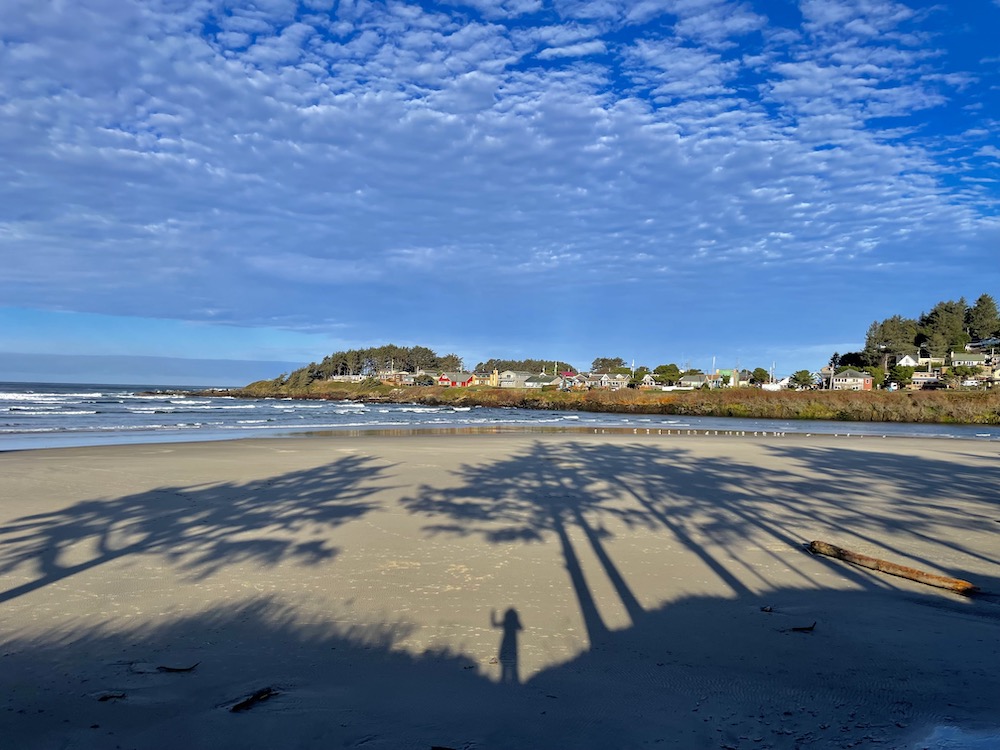
See those silver linings? (Yachats, Oregon in December 2021)

Here are my embers of optimism still burning through these fucked up years: 

1) American labor has reasserted its power. Customer service and factory jobs in particular, with their low wages and high risk of infection, are changing. Fewer people are tolerating the dodgy conditions, strikes have been widespread, and unions are finally confronting our country’s largest companies such as Amazon and Starbucks. 

Before now, labor has never been powerful within my lifetime—from the early 80s on, the deck was stacked heavily in favor of the wealthy, both within our government’s policies and our culture. There was only a negligible distrust of the country’s tycoons; the overwhelming majority of Americans idolized and envied the rich and powerful. This has changed, especially among young people in a trend that likely started around the Great Recession. 

Part of this movement is recognizing appalling American wealth inequality.  Mass economic need creates the conditions for political conflagrations. Folks on the left and the right can (and must) realize their real quarrel is not with each other, but rather with those at the top who have profited exorbitantly through the pandemic, those who have paid for their elected leaders to loosen regulations and enact tax cuts in their favor. Billionaires such as Jeff Bezos and Elon Musk paid 0.98 and 3.27 percent income tax rates between 2014 and 2018. Nobody cares how much they’re investing in the interest of their own tax deductions—when the wealthiest folks pay less taxes to our government than teachers or truck drivers, there’s something deeply wrong with our system.

If a broader swath of Americans had policies that helped them as handsomely as the billionaires, there would be less fuel for the squabbles between the left and right. The resurgent labor movement is evidence that Americans are waking up to economic inequality and realizing their own power.

2) We’re reconsidering the centrality of a job in our individual identities. One peculiar American habit is how important one’s career is in shaping our self-concept and place in society. One of our first questions in meeting new people is “What do you do?” In many other countries, this would be unusual as it’s assumed that there is more to a person than where they work. 

With folks questioning the importance of employment in their self-concepts, we’re outgrowing the old constraints of who we can be. People are much more than their job titles or educational attainment, especially since our economy simply isn’t set up for everyone to align their occupations with their dreams. 

3) We’re focusing our time and energy on our most valuable relationships and activities. Before the pandemic, It was easy to spread ourselves thin among mediocre acquaintances, pastimes, and expectations. Covid-19 has brought into focus the most significant parts of our lives.

I didn’t realize how much time I wasted maintaining dispensable branches of my existence. The Great Pause, with all of its associated risks and constant reminders of mortality, has helped me reevaluate what’s deserving of my precious time.

4) We’ve learned how much we rely on educators, healthcare workers, and caretakers. In the midst of a crisis, it’s not the overpaid stockbrokers or business consultants who matter—it’s the largely female workers whom our country underpays and takes for granted: teachers, home health aides, nurses, and others. The significance of these workers and how much we depend on them is now top of mind for many Americans. 

I’m hoping that these fields continue to assert their power through strikes, demonstrations, and salary negotiations. They deserve more respect and better pay. And by increasing the wages within these essential fields, they will be able to attract even more talent. I’d prefer to live in a country with the smartest people attracted to education and healthcare rather than banking.

5) The pandemic has sweetened what used to be considered mundane. I’ll never forget the first performance I attended in the middle of the pandemic: an October 2020 drag and burlesque show at a cocktail bar called Golden Era in Nevada City. In the presence of my friends and convivial strangers, my dopamine and serotonin receptors were firing on all cylinders. It was one of my most memorable evenings in a decade. The evening still sticks out like an erection in my life’s timeline after many months of solitude and restrictions. 

Since then, every maskless dinner we host at our house and every weekend trip with friends are imbued with more substance and magnitude than they used to be. 

There they are: my diamonds from our era’s mound of infected batshit. 

I’m weary. I’m baffled. I’m disgusted. I’m despondent. 

But I’m still optimistic. Time might render me a Pangloss, but it sure as hell beats moping around.

Tiptoeing Over American Vipers

“If a pregnant woman steps over a viper, she will be sure to miscarry.”

Historia Naturalis, Pliny the Elder (77 CE)

When I was 15, I had a pregnancy scare. I was in a long-term relationship and a condom had broken. I wasn’t sure if I could secure the morning-after pill as a minor, and I hadn’t yet discovered the Laguna Beach Community Clinic near my high school where I’d later receive free birth control pills.

I panicked and began leaning over a chair, letting it jut sharply into my abdomen and womb. I hoped it would disrupt any zygotes from developing in my adolescent body, not unlike the meat pulverizers desperate women used to hammer their stomachs in the decades before Roe vs. Wade. Fortunately, I got my period a week or two later, but that experience taught me that women walk a razor’s edge when it comes to sex.

Feminist Gadsden Flag, Artist Unknown

I’d always assumed that in the United States—the so-called “Land of the Free”—we would never again force women to give birth. Our mothers, our grandmothers, and our allies had fought hard for our right to choose. They had exposed the shameful hell of pre-Roe America with its poisons, bloodied staircases, abusive maternity shelters, and suicides. Even as red states slowly curtailed access to abortion over the decades, I thought the days of enslaving women as unwilling agents of religious fundamentalism were over. I was wrong.

As always, poor women will be more adversely affected by the overturning of Roe and pressed into prenatal state servitude. Rich women always have more choices, even in the most misogynistic places.

Advances in contraception and abortion pills by mail will be helpful in the battles ahead, but the reality is sobering: the Supreme Court has the power to impose its fringe theology on all of us. This injustice is both ironic and distinctly anti-American, as many of our ancestors migrated here to escape religious persecution.

The levers of power have been hijacked by a God-fearing cabal. Six of the nine SCOTUS justices (Thomas, Roberts, Gorsuch, Sotomayor, Kavanaugh, and Barrett) went to Catholic high schools. And two of them, Gorsuch and Kavanaugh, attended the same all-boys private Georgetown Preparatory School. The rightward lurch of SCOTUS is not representative of our increasingly secular country. A majority of us do not want Roe overturned and support a woman’s right to choose. 

I have a dear friend in her mid-30s who got her tubes tied a couple of years ago. I asked her what prompted such an invasive surgery. She shared that when Brett Kavanaugh was confirmed to the Supreme Court, she needed to make sure she was never handcuffed by pregnancy. She wasn’t only concerned about losing her right to have an abortion—she was afraid of losing access to any type of contraceptive. She’d always known she didn’t want kids and if the U.S. would deny her agency over her future, well fuck them.

To put this into terms that conservative congressmen can understand: when you remove legal access to a service people need or want, it doesn’t disappear. It just gets pushed into an expensive, seedy underground. It would be much safer and less stigmatized if we could keep women’s reproductive rights out of the dangerous sewers of American society. 

Abortion has been steadily creeping back into those dark alleys. Texas banned the procedure at six weeks in May 2021 and the law went into effect in September. When the second-most populous state abridged women’s right to bodily autonomy, Roe felt doomed. 

Denying a person healthcare or imposing a condition—pregnancy—doesn’t have any corollaries among folks without uteruses. Imagine a country where the state gets to deny individuals health services or impose unwanted bodily states:

  • Should the state be able to deny fertility treatments to people with risky genetic disorders?
  • Should the state be able to impose a condition—castration—on convicted sex offenders? 
  • Should the state be able to impose gastric bypass surgery on morbidly obese people who cost Medicare/Medicaid millions of dollars annually?
  • Should the state be able to force a person to get the Covid-19 vaccine? 

These issues of bodily self-determination expose the hypocrisy of anti-choice activists. And many of these “pro-life” Americans are the same people who support capital punishment, the same people who support deadly drone strikes in the Middle East, the same people who praised teenager Kyle Rittenhouse for murdering two protesters with an AR-15. Also, many anti-choice Americans are up in arms about mask mandates in the midst of a deadly pandemic and yet they think women should be denied life-altering healthcare. 

Republican voters don’t realize that abortion has been made a contentious issue to stir up their emotions, another steaming dish in the buffet of lies the GOP uses to galvanize their political base. Contrary to their misinformation:

  • Nobody uses abortion as birth control.
  • A zygote, embryo, or fetus is not a baby. 
  • Contraception sometimes fails.
  • Men commit rape and women are typically the only ones who face the consequences.
  • Safe haven laws don’t “take care of [the obligations of motherhood that flow from pregnancy]” as suggested by Amy Coney Barrett. Pregnancy is a risky health condition—not a simple inconvenience.

The Supreme Court will issue a ruling on Dobbs vs. Jackson in June 2022, which could effectively overturn Roe by banning pre-viability abortions. The cutoff would be 15 weeks in Mississippi, but all states would be allowed to set their own parameters. It’s infuriating that this will likely happen, especially since three of the nine SCOTUS justices were appointed by a disgraced, twice-impeached president who lost the popular vote.

If Roe falls, I’m most concerned about low-income women living in red states. Please help spread the word about services such as Women Helping Women and Aid Access, which offers online consultations and abortion pills by mail, effective up to 10 weeks. The FDA recently decided that obtaining this medication by mail will be allowed regardless of a person’s state of residence.

Don’t let American women’s bodies be used as tools of the government’s religious zealots. The political party that supports citizens owning assault weapons is not the party of protecting life—it’s the party of oppressing women and limiting their choices. I hope that the women of Texas, Mississippi, Missouri, and other red states seeking to ban abortion have the ability to move somewhere that respects their dignity, humanity, and reproductive rights. 

Elected Republicans Are Wasting Our Time With Imaginary Problems

What do voter suppression measures, anti-trans bills, repealing mask mandates, and tax cuts for the wealthy have in common? They’re among the top GOP priorities—and they’re all sham solutions for imaginary problems:

  • Voter fraud is rare to non-existent.
  • Trans folks are not transitioning to infiltrate girls’ bathrooms or sports.
  • Masks are still necessary to fight this pandemic.
  • And rich Americans, for fuck’s sake, don’t need any more goddamn money.

Why aren’t more GOP voters angry about this? Why aren’t they upset that their legislators are wasting our time and tax dollars on empty objectives? And what does the modern GOP even stand for? 

Red demon fighting blue dragon (Aomori, Japan)

Like most Americans, I’ve nearly lost the plot of Republican machinations. Their platform used to be real: small government, fiscal conservatism, strong national defense, support for small businesses, and traditional family values. But these days, most elected Republicans have abandoned their principles, lied to their constituents, and erected a golden Trump idol at the heart of their party.

I get it: there’s a serious charisma gap in the GOP and they haven’t found someone to fill that Trump-sized hole in their presidential prospects. But promoting the lie that the 2020 election was stolen is disgusting—and it will cost the party dearly when conservative voters demand more of their leaders. Dr. Seuss, Potato Head, and other “cancel culture” spectacles are there to distract folks from the GOP’s negligence of important priorities.

Just this week, Senate Democrats passed a Covid-19 relief bill without a single Republican vote—this is despite its widespread support among a majority of voters. A Morning Consult poll found that 53 to 59 percent of Republicans supported the $1.9 trillion bill (depending on how the question was worded). And 71 to 77 percent of voters supported it overall. 

With more than 526,000 Covid-19 deaths, a stagnant economy, a looming eviction crisis, and a dispirited nation craving government relief, you’d think that the GOP would step up. But most of these Republican “leaders” are focused on anti-democratic priorities, especially maintaining their power by passing voter suppression bills.

On March 2, 2021, GOP lawyer Michael Carvin revealed his party’s intentions in his arguments to the Supreme Court. Justice Amy Coney Barrett asked him, “What’s the interest of the Arizona RNC here in keeping, say, the out-of-precinct ballot disqualification rules on the books?” 

He responded, “Because it puts [Republicans] at a competitive disadvantage relative to Democrats.”

That is the predominant focus of today’s GOP leadership: to suppress as many votes as possible. Not fighting the pandemic, not affordable healthcare and education, not infrastructure, and certainly not increasing the prosperity of the American people. 

The Democratic vs. Republican Redistribution of Wealth (Sources: Crooked Media / Tax Policy Center, March 2021)

Of course, voter suppression isn’t a new Republican tactic. Restricting voting—especially among people of color—has been a long-time pet project of the GOP. In 1980, conservative activist Paul Weyrich told evangelical leaders, “As a matter of fact, our leverage in the elections quite candidly goes up as the voting populace goes down.”

How do Republican voters feel about this? Doesn’t it feel anti-American that the less popular of two parties continually suppresses the vote? Do the ends (tax cuts for the wealthy) justify the means (cheating in elections)? Are they proud of their leaders? 

We see this playing out in state legislatures all over the country. There have been over 250 bills proposed in 43 states just this year to restrict our access to the ballot. 

Consider this: Trump’s pathetic lickspittle, Mike Pence, just published an op-ed in The Daily Signal, a 7-years-old, right-wing propaganda outlet. (Google it. I’m not linking to that garbage.) 

You’d think that the former Vice President might be welcomed into more respectable conservative publications such as The Wall Street Journal or The National Review, but the liability of publishing his bullshit outweighed the prestige of his former office.

Pence’s article contained gems of American unity such as, “Leftists not only want you powerless at the ballot box, they want to silence and censor anyone who would dare to criticize their unconstitutional power grab.” Those are strange words from someone who was almost murdered by a Trumpist mob on January 6—all based on the lie of election fraud. 

Pence, like many Republicans, is terrified by the passage of the “For the People Act” (HR 1). The bill aims to expand voting rights, facilitate voter registration, limit gerrymandering, and strengthen campaign finance laws. Rather than embracing this bill—which is supported by 67 percent of likely voters, including a majority of Republicans—GOP leaders have lied about HR 1’s contents and tried to stoke fear with their favorite fairytale: election fraud.

So I ask again: What is the GOP leadership’s current guiding philosophy? Why did the party of status quo and conservatism allow Trump to launch its base into the fringe of crazy town? And why do they seem intent on staying there?

Most elected Republican leaders have given up or doubled-down on the lies their constituents believe: QAnon, climate change denialism, xenophobia, an anti-socialist “blue scare,” and election theft all play prominent roles in their arsenal of horseshit. 

Author Timothy Snyder wrote, “A patriot has universal values, standards by which he judges his nation, always wishing it well—and wishing it would do better.” GOP leaders have no universal values. Most are playing obedient civil servants to Trump, a rapist and inveterate liar. 

Republican voters should be furious that their party’s leadership has been hollowed out by a grifter and charlatan. Those within the GOP who double-down on these imaginary problems aren’t team players—they’re dishonorable and complicit. But those who champion a return to the GOP standing for something—anything real—should be applauded.

Dispatches From the Gulf Coast of Flovid

Since moving to Oregon five years ago, I’ve hit a wall every mid-February. The glow of the holidays carries me through most of the dreary winter, but after weeks of unabated rain, I flee the Pacific Northwest to soak up precious vitamin D to get me across the early spring finish line. 

In 2020, I went to Oaxaca for a month, barely making it out as the pandemic was upending international travel. This year, I confess that in my desperation for sunlight, I flew straight into the heart of Covid country. Yes, folks: I visited my old stomping grounds on the Gulf Coast of Florida.

Playing it safe on the Venice Fishing Pier, Florida

I knew that the Covid protocols in Governor Kate Brown’s Oregon and Ron DeSantis’s Florida would be vastly different. (I once got yelled at in Eugene for walking along an empty residential sidewalk in the rain without a mask on.) But just as these areas occupy opposite poles of our country’s landmass, so too have their citizens’ responses to this pandemic.

In Oregon, indoor dining has been banned or severely limited since the pandemic began. The Governor has assigned risk levels by county according to case numbers and local businesses comply. At least in Eugene, everyone wears masks indoors and most people wear them outdoors, too. Oregon has been among the top five states in containing the pandemic and keeping the death toll low.

In Florida, indoor dining is at full capacity, bars are open, and hardly anyone wears masks. When going indoors, some Floridians simply pulled their shirts over their noses. Many people, including service workers, had masks dangling around their chins or with their noses exposed. Life in Clearwater, Treasure Island, Venice, and Nokomis seemed pre-pandemic, as if nobody had changed their lifestyle at all. 

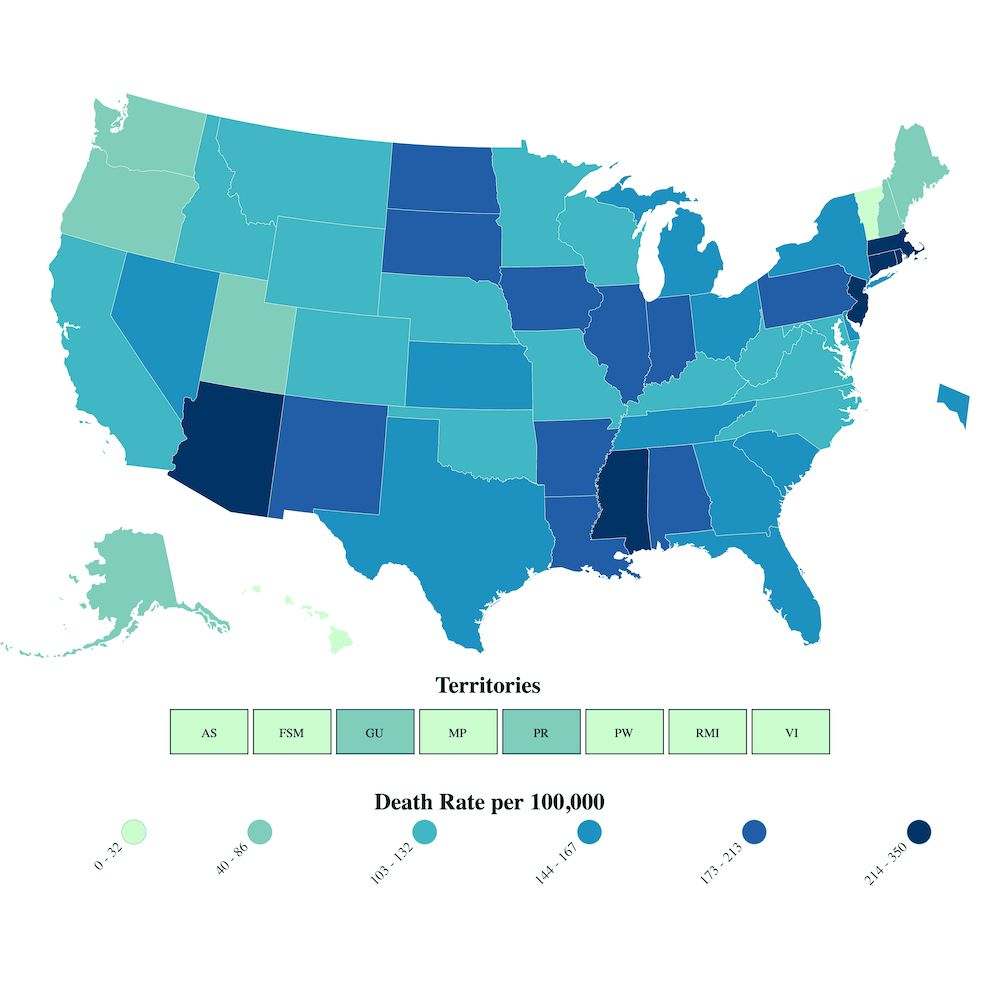
These two different approaches are reflected in our state outcomes  (CDC 3/4/21):

  • Cases per 100,000 in Oregon (since 1/20/20): 3,700
  • Deaths per 100,000: 52
  • Cases per 100,000 in Florida (since 1/20/20): 8,767
  • Deaths per 100,000: 144
Deaths per 100,000 people (CDC 1/20/20-3/4/21)

Coming from progressive Eugene, Florida felt like absolute chaos. It took me a few days to shake my low-key anxiety. I imagined the stew of Covid particles swirling around the mouths of tanned senior citizens. They guzzled their cocktails and threw their heads back in laughter, spewing viral clouds to their wrinkled neighbors. Why didn’t anyone in the Sunshine State seem to care—especially those who would be most vulnerable to the disease?

I wanted to ask Floridians if they’d known anyone who had died of the disease, or if they even thought about it at all. It was an alarming contrast to my home state. Covid has consumed the lives of most people I know in California and Oregon. My friends and family have stayed home, worn masks, canceled plans, put off travel, socially distanced, quarantined after short trips, and signed up for grocery delivery services. It felt deeply unfair that Floridians were being so cavalier while Oregonians had made countless sacrifices. I haven’t seen most of my family and friends in over a year at the recommendation of Dr. Fauci and my governor, but here I realized that some parts of the country have hardly adjusted their lives at all.

Nokomis Beach Biweekly Drum Circle (2/24/21)

Florida has lost more people per capita than roughly half of all states. That doesn’t seem too bad—especially given their large elderly population—but consider one major caveat: there’s strong evidence that Florida’s Covid-19 numbers could be an undercount. Rebekah Jones, a former state data scientist and whistleblower from Tallahassee, claims that her supervisors pressured her to change the state’s infection data. She launched her own data dashboard (Florida COVID Action) and her home was raided by armed police on December 7. They seized her equipment and terrified her children. (As of March 4, 2021, her dashboard indicates that the state death and case counts are underreported by a few thousand and tens of thousands, respectively.)

Assuming the truth falls somewhere within that range, Florida’s cases should be much lower given the state’s significant sunshine advantage. Sunlight has been shown to rapidly denature the Covid-19 virus on surfaces. Humidity has also been shown to potentially slow the spread.

I’m much more comfortable at home with the high levels of social trust and mask-wearing, but with Florida’s retirees partying like it’s 1999—and not seeming to suffer—what has this all been for? Is it better to protect as many people as possible—at any cost and to the detriment of businesses and people’s mental health? Or would a more balanced approach be appropriate?

I felt a swelling mix of resentment and envy toward the careless hedonism of Floridians. My selfishness told me that even if I did catch Covid, I’d likely have a mild case or even be asymptomatic because I’m young and healthy. My pro-social side reminded me that I wear masks and make personal sacrifices not for my own well-being, but because I don’t want to be the person who unknowingly transmits a deadly disease to someone else.

Last April, I wrote a piece titled “America’s Other Disease,” which proved to be prescient. Back then, we’d only had 213,000 confirmed cases across the country. (As of March 4, we’ve suffered 28.51 million confirmed cases.) I suggested that our country’s individualism would prove an impediment to mask-wearing. In Americans’ twisted sense of personal freedom, covering one’s face to prevent the spread of disease is too much of an inconvenience for many. If only Covid-19 could be traced to male impotence, for example, we’d likely eradicate the disease in a month.

As vaccinations become more widely available, the daily threat and anxiety surrounding Covid should begin to abate. I do wonder about the long-term psychological impact on Oregonians and folks from more cautious states. How many people will fear the presence of strangers in the post-pandemic era? How many will continue to feel depressed and become shut-ins? How many relationships will suffer from the stress of long-term confinement? Will these effects be justified by our relatively low death-count? 

Anyone who has lost a friend or a member of their family would say yes. I’m proud of Oregon’s response to the disease and recognize how many more people we would have lost given Governor Ron DeSantis’ approach. 

And just this week, Governors Greg Abbott (TX) and Tate Reeves (MS) have lifted their mask mandates and business restrictions. We’ll see how these “leaders’” commitments to toxic individualism play out. Is it really so difficult for folks to wear masks? Half-a-million dead Americans and their families certainly don’t think so.

America’s Sacred Cows Make Delicious Hamburgers

There has always been great tension between America’s founding principles and our reality. 

We’re the land of opportunity in which wealth is concentrated in the hands of a few. We’re the land of equality in which our Black citizens, whose ancestors were brought here in chains, are routinely denied the vote and killed by the police. We’re the land of the free in which the bulk of the world’s prisoners reside, many for nonviolent offenses. We’re the land of the brave in which white fear is manipulated to win elections. And we’re the land of religious freedom in which Muslims are banned.

Our religious freedom myth, in particular, has always bothered me. Can you imagine a U.S. president who was a Buddhist, Muslim, or Atheist? In order to qualify for the highest office in our country, there’s an assumption that one must embrace religion—specifically, Christianity.  Even those who never attend church are forced into a faith pantomime, saying “God bless” this, that, and the other. 

The most pious states even fight for creationism to be taught side-by-side with the theory of evolution in public schools. And abortion—rather than being accepted as a medical procedure as it is in other developed countries—has been warped into an all-consuming political tool to ossify that timeless dialectic: the Christian conservatives on one side and the Godless progressives on the other. 

Sure, there are some churches who eschew the divisive rhetoric and preach love, acceptance, and charity. But from where I stand, American Christian values have done much harm.

Christianity has been used: 

  • To justify slavery. It was argued that the Black sons of Ham were predestined to serve white America.
  • To suppress women. In many Christian sects, wives must submit to their husbands.
  • To persecute our LGBTQ+ community. How many “Christians” have kicked out their gay children or sent them to abusive conversion therapy camps?
  • To justify the theft of land. The baseless theory of “manifest destiny” devastated ancient Native American cultures and populations.

James Baldwin said it best in The Fire Next Time: “It is not too much to say that whoever wishes to become a truly moral human being…must first divorce himself from all the prohibitions, crimes, and hypocrisies of the Christian church. If the concept of God has any validity or any use, it can only be to make us larger, freer, and more loving. If God cannot do this, it is time we got rid of Him.”

On the whole, the American Christian God has not made us “larger, freer, or more loving.” And our stubborn Puritan roots have been used to restrain normal human pleasures. To paraphrase Abbie Hoffman: this sacred cow of exclusion, pleasure-denial, and hate will make the most delicious of hamburgers. 

Consider this: American adults tend to be dishonest about the delights of sex and drugs when talking to their children. You still with me? It’s as if telling kids the truth will lead them to lives of sin. 

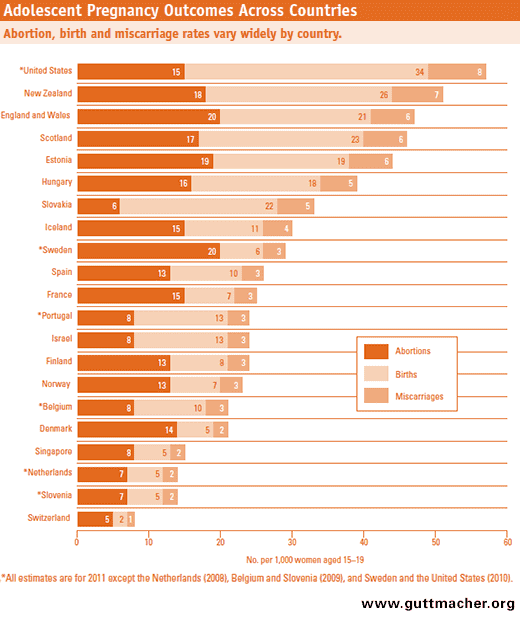
But what if I told you that the U.S. has so many teenage pregnancies and substance abuse problems precisely because of its overcritical attitude toward sex and drugs? That our Puritan values have backfired? That we’d actually be better off if we were more honest with young inquisitive minds? 

A portrait of my teenage American excess

With sex work and drug use, for example, there’s abundant evidence that pulling these modern realities out of the shadows leads to better outcomes. Decriminalizing prostitution and substance use could help remove the stigma surrounding both and reduce the non-violent prison population.

Stifling or ignoring parts of human existence leads to their more dangerous expression. It’s the difference between a legal brothel with regular STD testing and an unregulated operation where sex workers have no recourse for abuse. It’s the difference between injecting drugs in a safe space with a clean needle and shooting up in the corner of a decaying tenement. I argue that it’s also the difference between a teenage girl who isn’t ashamed about the pleasure of sex and a middle-aged woman who still hasn’t had an orgasm. 

When we bake our American religious shame into normal human pleasures, we deny ourselves growth and experience. 

The same goes for non-vices such as gender identity. If we had more evolved attitudes toward gender—recognizing it not as a binary but as a spectrum—our transgender citizens would have better life outcomes. 

That’s the type of Christian God we need: one who makes our citizens feel freer and more loved.

These are the facts: 

The U.S. has the highest rate of teenage pregnancy in the developed world—with most of those unplanned pregnancies occurring in the more religious Southern and Midwestern states

We also have the highest rate of alcohol, drug abuse, and substance-related disorders in the developed world. 

D.A.R.E. preached abstinence-only with the fervor of a religious organization. There was no room in the narrative for gray area or any explanation as to why our parents drank or smoked. And suppressing our healthy curiosity actually had the opposite effect: without knowledge of alcohol and drugs’ effects, we American kids tended to overdo it.

I’ve noticed that other countries handle adult pleasures differently than Americans do, with less Puritan scrutiny and more education. In France, Spain, Italy, for example, drinking wine with meals is common, even among adolescents. People from those countries are also less likely to become alcoholics compared to Americans. 

In Holland, it’s not uncommon for high schoolers to have their partners over for sleepovers. Is it a coincidence that they have one of the lowest rates of teenage pregnancy? That culture recognizes that kids have sex and they may as well be safe and educated about it. 

There’s also the issue of psychological reactance. When people—especially individualistic Americans, I suspect—are told to do something, it can be perceived as a threat to one’s freedom. As a result, they may “[demonstrate] an increased preference for the behavior that is restrained, and may perform the behavior opposite to that desired.” This is one reason why an abstinence-only approach to sexuality and substance use fails so spectacularly within the United States. 

In other words, by pulling sex and drugs out of the shadows of American scripture, we can make life safer and more enjoyable. 

I have a personal example. I was lucky to grow up in a progressive town with a mother who recognized when to let go. I lost my virginity at 15—the same year I started sneaking out, drinking on weekends, and occasionally smoking pot. There was a free clinic in Laguna Beach where I would go every three months to pick up birth control. It was within walking distance of my high school. I was grateful I didn’t need a parent signature.

When I was 17, my mom finally gave up and lifted my curfew, even allowing my boyfriend (who came from a rough family) to move in with us. This was undoubtedly a radical move—especially for an American single mother—but it was also the best thing for me. I was an incorrigible teenager, but I finally had the freedom and balance I desired. I maintained straight As and even went on to become our high school’s valedictorian. 

If my mom hadn’t let go and given me room for my rebellion, I’m not sure I would have been as successful academically. My opposition was fierce and I would have spent more energy struggling for my independence than on schoolwork. So by my mother choosing to stop fighting my urge to grow up—letting me know that I could always call her for a safe ride home—I thrived.

Normal human urges and knowledge can’t be suppressed. It’s better to be an educated young adult when confronted with life’s choices. And as much as American parents try to shield their children from sex and drugs, there always comes a day when mom and dad aren’t there. Kids need to learn how to protect themselves. 

Imagine a society in which adolescent boys and girls are educated about the pleasures of sexuality. Instead of boys being framed as “predators” and girls as “prey”—a myth that has robbed many young women of taking pleasure in sex since it’s something “given up” rather than enjoyed—we can let everyone know how to engage in sexual activity safely. 

Imagine a society in which there’s age-appropriate education for alcohol and cannabis use. Instead of young folks experimenting to excess and putting themselves in uncertain situations, they would better-understand responsible consumption and be able to make wiser decisions.

Pleasure-denial—like abstinence-only education—ultimately fails. These religious rules regulating pleasure are arbitrary and end up backfiring, producing a fearful and ashamed citizenry.

So if we still have use for that American Christian God, let’s make it one who embraces knowledge instead of dusty superstition, one who preaches love instead of intolerance. Our culture’s Puritan denial of the pleasures of sex and drugs only leads to abuse, ignorance, and discrimination against non-conforming folks. 

With a more charitable view of human pleasures and with an acceptance of diversity, our citizens will be better protected and happier. 

Isn’t this what all parents want for their children?

No, The Racist Republican Riot at the Capitol is Not Like BLM

Last week, I published a piece decrying the Republican support for Trump’s election fraud lies. The following day, a violent mob of Trump supporters waving confederate and neo-Nazi flags forced their way into the Capitol Building to disrupt the electoral college vote certification. 

Image Credit: Mike Theiler, Reuters

How will history refer to this disgraceful event? I’ve heard it called simply “The Insurrection,” but that’s a euphemism lacking an agent and cause. Future generations deserve to know exactly who fueled the bloodshed (and why) on January 6, 2021. Some suggestions:

  • The MAGA Mob Mutiny
  • Trump’s Failed Rebellion
  • The False Patriots’ Putsch
  • The Racist Republican Riot (RRR)

It’s tempting to say, “We told you so.” For years, progressives have been warning this country about the brutality of Trump’s white supremacist cult. One man in full tactical gear, Eric Munchel, was carrying flex-cuffs to take hostages. Molotov cocktails and pipe bombs were found on the scene. The Trump rioters even had built a gallows with a noose and they chanted “Hang Mike Pence!”—a phrase that also trended on Twitter before being removed. Many were carrying baseball bats, guns, chemical agents, and other weapons. 

Five people are dead, including one police officer (Brian Sicknick) murdered by the mob with a fire extinguisher. One woman was shot (Ashli Babbitt) and another was trampled to death (Rosanne Boyland). A man among the dead (Kevin Greeson) even had a heart attack from the “excitement.”

Over the past six days, people across the world have been asking themselves how could this happen in the birthplace of modern democracy? But thoughtful observers within this country know exactly why this mob got so close to taking Mike Pence, Nancy Pelosi, and other legislators hostage: 

Law enforcement has consistently underestimated white supremacist (and Christian nationalist) violence within the United States. 

Hateful gatherings such as Charlottesville’s “Unite the Right” rally and the Proud Boys marches have had little police presence and few arrests—unless, of course, there were counter-protestors of color in the crowd.

Time after time, groups of white men are treated as non-threats. Consequently, security forces were completely unprepared.  It’s important to recognize that some of the Capitol police officers acted courageously, trying to stop the deluge of red hats from entering the building. Officer Eugene Goodman, a national hero, led the initial wave of angry Trump supporters away from the Senate entrance where the legislators were still evacuating and fearing for their lives. The courage of this Black man running from an armed white mob feels plucked from another century, but racism still permeates our citizenry and institutions. 

By illustration, many other DC Capitol Police officers exercised that familiar soft touch with the white mob, taking selfies, inviting them past the barriers, donning MAGA garb, and escorting them down stairs. There’s evidence that some of the participants in the RRR were off-duty cops and firefighters. Also, two officers have been suspended (with more than a dozen others under investigation) for supporting the deadly riot.

Before the event, the DC Capitol Police actually turned down the FBI’s offers to help with security. Trump’s Department of Defense even tied the National Guard’s hands, limiting their ability to get riot gear and coordinate with local officials without the acting defense secretary’s permission.

The Capitol Police Chief, the Senate Sergeant-of-Arms, and the House Sergeant-of-Arms—the Capitol’s three top security officials—have all resigned. They failed to secure their jurisdictions, even though violent plans had been brewing for months in the internets’ darkest corners and on social media. 

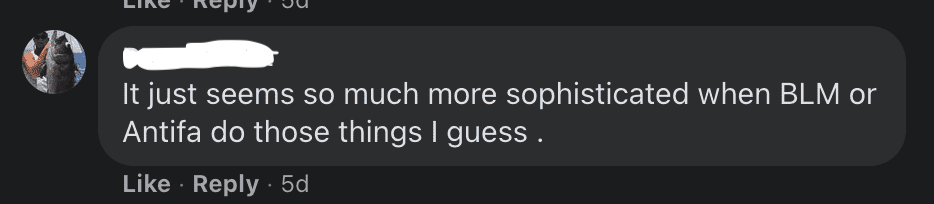
While the Trump mob was storming the Capitol Building, I took to Facebook to share my thoughts:

Most of my friends weighed in with support for my statement, but three others expressed a common theme:

The comparison between the Black Lives Matter protests and the Racist Republicans’ Riot was a common “hot take.” Many conservative congressmen, pundits, and everybody’s white supremacist uncle decided that the progressive outrage over the RRR was hypocritical. After all, there was damage to government buildings and looting in both instances.

Here’s a primer to educate the folks in your life who who falsely equate the murderous RRR and the BLM Movement:

1) Black Lives Matter is grounded in real and provable causes—the RRR is not. BLM is a movement against the recurring slaughter of unarmed Black citizens at the hands of police. The violent riot at the Capitol inspired by Trump’s “Save America” rally was based on the lie that Democrats had stolen the election. There is near-zero evidence of Trump’s repeated allegations of voter fraud and he’s lost over 60 lawsuits.

2) There was no violent BLM leader or coordinated effort to destroy property; on the contrary, the leadership continually emphasizes that BLM is a peaceful movement and disavowed isolated incidents of property destruction. In 2017, BLM even won a global peace prize from the Sydney Peace Foundation—an award that has been given to Desmond Tutu, among others. The RRR, by contrast, occurred because President Trump and Rudy “Trial by Combat” Guiliani fanned the flames of savagery both in the pre-riot rally and on Twitter. 

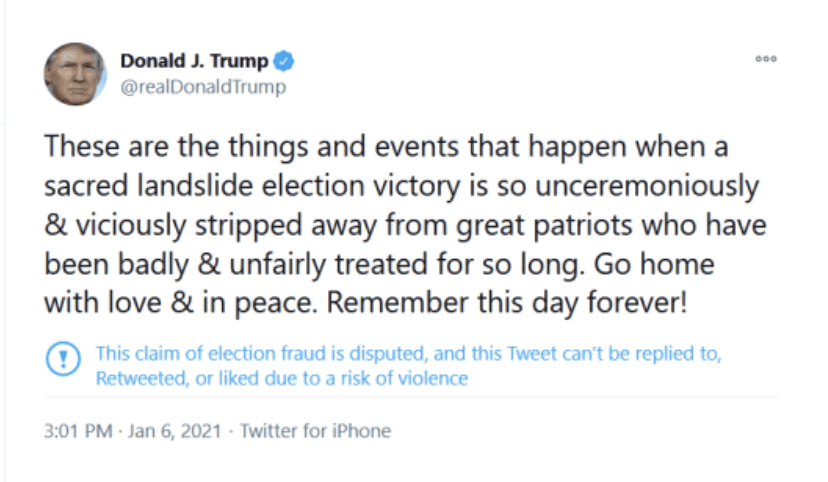
After several Americans had died, Trump tweeted:

His Facebook and Twitter accounts were locked shortly after for inciting violence—and now he’s been banned indefinitely from both platforms. (And spare me the free speech crybabyism: our First Amendment laws do not protect the president or anyone else inciting violence.)

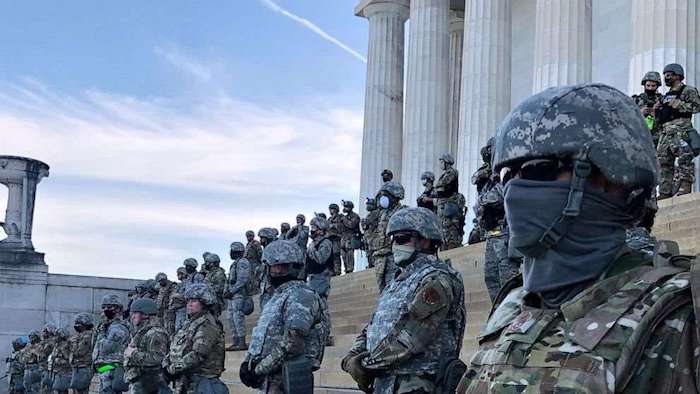
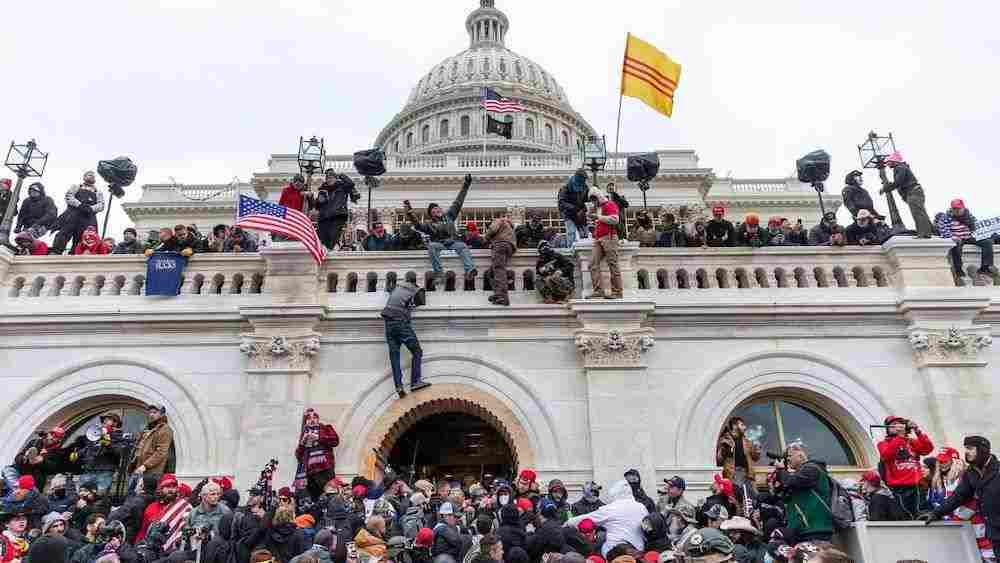
3) Law enforcement bodies have had very different responses to BLM and the RRR. The images contrasting the police responses speak volumes and underscore the racist roots of law enforcement in the United States. Sure, not all police officers are racist, but they work for an inherently racist institution. 

Image Credit: Martha Raddatz, Reuters (June 2, 2020)
Image Credit: Lev Radin, Sipa USA via AP Images (January 6, 2021)

On that last point, if anything, the tepid law enforcement response on the day of the RRR proves the point of BLM: people of color and their allies can’t march peacefully without being tear-gassed or shot with rubber bullets, but a disorganized swarm of white supremacists was allowed to enter the Capitol with little effort. 

The racialized double standard of policing—the primary cause of the Black Lives Matter Movement—was clearer than ever on January 6. When peaceful BLM protesters were violently suppressed by the police and paramilitary groups on normal city streets, we can only imagine how police would have responded if they tried to seize the Capitol by force.

For short-term gains, the Republicans and conservative news media have poisoned the minds of millions of Americans. They have used the fear of Black people, Islam, immigrants, and socialism to get out their vote. The racists have come home to roost—and it’s fucking ugly.

The RRR is already shaping up to be one of the most devastating days in U.S. history, but I remain hopeful. January 6 exposed the racism of law enforcement and the wave of resignations, criminal investigations, and arrests is just beginning. 

Americans can no longer ignore racist policing in the U.S.—a country where white violence is tolerated and Black protest is quashed. The RRR already has pushed more reasonable Republicans to condemn Trumpism and a second impeachment is underway in the House right now. Trump will likely face yet another criminal charge when he leaves office: this time for inciting the violent overthrow of our government.

This is a turning point. Republicans no longer have control of the Senate and presidency. They’re being forced to deal with the violent racists within their ranks. And they’re being forced to reckon with their deal with the devil in supporting Trump. 

Will they denounce their voters who have threatened to hang lawmakers because of Trump’s lies? It’s difficult to see how their party recovers from these four years of fear-mongering, deception, destruction, and spectacle. 

Bullshit provided a messy and unsteady foundation for the party’s platform. Maybe now the GOP will finally start telling their voters the truth.

The Old Liar Who Cried “Election Fraud!”—And the Congressional Chumps Who Support Him

“So look. All I want to do is this. I just want to find 11,780 votes, which is one more than we have. Because we have won the state.”

Donald Trump urging Georgia Secretary of State Brad Raffensburger to overturn the state’s election results (January 2, 2021)

In this era of savage partisanship, an American ratfucker is born every day. Traditionally, dirty tricks to sway elections take the forms of voter suppression, gerrymandering, and batshit crazy lies about the opposition. Both political parties have participated in the past, but these days, the Republicans have enshrined these tactics as part of their survival strategy. Perhaps the most glaring offense is happening right now: 12 GOP senators have turned downright seditious in their attempt to cast doubt on the outcome of the 2020 presidential election. 

Tomorrow, rather than certifying the Electoral College results, this fools’ brigade will oppose Joe Biden’s clear victory (306 electoral votes to Donald Trump’s 232). This shameful subversion of democracy isn’t limited to the Senate: two-thirds of U.S. House Republicans already petitioned the Supreme Court to prevent Pennsylvania, Georgia, Michigan, and Wisconsin from casting electoral votes for Biden. 

It doesn’t matter that Biden won the popular vote by 7 million. It doesn’t matter that Trump has filed (and lost) over 50 lawsuits in 7 swing states to overturn the election—many of which were dismissed by judges he appointed! It doesn’t matter that Trump was recently caught red-handed asking the Georgia Secretary of State to commit a crime and “find 11,780 votes.” 

What the fuck, GOP? You claim to be the party of patriots and Christians, but you’re shitting all over the Constitution with impunity. You are showing yourselves to be spineless lackeys who would rather burn down the country than transfer executive power. 

Um, no, GOP

Who are these treasonous Trump chumps?

  • Ted Cruz (TX)
  • Ron Johnson (WI)
  • James Lankford (OK)
  • Marsha Blackburn (TN)
  • Mike Braun (IN)
  • Cynthia Lummis (WY)
  • Roger Marshall (KN)
  • Bill Hagerty (TN)
  • Tommy Tuberville (AL)
  • Josh Hawley (MO)
  • John Kennedy (LA)
  • Steve Daines (MT)

What’s strange is that most of these folks know better. Ok, Tommy Tuberville, who can’t name the three branches of government, might not know better. (One too many knocks to the head, I reckon.) But Ted Cruz, Mike Braun, and Josh Hawley, for example, graduated from Ivy League law schools. They may be despicable, but they’re not stupid.

And to anyone who thinks this is how politicians on both sides of the aisle behave, let’s examine the 2016 presidential election: President Barack Obama called Donald Trump to congratulate him on Wednesday, November 9—the day after the election. Trump had received 304 electoral votes to Hillary Clinton’s 227—less than Joe Biden’s margin of victory in 2020. 

We’ve all been dragged along Trump’s bullshit sore loser crusade for months now. Perhaps if Republican congressmen hadn’t wasted so much time with Trump’s dick in their mouths, they could have articulated a robust response to Covid-19—the greatest public health crisis in generations. Or, you know, without that dick in their mouths, they could have set a good example to their constituents and worn a goddamn mask.

I’ve gotten some pushback on social media for being divisive in the wake of the 2020 election. I know that some Republicans are good people. Hell, they were the first political party to endorse the Equal Rights Amendment in 1940! I also come from a Republican family, but most of them have reasonably abandoned the GOP as it’s gotten more racist and embraced a rapist, tax fraud, and liar as its top leader. At this point in history, it’s morally repugnant, irresponsible, and anti-American to embrace the GOP.

  • Republicans claim to be pro-life, but they support capital punishment, assault weapon ownership, and murderers like Kyle Rittenhouse.
  • They claim to be Christians, but they separate young immigrant children from their families.
  • They claim to be supportive of “law and order,” but they say nothing to defend the lives of unarmed Black citizens who die at the hands of police officers.
  • They claim to not be racist, but they embrace the Proud Boys and other white supremacist groups.
  • They claim to be patriots, but again: a majority of the U.S. congressional Republicans are trying to overthrow the results of the 2020 presidential election and refusing a peaceful transfer of power.

There’s a reason the GOP is so old, so male, and so white. And there’s a reason they continue to cheat to win elections. Their views are unpopular. They know that they are a dying minority party. They must suppress voters of color and gerrymander their way into relevance.

Calling out the modern GOP isn’t divisive—it’s an ethical responsibility. They don’t respond to well-reasoned sober arguments. The time has passed for meeting this party halfway. They’ve spent years manufacturing a “Blue Scare”—telling their base that dangerous socialists are coming for their guns and will turn their children into sex slaves for George Soros. Trump merely took advantage of the lies FOX News and others have been telling for years—and turned the volume to 12.

Fuck you very much, Trump’s GOP

In reality, progressives like me are just trying to create a more livable society with affordable healthcare and education, strong environmental protections, and a tax structure where the wealthy pays their fair share.

What part of this is unreasonable?